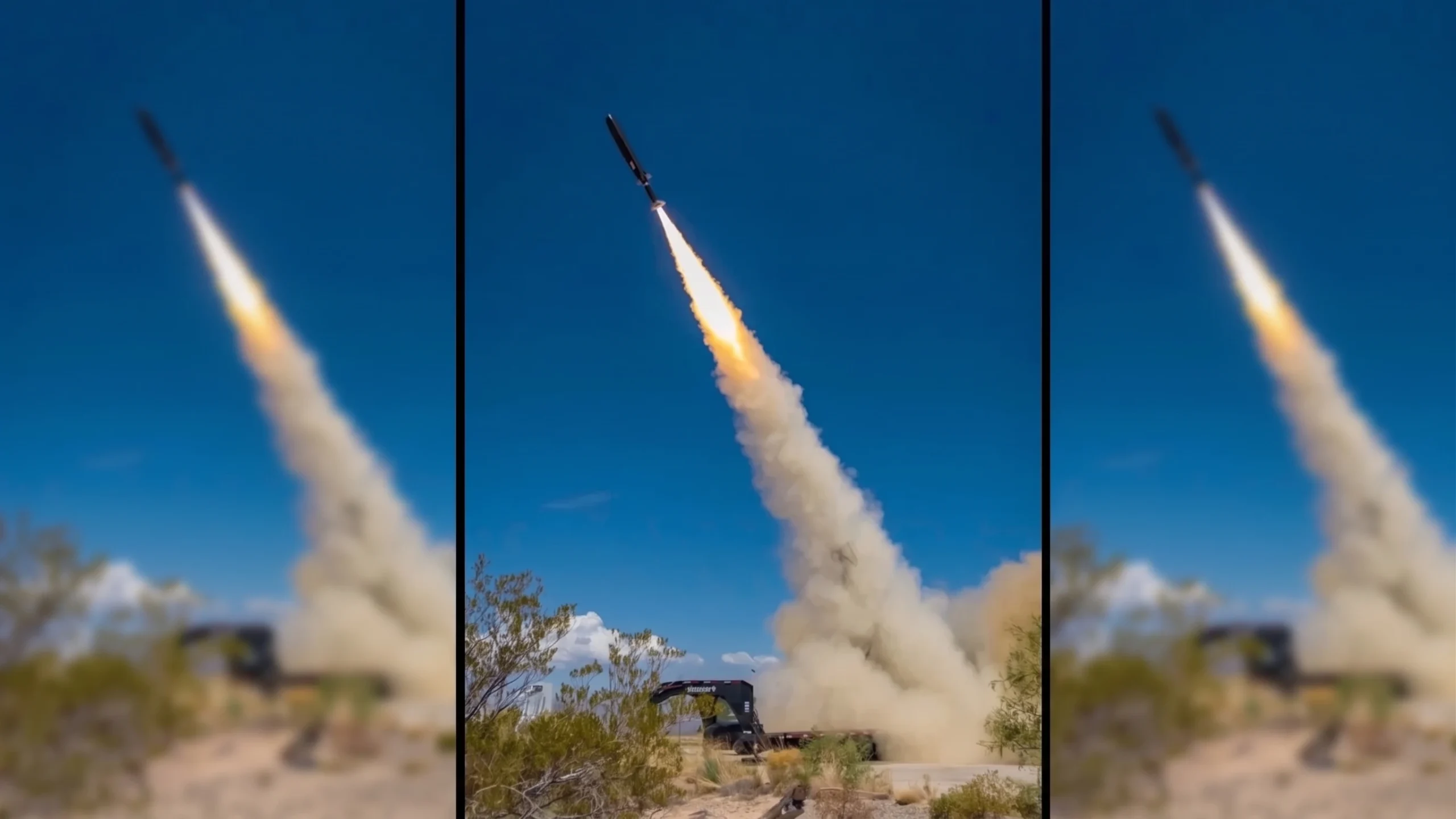
Zone 5 Technologies has shared with The War Zone (TWZ) the first images of its Block 40 Rusty Dagger low-cost cruise missile firing from a ground launcher, confirming that a weapon designed for air launch and first fielded by Ukraine is being adapted for land and sea. The California-based company, now 90 percent owned by Norway’s Kongsberg, told TWZ that versions of Rusty Dagger have been selected for separate U.S. Army and U.S. Navy programs, in addition to the missile’s original development path with the U.S. Air Force.
The surface-launched variant arrives in the middle of the Pentagon’s push for affordable mass. On May 13, 2026, the Pentagon signed framework agreements with Zone 5, Anduril, CoAspire, and Leidos under the Low-Cost Containerized Missiles (LCCM) program, which aims to procure more than 10,000 low-cost cruise missiles over three years beginning in 2027. The Army’s Portfolio Acquisition Executive Fires (PAE Fires) leads procurement, while the Office of the Under Secretary of War for Research and Engineering runs the experimentation and assessment campaign.
Rusty Dagger Cruise Missile Block 40: Booster, Warheads, and Airframe
Zone 5 says the Block 40 accepts warheads in the 100-pound to 250-pound classes. The missile remains configurable for air launch, either from underwing pylons or from palletized munitions systems deployed from cargo aircraft. For launch from ground vehicles or ships, the Block 40 adds a solid-fuel booster at the tail that accelerates the airframe to flight speed before the cruise engine takes over.
The company has not disclosed where or when the launches took place, which program they supported, or the configuration of the trailer-mounted launcher, which is not clearly visible in the released imagery. Zone 5 says the team moved from design to demonstration in under three months.
Externally, the Block 40 resembles the air-launch-only Block 20, though its tail fins appear more rounded than the earlier squared-off design, and low image resolution leaves open whether the tail has moved to a cruciform layout.
Publicly available specifications for the air-launched AGM-188A place it in the 500-pound class, with GPS/inertial navigation and a reported option for autonomous visual navigation. Previously reported ranges are 300 nautical miles at low altitude and 500 nautical miles when released from medium altitude at higher speed. Zone 5 has not published a range for the Block 40; surface-launched variants typically fly shorter distances because they lose the altitude and speed a launch aircraft provides. A 100-to-250-pound warhead, well below the Tomahawk’s 1,000-pound class, points the weapon toward radars, air defense sites, and logistics nodes where volume matters more than penetration.
From ERAM to LCCM and CHAOS: Rusty Dagger’s Expanding Program Footprint
The air-launched AGM-188A matured under the Air Force’s Extended Range Attack Munition (ERAM) program, including live-fire tests at Eglin Air Force Base, Florida, on January 22, 2025. The missile has since been cleared on four fighter types, including the F-16. ERAM was oriented first toward Ukraine: on August 28, 2025, the State Department approved a possible Foreign Military Sale to Kyiv of up to 3,350 ERAM rounds, estimated at $825 million, naming Zone 5 and CoAspire, developer of the Rapidly Adaptable Affordable Cruise Missile (RAACM), as principal contractors. Zone 5 says Rusty Dagger is the only publicly reported operational missile in its class fielded by the Ukrainian military.
ERAM also feeds the Air Force’s Family of Affordable Mass Missiles (FAMM), under which the service wants 28,000 pylon-launched and palletized munitions over five years. The Block 40 keeps Rusty Dagger eligible for that requirement while opening two surface-launched lanes.
The first is LCCM, where Rusty Dagger competes with Anduril’s Barracuda-500M, CoAspire’s GHOST, and a Leidos design derived from the AGM-190A Small Cruise Missile. The second is the Navy’s Coalition Heterogeneous Affordable Offensive Strike (CHAOS) program, run by the Portfolio Acquisition Executive for Munitions and focused on low-cost anti-ship cruise missiles, particularly for allies and partners, with an expeditionary ground-launched variant expected in production by 2028. CoAspire is on contract for CHAOS with its RAACM-Extended Range, and in August 2026 the Navy awarded Zone 5 a $65 million Other Transaction Agreement to develop a CHAOS variant of Rusty Dagger.
Kongsberg Ownership and a Three-Site US Production Network
Kongsberg closed its acquisition of a 90 percent stake in Zone 5 in June 2026 after U.S. regulatory approval, and Zone 5 operates as an independent subsidiary. Kongsberg pairs Rusty Dagger with its low-observable Joint Strike Missile (JSM) in a high-low mix, with Rusty Dagger supplying affordable volume.
Zone 5 is expanding U.S. production across three sites. Manufacturing is established in San Luis Obispo, California; production is beginning in the Dallas-Fort Worth area of Texas; and a franchised facility is under development in Miamisburg, Ohio, with Hawthorn Aero, a high-rate airframe manufacturer. Each site is designed to exceed 2,500 missiles per year by the end of 2027, for combined capacity above 7,500 annually.
Those figures matter against demand. LCCM’s 10,000-plus missiles over three years average roughly 3,300 per year across four vendors, and FAMM’s 28,000 over five years averages 5,600 per year. If Zone 5 hits its target, its capacity alone would exceed the annual average of either program.
Analysis: Surface launch turns Rusty Dagger from a fighter-dependent weapon into a theater fires asset that can be stockpiled in containers, dispersed on trailers or ships, and fired without generating a sortie. In an Indo-Pacific conflict, where Chinese long-range fires would threaten forward airfields and tankers, that decoupling from airpower is the real gain: dispersed, inexpensive rounds could saturate air defenses while preserving scarcer Tomahawk, Precision Strike Missile, and JSM inventories. The open questions are kinematic and economic. Zone 5 has disclosed neither the Block 40’s surface-launched range nor its unit cost, and its 7,500-per-year capacity remains a target, not a demonstrated rate.
The next milestones sit inside LCCM’s experimentation campaign and the Military Utility Assessment the sponsoring services will conduct ahead of production contracts, with deliveries slated to begin in 2027. Key unknowns include the Block 40’s launcher configuration and range, which program the ground launches supported, and whether the Texas and Ohio lines reach rate on schedule.