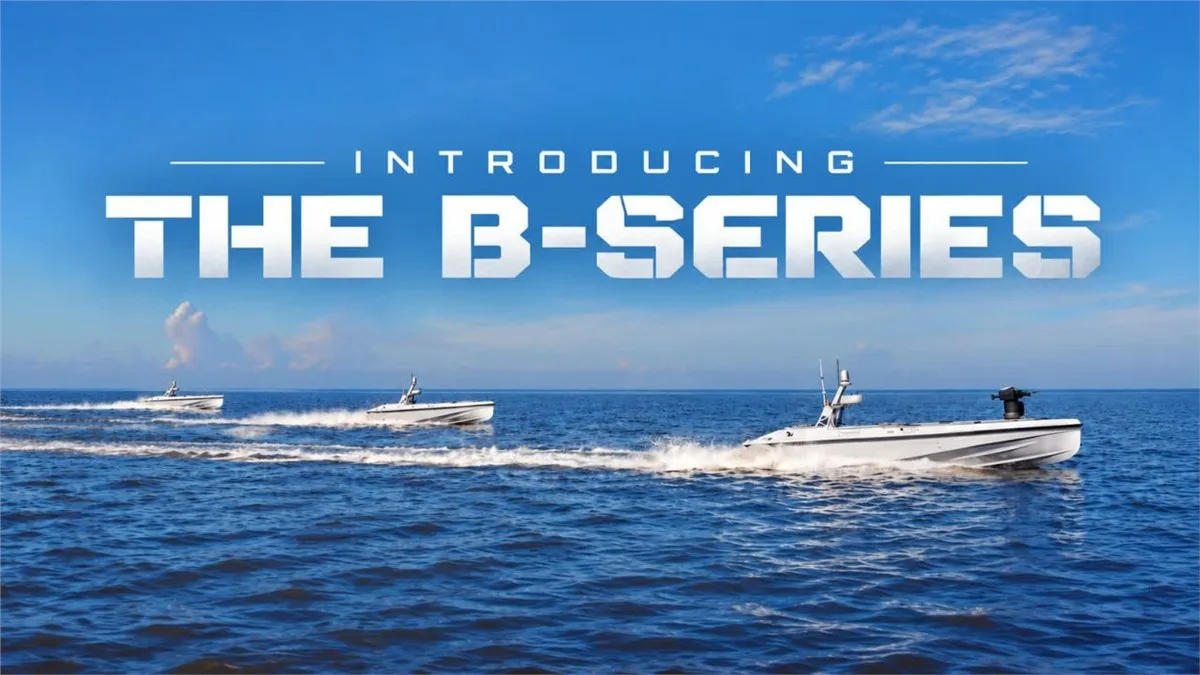
Blue Ops, the maritime division of Red Cat Holdings, has opened orders for two new uncrewed surface vessels (USVs), the 18-foot B-18 and the 39-foot B-39, under a B-Series portfolio announced on October 22, 2026, in Salt Lake City. The lineup also absorbs the company’s flagship Variant 7, now redesignated B-26, with every hull named after its length in feet.
The launch lands as the U.S. Navy rebuilds its approach to unmanned surface craft. The service cancelled its Modular Attack Surface Craft (MASC) program in March 2026, describing it as a prototyping effort too narrowly scoped for the multi-mission medium USV it now wants under its Golden Fleet concept, and moved toward a vendor marketplace model. Blue Ops, which Red Cat stood up in 2025, is pitching the B-Series directly at that gap: hulls that exist, have been tested and can be bought now.
Inside the Blue Ops USV Family: B-18, B-26 and B-39
The B-18 has completed sea trials and is available ahead of its original schedule, according to the company. Blue Ops says it is built around the internationally recognized form factor for one-way attack (OWA) vessels, the class of small explosive-laden drone boats Ukraine has employed against Russia’s Black Sea Fleet since 2022. Its stated mission set covers tactical reconnaissance, shipboard launch and recovery, and one-way attack. The company says the design reflects U.S. Navy requirements, including deployment from Littoral Combat Ships (LCS), and uses a Modular Open Systems Approach (MOSA) architecture to accept third-party payloads and autonomy software.
Blue Ops’ website lists the B-18 at 5.5 meters, with a 1,000-pound (454-kilogram) payload, a top speed above 45 knots, up to 325 hours of endurance in the intelligence, surveillance and reconnaissance (ISR) role and a 280-horsepower diesel engine. The company has not published range or warhead data for the craft.
The B-39, already in low-rate production, is built on an established commercial vessel platform that the company has not named. Blue Ops cites greater range, endurance and payload capacity than its smaller craft, aimed at persistent surveillance, integrated maritime defense and logistics. No performance figures have been published.
The B-26 remains the best-documented member. Marketed until now as Variant 7, it entered full-rate production in May 2026. Blue Ops’ website lists the 7.8-meter (25.6-foot) boat with a baseline payload of 800 kilograms (1,764 pounds), a top speed of 40 knots, a range of 2,500 nautical miles at maritime security speed and up to 450 hours of endurance in the ISR role, powered by a 280-horsepower diesel. Integrations demonstrated to date include the Allen Control Systems Bullfrog remote weapon station mounting an M240G machine gun, an optional Volvo Penta D4-320 diesel propulsion package and Kymeta multi-orbit satellite communications for operations in degraded networks.
Valdosta Production and the Navy’s Shifting USV Requirements
Industrial capacity is the other half of the pitch. Blue Ops leases a 155,000-square-foot former boatbuilding plant in Valdosta, Georgia, where it has committed $30 million and more than 200 jobs, and is introducing large-format 3D-printed hulls through a partnership with robotics firm HADDY. Hodgdon Shipbuilding in Maine built the first five Variant 7 prototypes and continues lower-volume work. In April 2026, the company said Valdosta was turning out roughly two Variant 7 hulls a week and that build time had fallen from 700 to 400 hours.
That throughput matches what Navy acquisition officials say they need after MASC: attritable, multi-mission USVs bought in volume rather than long prototype cycles. The B-18’s LCS orientation is a practical selling point, since the mission bays and launch-and-recovery gear on Freedom- and Independence-class ships offer a ready host for small craft without new shipboard infrastructure. Blue Ops has not disclosed whether the B-18 has been trialed from an LCS.
“The Navy doesn’t need examples of what autonomous vessels might deliver years from now. It needs affordable, reliable systems that perform in real-world conditions and are available today,” said Barry Hinckley, President of Blue Ops. He framed the B-Series as one half of a family of systems paired with Red Cat’s aerial portfolio.
Analysis: The B-Series is a procurement play more than a technical leap. Three length classes give buyers a menu running from expendable strike craft to persistent sensor and logistics hulls, all from a domestic, NDAA-focused supply chain. The weak point is data. With only partial specifications for the B-18, none for the B-39 and no announced Navy contract for either, the portfolio’s credibility rests on the B-26 production record. The company’s reference to combat-proven capabilities describes the OWA form factor validated in the Black Sea, not any reported combat use of Blue Ops hulls.
The next markers are first orders for the B-18 and B-39, release of full performance figures, awards under the Navy’s post-MASC medium USV approach and any shipboard trials from an LCS. Red Cat’s next quarterly report should show whether the B-Series is translating into backlog.