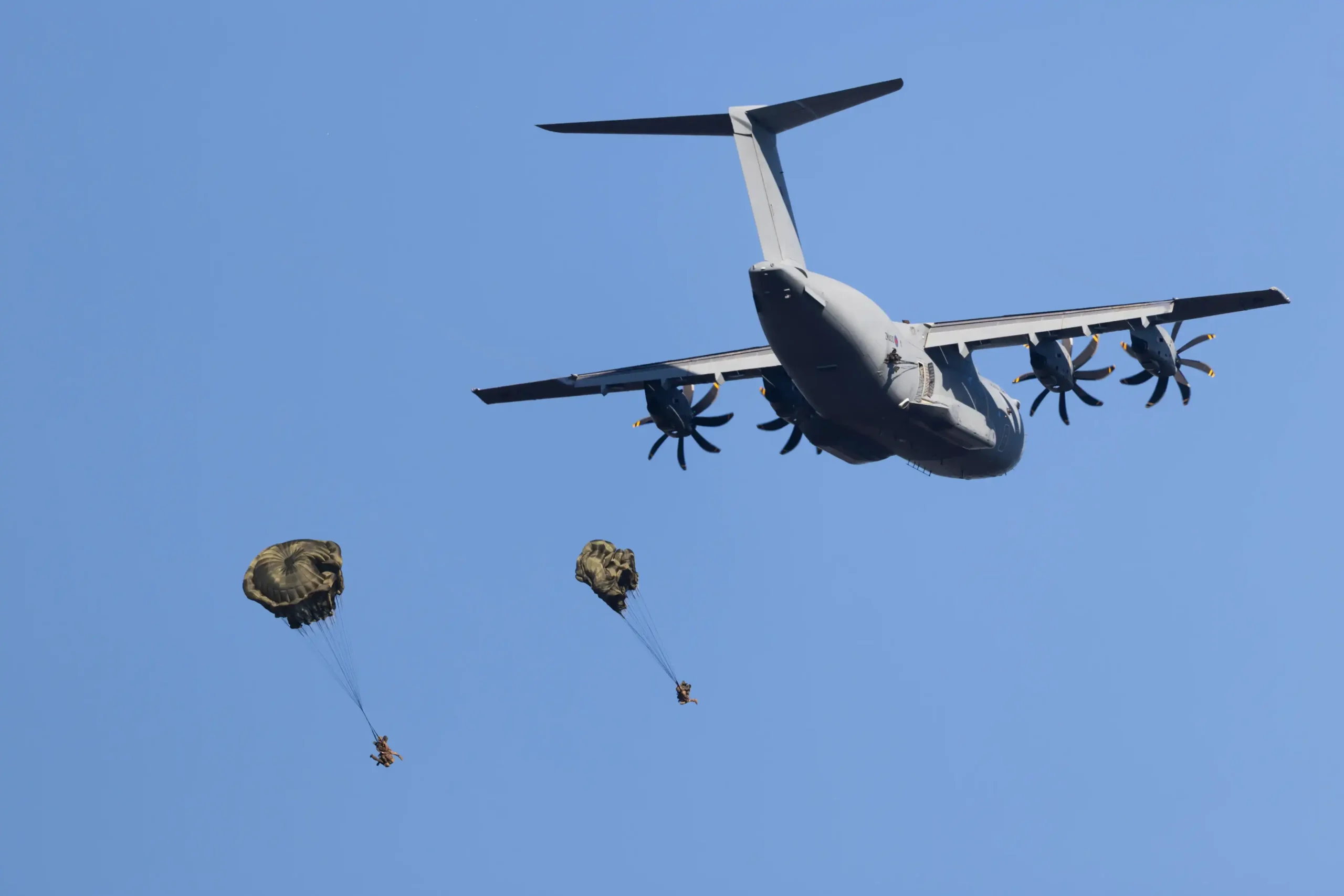
The Royal Air Force and British Army have dropped approximately 700 paratroopers onto a German drop zone during Exercise Rhino Titan, using RAF Atlas C1 (A400M) transports to deliver troops and equipment in the same aircraft across multiple waves, according to the Royal Air Force. The service, which detailed the exercise on October 25, 2026, described it as the return of battlegroup-level airborne insertion with the Atlas, with British, French and German partners taking part.
Rhino Titan tests the Joint Airborne Task Force, which pairs the RAF Air Mobility Force with 16 Air Assault Brigade Combat Team, the British Army’s Colchester-based Global Response Force. The UK lost its legacy parachute platform when the RAF retired its C-130J Hercules fleet in 2023, more than a decade ahead of its planned out-of-service date, leaving the Atlas to inherit the full airborne delivery role. Rebuilding mass parachuting on the new aircraft has required years of trials and clearances. On March 30, 2026, three RAF A400Ms dropped some 270 paratroopers over Salisbury Plain while a fourth delivered 24 tonnes of equipment and supplies separately, according to the British Army; Rhino Titan scales that effort up and moves it onto the European mainland.
How Rhino Titan Tests Combined Personnel and Stores Delivery
The defining feature of the exercise is the integration of paratroopers and stores inside the same airframe. According to the RAF, equipment previously often required separate aircraft. Delivering both together means the force can become operational almost immediately on landing and generates more combat power from the same number of sorties.
Publicly available specifications indicate the A400M is powered by four Europrop TP400-D6 turboprops, carries a maximum payload of roughly 37 tonnes and can seat up to 116 paratroopers in a pure personnel configuration. At that ceiling, 700 jumpers would still require at least seven aircraft loads. Mixed troop-and-stores configurations reduce seating further, which is consistent with the four-aircraft formation described by the RAF delivering the force in waves. For planners, sortie generation, not airframe count alone, sets the pace of a battlegroup insertion.
Individual loads are heavy. Paratroopers board with parachute equipment, weapons, communications systems and bergens weighing up to 50 kilograms, with Air Loadmasters and Parachute Jump Instructors checking each soldier before departure. On approach, static lines are connected and personnel exit at controlled intervals to maintain separation in the air.
“The Atlas allows us to deploy combat forces further, faster and more efficiently than previous generations of aircraft, giving Defence the ability to project force rapidly wherever it is required.” Squadron Leader Luke, Flight Commander, 30 Squadron, and Airborne Mission Commander
Force Generation and NATO Interoperability Behind the Atlas Airborne Drop
The drop is the product of 18 months of increased activity between RAF Brize Norton, Weston-on-the-Green and Salisbury Plain. Training progressed from basic parachuting serials to formation flying, simulated mass drops and integrated personnel-and-stores delivery, with aircraft, crews and specialist instructors ring-fenced for the task despite ongoing global operational commitments.
On the ground, Pathfinders deploy ahead of the main force to validate the drop zone and provide reconnaissance and surveillance before the larger force arrives. Squadron Leader Nick, Officer Commanding the Parachute Training Squadron at RAF Brize Norton, said the capability depends on RAF aircrew, engineers, Air Loadmasters, Parachute Jump Instructors and support personnel working alongside the Army.
The multinational dimension builds on Exercise Falcon Leap, where the UK works with fellow Atlas operators and other tactical airlift nations on common tactics and procedures. The RAF has not identified which French and German units or aircraft participated in Rhino Titan, nor named the drop zone.
Analysis: Rhino Titan shows that the UK can again generate a battlegroup-scale parachute insertion, but it also exposes the arithmetic behind it. The RAF operates a fixed fleet of 22 Atlas aircraft that must also cover tactical and strategic airlift, aeromedical tasks and a standing Falkland Islands detachment, so every airframe dedicated to airborne training competes with other commitments. Only about 10 of those aircraft are mission-capable on a given day, according to the Ministry of Defence, which extended Airbus’s support contract by £190 million ($251 million) on October 1, 2026, to raise that figure to 13 by the end of 2027. The more durable gain may be multinational: France and Germany both fly the A400M, and shared procedures allow allies to pool lift, giving NATO commanders a credible option to place forces beyond established airfields on short notice.
Key unknowns remain, including the number of sorties flown, the composition of the stores delivered and whether heavier platforms were dropped. The next milestones to watch are whether the Joint Airborne Task Force is formally held at readiness for battlegroup parachute operations, and whether future iterations extend the range and scale of insertion beyond a single German drop zone.