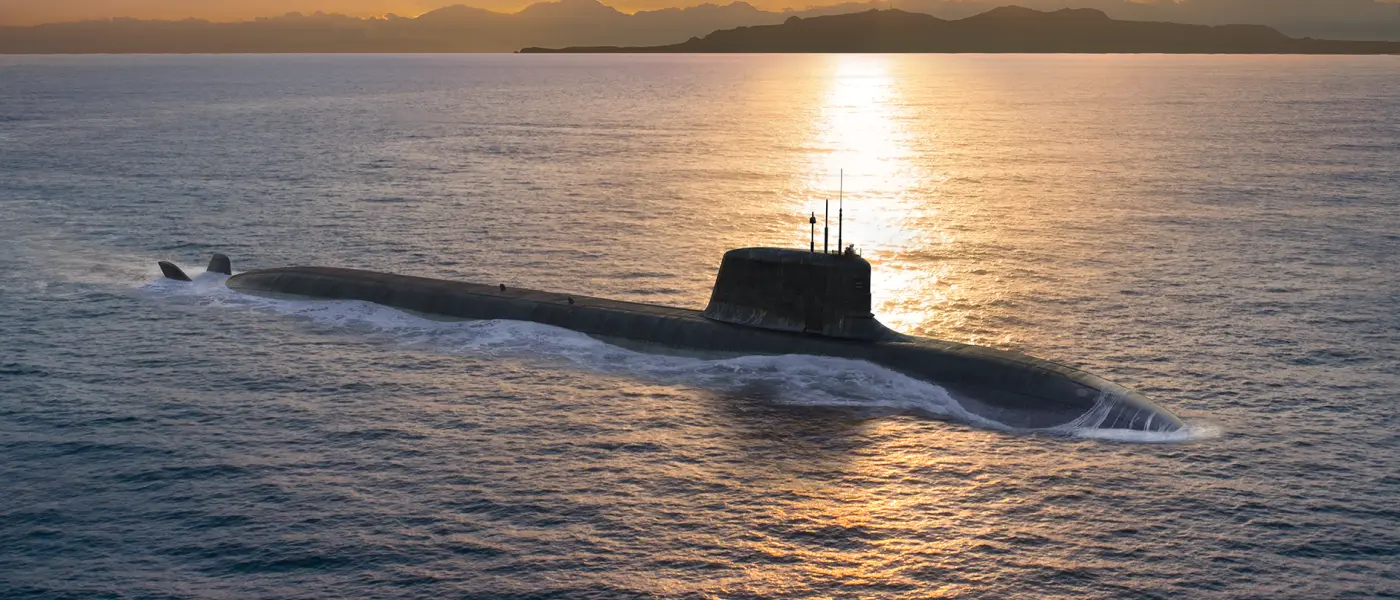
The United Kingdom still intends to procure up to 12 SSN-AUKUS nuclear-powered attack submarines and has made the investments needed to deliver one boat every 18 months from the mid-2030s, Defence Minister Luke Pollard told Parliament in written answers published in October 2026. The final number will not be confirmed until the Detailed Design and Long Lead (D2L2) phase ends in 2028.
The answers, given to Reform UK MP Andrew Rosindell and Conservative MP Ben Obese-Jecty, restate a commitment first made in the June 2025 Strategic Defence Review and repeated in the Defence Investment Plan (DIP) published on June 30, 2026. Obese-Jecty asked specifically what the plan would be after the 2027 spending review; the reply did not say whether the 12-boat figure is protected. The Royal Navy’s attack submarine force is planned around seven Astute-class boats, so a full buy would expand hull numbers by roughly 71 percent at a time when British submarines are tasked with tracking Russian Northern Fleet units moving toward the Greenland-Iceland-United Kingdom (GIUK) gap.
Up to 12 SSN-AUKUS Submarines: Decision Point Set for 2028
Pollard’s answer to Rosindell set out the position in three steps. “As set out in the Defence Investment Plan (DIP), the Ministry of Defence intends to procure up to 12 SSN AUKUS submarines,” he said, adding that the programme is midway through D2L2 and that the number of boats should be confirmed before the phase closes in 2028. He also stated that “through the DIP, the Government has made the investments necessary to establish the industrial capacity required to ultimately deliver a submarine every 18 months from the mid-2030s.”
In a separate answer the same day, Pollard confirmed that the Preliminary Design Review for the class concluded on July 1, 2026, and that steel will be cut on the first British boat in 2027. The Defence Nuclear Enterprise 2026 Annual Update to Parliament, published in September 2026, puts the first Royal Navy SSN-AUKUS into service in the late 2030s, records around £4 billion in development contracts already placed, and cites roughly £6 billion for infrastructure at Barrow-in-Furness and Raynesway over the Spending Review period.
The drumbeat sets the arithmetic. At one boat every 18 months, 16.5 years separate the first and twelfth deliveries, which would place the last hull in the mid-2050s if the lead boat enters service in the late 2030s. The 18-month figure is a production interval, not a build time for an individual submarine.
SSN-AUKUS vs Astute: Displacement, Reactor, and Vertical Launch Payload
SSN-AUKUS grew out of the British SSN(R) Astute replacement study and was renamed in March 2023 when Australia joined the programme. Publicly available specifications indicate a submerged displacement above 10,000 tonnes, against about 7,400 tonnes for the 97-meter Astute class. Propulsion shifts from the Rolls-Royce PWR2 reactor used on Astute to the PWR3+, an evolution of the PWR3 plant fitted to the Dreadnought-class ballistic missile submarines, driving a pump-jet propulsor. The reactor core is expected to last the life of the boat without refueling, removing a costly mid-life refit from the availability cycle.
The largest operational change is the payload. Astute carries up to 38 Spearfish heavyweight torpedoes and Tomahawk land-attack cruise missiles, all fired through six 533 mm tubes, so every Tomahawk loaded displaces a torpedo. SSN-AUKUS will incorporate a common vertical launch system, along with US propulsion plant components and weapons. On March 23, 2026, the US State Department cleared a potential $1 billion foreign military sale to the UK covering design and development support for vertical deployment tubes, common weapon launchers, custom electronics and engineering services.
The combat system will be based on the US AN/BYG-1 architecture already used on Virginia-class boats and Australia’s Collins class. That commonality matters for coalition anti-submarine warfare in the North Atlantic and the Indo-Pacific.
Barrow and Raynesway Must Absorb Dreadnought, Astute, and AUKUS Workloads
BAE Systems’ Barrow yard must finish the seventh and final Astute boat, HMS Agincourt, continue building four Dreadnought submarines and start SSN-AUKUS production in parallel. Dreadnought holds priority at the yard through the late 2020s, so attack submarine work builds up behind it. Steel was cut on the fourth Dreadnought boat, HMS King George VI, on September 22, 2025, inside a programme cost envelope of £41 billion that includes a £10 billion contingency. Barrow’s workforce has passed 12,000 after a major infrastructure expansion.
Rolls-Royce Submarines has doubled its Raynesway site in Derby to produce reactors for both Dreadnought and every SSN-AUKUS boat, including Australia’s. Australia will build its own boats to the common design at Osborne in South Australia, with its first locally built SSN-AUKUS due in the early 2040s after it receives at least three Virginia-class submarines from the United States. Senior officials told the Commons Defence Committee earlier in 2026 that the final fleet size depends on what Barrow can actually produce.
Analysis: The 2028 decision is less a statement of ambition than a test of demonstrated industrial throughput. Twelve hulls only translate into more submarines at sea if Barrow sustains its drumbeat and the support enterprise, from refit capacity to qualified crews, grows in step; the Royal Navy’s recent difficulty keeping its existing Astute boats deployable shows that the binding constraint is availability, not order books. Timing compounds the risk for NATO. The first SSN-AUKUS will not reach the fleet until the late 2030s, so the Astute class, Type 26 frigates and P-8A Poseidon patrol aircraft must carry the North Atlantic anti-submarine mission through the period allied planners regard as most dangerous.
The next markers are the 2027 spending review, first steel at Barrow later that year, delivery of HMS Agincourt and the D2L2 exit in 2028, when the fleet number becomes a firm figure or a smaller one. Total programme cost, unit cost, crewing requirements and the in-service date for each boat remain undisclosed; the MoD withholds planned in-service dates for Royal Navy submarines on security grounds.