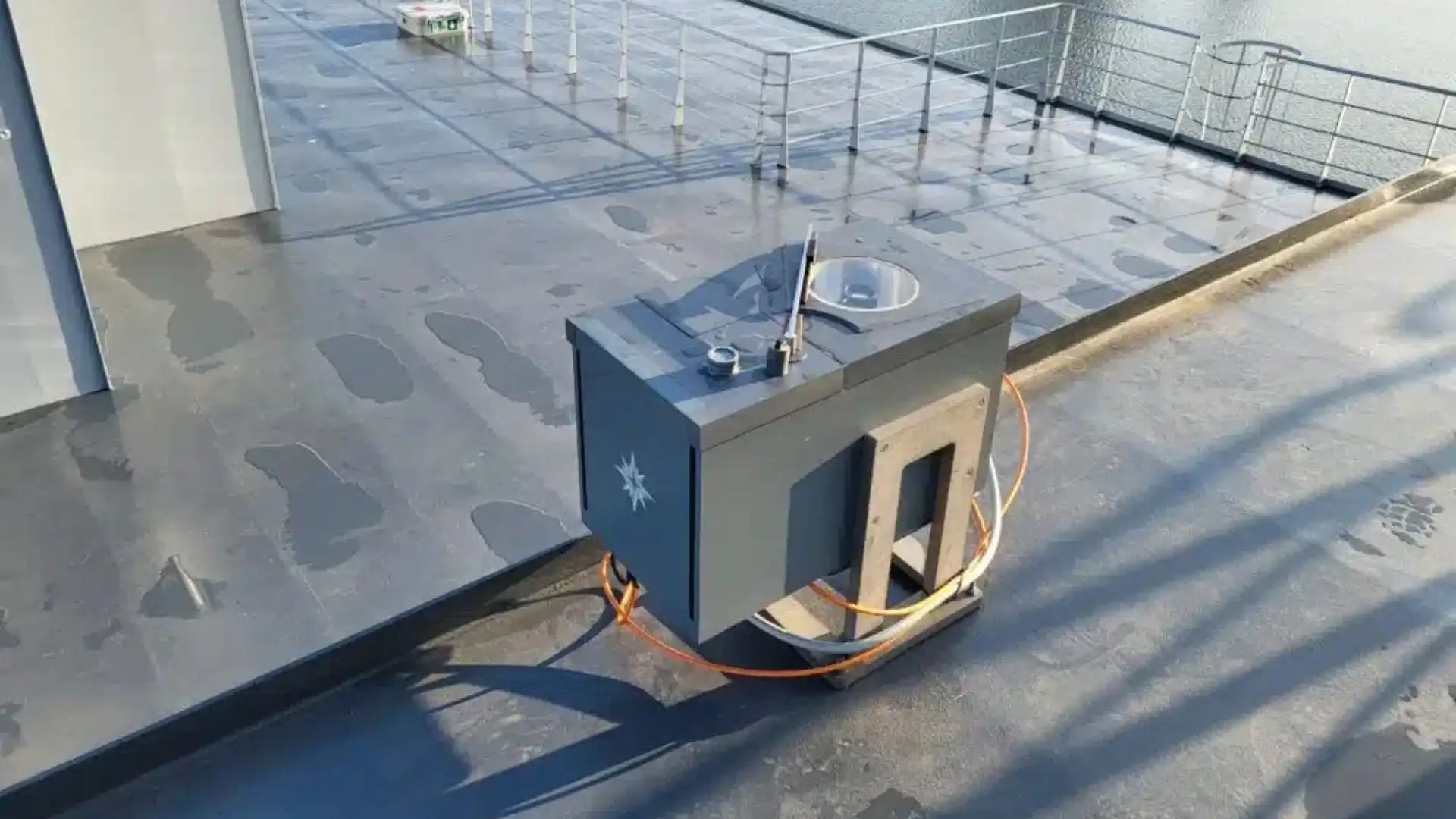
French navigation specialist STARNAV is moving its Magellan astro-inertial navigation system from prototype toward operational use, with Naval Group integration work under way ahead of French Navy sea trials scheduled for 2027 and a further round of flight testing planned to complete validation of the airborne MAGELLAN AERO variant, NATO’s Defence Innovation Accelerator for the North Atlantic (DIANA) said on October 26, 2026.
The push comes as interference with satellite navigation has become routine along NATO’s eastern flank. In a May 2025 note to the EU Council, Lithuania, Estonia and Finland reported a sharp rise since August 2024 in Global Navigation Satellite System (GNSS) jamming and spoofing affecting aircraft in the Baltic region, attributing it mainly to sources in Russia and Belarus. Figures cited in the note show 2,732 affected aircraft in Polish airspace in January 2025, up from 1,908 in October 2024. STARNAV, founded in 2007 in Bretteville-sur-Odon, Normandy, was built around one goal: to “bring star-based navigation from space to Earth,” in the words of chief executive Georges Lamy au Rousseau. It joined DIANA’s 2025 cohort at The Gate Brainport accelerator in Eindhoven, the Netherlands.
How the STARNAV Magellan System Navigates Without GNSS
Magellan pairs an integrated inertial measurement unit (IMU) with an automated wide-field optical sight that recognizes stars at night and the sun by day. Rather than correcting inertial drift with satellite fixes, the system recalibrates its inertial solution against celestial observations, with no visible horizon, manual pointing or astronomical expertise required, according to the company. STARNAV describes two operating modes: a sextant mode that computes a fix from each usable sky image, and an inertial mode in which celestial observations recalibrate the inertial unit in real time.
Company data sheets published in 2026 list position accuracy of 0.1 nautical mile (1-sigma), roughly 185 meters, with heading, roll and pitch accuracy of 36 arcseconds (1-sigma), a 100 Hz data rate and clock drift below 100 microseconds per day. STARNAV states that position error stays within 200 meters regardless of mission duration. That bounded error is the operational point: a free-running inertial system degrades the longer it sails or flies without an external fix. These remain manufacturer figures; detailed results from the 2026 test campaigns have not been released.
The naval opto-inertial block measures 530 x 290 x 380 mm and weighs 22 kg before mounting, with an integrated wiper and washer to keep its optics clear at sea, linked to a separate 20 kg computing unit. It outputs National Marine Electronics Association (NMEA) data over UDP multicast and RS-422/RS-485 serial links, with Precision Time Protocol (PTP) timing, easing connection to existing shipboard navigation networks. The airborne sensor head is far smaller, at 240 x 210 x 190 mm and 7.15 kg. STARNAV says the airborne version can be fitted to the C-130 and the Atlantique 2 (ATL2) without modification, in place of the old manual sextant.
Naval Group Integration Work and C-130H Flight Trials
The Naval Group agreement, which STARNAV announced in July 2026, covers joint development of the interfaces needed to connect Magellan to the navigation architecture of Naval Group-designed ships, followed by sea trials with the French Navy starting in 2027. It builds on earlier at-sea experience: backed by regional innovation funding, STARNAV installed Magellan aboard a major French Navy vessel in Toulon for operational testing from May to October 2024. Lamy au Rousseau said the partnership has “helped reduce the cost and complexity of experimentation” for a company of STARNAV’s size and lays the groundwork for cooperation with other NATO countries.
In the air, MAGELLAN AERO completed a six-flight performance evaluation campaign aboard a C-130H from June 2 to June 10, 2026, with personnel from the Direction générale de l’armement (DGA), France’s defense procurement agency, the French Air and Space Force and the French Navy. Flights covered day, night and twilight transition phases, a regime that tests the handover between solar and stellar sighting, in conditions ranging from very cold to very hot temperatures. The campaign followed a January 14 to 18, 2026 transit of roughly 15,000 km with five take-offs and landings, during which STARNAV reports that astral recalibration improved inertial accuracy.
Lamy au Rousseau said another round of aircraft testing is planned “with the aim of completing final validation.” STARNAV also intends to pursue further validation with Airbus for military aircraft applications, while contacts made through DIANA in Eindhoven have opened discussions with the Royal Netherlands Navy on potential testing.
Analysis: Magellan targets a gap that inertial navigation cannot close on its own. Even high-grade IMUs accumulate position error over time, and the standard correction, GNSS recalibration, is exactly what adversaries now attack. A passive optical reference emits nothing and cannot be jammed or spoofed by radio-frequency means, making it a complement to, not a replacement for, layered positioning, navigation and timing (PNT) architectures. Its limits are equally clear: cloud cover and obstructed sight lines interrupt sightings, leaving the inertial mode to carry the solution. The 2027 sea trials will show whether the claimed 0.1 nautical mile accuracy survives operational weather and ship motion.
Near-term milestones include the second MAGELLAN AERO flight campaign, the Airbus work and Naval Group interface development, with STARNAV aiming to begin installations on French Navy platforms in 2027. Key unknowns remain: no production contract, unit cost, target ship class or production aircraft platform has been disclosed. The company is also courting major container carriers facing unreliable navigation data, a dual-use market that could help sustain volumes beyond defense orders.