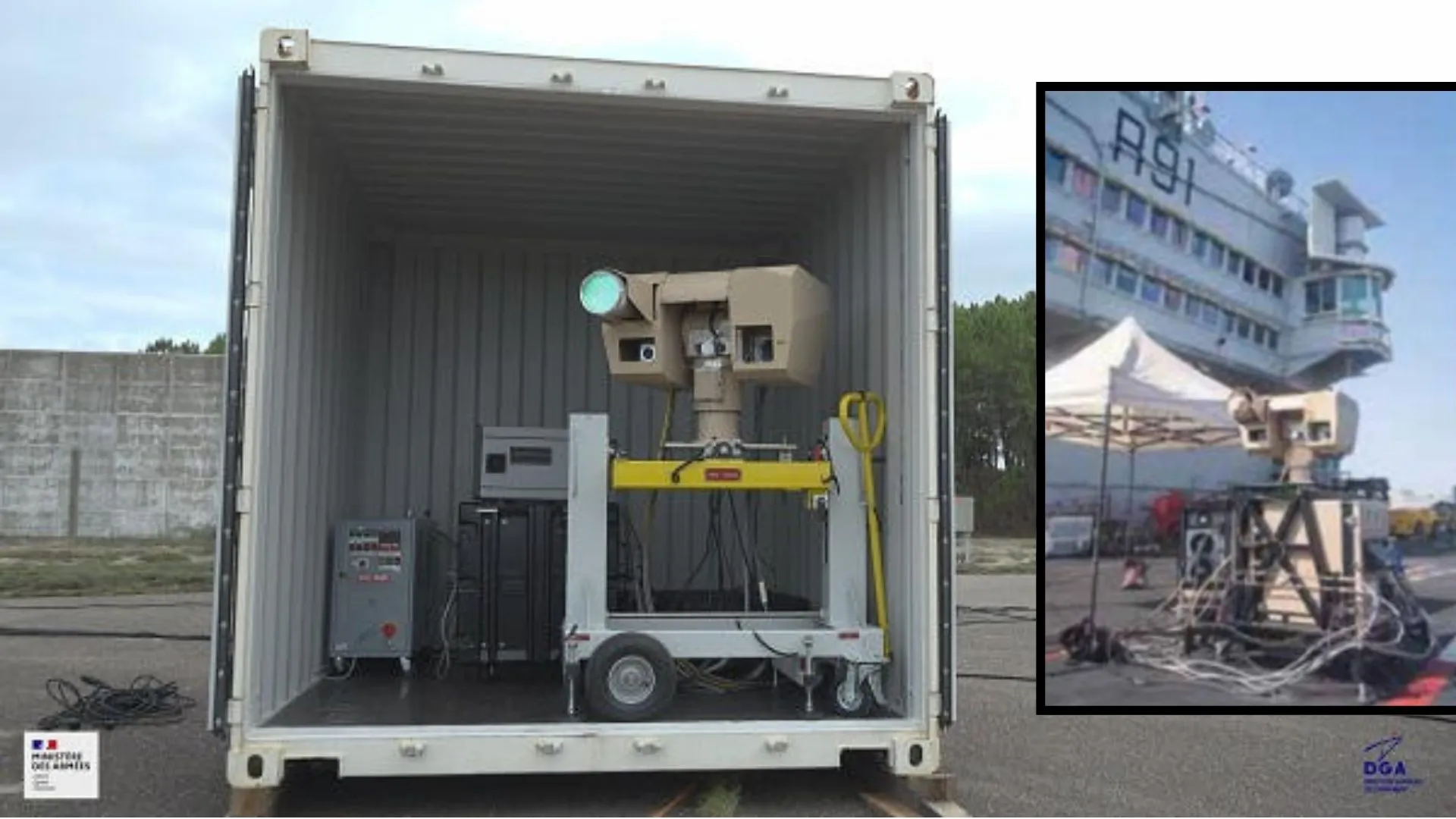
France has tested a laser anti-drone weapon aboard its nuclear-powered aircraft carrier Charles de Gaulle (R91), installing the system on the flight deck from June 4 to 8, 2026, during a port call in the La Fayette 26 deployment, according to the October 2026 issue of Cols Bleus, the French Navy’s official magazine. A joint team from the French Air and Space Force’s Military Air Expertise Center (CEAM) at Mont-de-Marsan and Ground-Based Air Defense Squadron (EDSA) at Istres deployed the equipment, which the magazine describes as the first trial of this system aboard a French Navy vessel.
The trial came during the carrier’s second-longest deployment. The strike group left Toulon on January 27, 2026, operated with NATO allies in the North Atlantic and Baltic, shifted to the eastern Mediterranean in March, then transited the Suez Canal on May 6 toward the Arabian Sea and the Strait of Hormuz, returning on July 11 after 166 days at sea. The backdrop is a cost problem: since December 2023, French frigates in the Red Sea have fired Aster surface-to-air missiles at Houthi one-way attack drones worth a fraction of each interceptor, and cutting the cost per engagement is a stated Navy objective.
Charles de Gaulle Laser Trial: Airlift, Crane and Four-Hour Setup
The team needed about four hours to set up the complete system on deck: a turret integrating cameras, a light detection and ranging (LIDAR) sensor and the laser source, plus a chiller unit and an operator console. The Air and Space Force warrant officer leading the team said the trial exposed the system to configurations it had never faced, namely air transport, crane handling and extreme climatic conditions, and validated its behavior in previously untested operational conditions.
What the account leaves out matters as much. Cols Bleus reports no live fire, target drones, engagement ranges or interception results. The Navy has not disclosed the port’s location or officially named the system. A published photograph shows a compact turret beside the carrier’s island; its configuration is consistent with HELMA-P, the counter-drone laser developed by French firm CILAS, but the identification is unconfirmed. The first-trial wording also sits uneasily with HELMA-P’s 2023 at-sea test aboard a French air defense frigate, pointing either to a different system or to a new configuration.
HELMA-P Specifications: A 2 kW Laser Sized for Class 1 Drones
CILAS began developing the High Energy Laser for Multiple Applications-Power (HELMA-P) in 2017. In November 2022, ArianeGroup sold its 63% majority stake in CILAS to Safran Electronics and Defense and MBDA. After land trials in 2020 and 2021, France’s procurement agency, the Direction générale de l’armement (DGA), awarded CILAS the Laser de lutte antidrone (L2AD) contract in June 2022. A demonstrator completed first at-sea trials aboard the Horizon-class air defense frigate Forbin in the Mediterranean from June 12 to 14, 2023, before supporting security for the Paris 2024 Olympic Games.
The CILAS data sheet for HELMA-P lists a neutralization range of up to 1,000 meters and optical damage out to 3,000 meters, a ±180-degree field of view, battery or grid power with integrated thermal regulation, operation between -30°C and +60°C, and fixed, vehicle-mounted and ship-mounted configurations. The demonstrator’s output has been reported at about 2 kW. Figures published when the DGA placed the L2AD order set the target envelope at drones of 100 grams to 25 kilograms, within NATO’s Class 1 category.
Those numbers define the mission. At 2 kW, the beam needs several seconds of dwell to damage a target’s structure, which suits small quadcopters and reconnaissance drones probing a ship at close range, not the larger one-way attack drones engaged in the Red Sea, whose mass and standoff exceed the HELMA-P envelope.
From HELMA-P to SYDERAL: Scaling French Shipborne Laser Power
That heavier requirement falls to SYDERAL (Système Laser de Défense de Nouvelle Génération), a demonstrator the DGA ordered on August 22, 2025, from MBDA, Safran Electronics and Defense, Thales and CILAS under the 2024-2030 military programming law. Rated at several tens of kilowatts through beam combination, it will be assessed against tactical drones, rockets, mortar rounds and loitering munitions with a view to equipping the forces by 2030, building on a €10 million contract awarded in 2024 to Lumibird and CILAS for combinable laser sources.
The US Navy took the same bolt-on route in October 2025, when AeroVironment’s 20 kW-class palletized LOCUST laser tracked and neutralized multiple target drones in a live-fire test aboard the Nimitz-class carrier USS George H.W. Bush (CVN 77). Publicly available specifications indicate the Charles de Gaulle’s own self-defense rests on Aster 15 missiles under the SAAM-FR system and Sadral launchers firing Mistral; a laser would add a layer below Mistral for the smallest threats.
Analysis: The June trial tested deployability, not lethality, and that is the point. An air defense team flew in a self-contained laser with its own chiller, craned it aboard and set it up in about four hours, with no permanent ship modification reported. That model suits a carrier commissioned in 2001, long before shipborne lasers entered French planning, and mirrors the US approach with LOCUST. It also confirms counter-drone defense as a joint mission, run here by the service that defends French air bases. A ship alongside is most exposed to small commercial drones, exactly where a 2 kW, 1,000-meter system fits. It does not close the cost gap against the attack drones that consumed French Aster interceptors in the Red Sea; that takes SYDERAL-class power.
Key unknowns remain: the system’s official identity, the port of call, and whether the laser fired at all. The next public milestone is the SYDERAL demonstrator, on a 2030 horizon, which will show whether France can field the tens-of-kilowatts class needed against larger drones and rockets. Beyond it, the next-generation carrier PA-NG, planned to replace the Charles de Gaulle from 2038, could be designed with power and cooling reserved for a permanent laser, although no such integration has been announced.