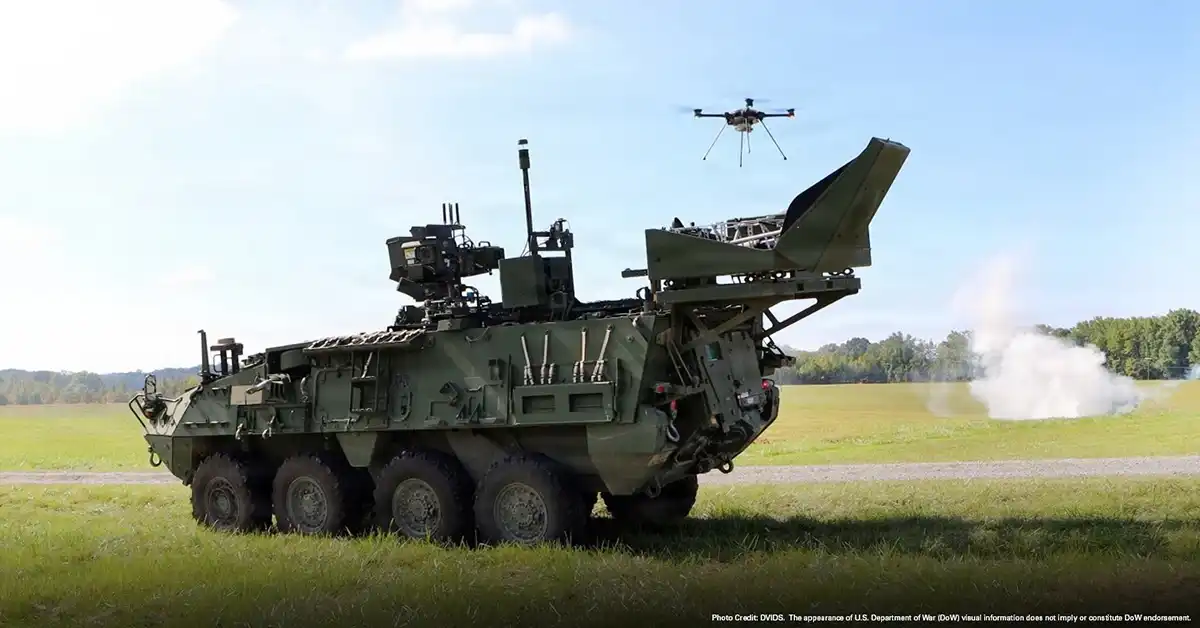
Teledyne FLIR Defense has won a $48 million U.S. Army contract to supply Nuclear, Biological and Chemical Reconnaissance Vehicle (NBCRV) Sensor Suite Upgrades (SSU) for Bulgaria’s new Stryker fleet, the company announced on October 26, 2026. The U.S. Army Contracting Command at Aberdeen Proving Ground, Maryland, awarded the contract under a Foreign Military Sales (FMS) case. Ten Bulgarian Strykers will receive the chemical, biological, radiological and nuclear (CBRN) reconnaissance package.
Bulgaria is buying 183 Stryker 8×8 vehicles in six variants to replace Soviet-era armor such as the BTR-60PB armored personnel carrier, a purchase approved by the Bulgarian parliament in November 2023. The Ministry of Defense puts the cost at about €1.12 billion for 198 combat and support vehicles, including 15 support trucks, plus roughly €96.1 million for Stryker ammunition. The first five combat vehicles reached the port of Burgas on February 14, 2026, for final assembly at the Terem-Ivaylo plant in Veliko Tarnovo. The fleet will equip the 61st Mechanized Brigade in Karlovo, with deliveries scheduled through the first quarter of 2028.
Bulgaria Stryker NBCRV Sensor Suite: Drone-Based Standoff Detection
The SSU modernizes the U.S. Army’s M1135 Stryker NBCRV, a reconnaissance variant built to detect, identify, locate, sample and mark CBRN hazards. The Army launched the upgrade in 2018 with three goals: a standalone sensor package, a remote detection capability, and better reliability and mobility. The baseline vehicle detects ground chemical agents with an onboard probe and double-wheel sampling system. The upgraded suite adds an unmanned layer: when a threat is identified, the crew launches a drone docked on the back of the vehicle, which passes over the hazard several times to collect a sample. The result is standoff detection and decision-quality data for commanders, with less risk to troops.
That drone is the R80D SkyRaider, a Group 1 vertical takeoff and landing quadcopter. Manufacturer specifications indicate the aircraft carries payloads of up to 7.7 pounds (3.5 kilograms), runs embedded artificial intelligence processing for object detection and classification, and is designed to operate in GPS-denied or communications-denied environments. In the NBCRV configuration, it carries Teledyne FLIR’s MUVE B330, a continuous biological detection payload sized for small unmanned aircraft.
A Teledyne FLIR-developed command and control system fuses inputs from every onboard and airborne sensor, automating parts of the detection workflow to reduce operator cognitive load. The company says the suite also integrates other third-party solutions, which it does not name.
From Army Production to Export: Teledyne FLIR’s NBCRV Track Record
Teledyne FLIR is the lead integrator of the Army’s NBCRV modernization. After delivering initial prototypes for government testing and supporting a training evaluation with the 7th Infantry Division at Dugway Proving Ground, Utah, in August 2024, the company received a five-year, $168.3 million indefinite-delivery/indefinite-quantity low-rate initial production contract in November 2024. A four-year, $74.2 million award followed in April 2025 to develop an expanded Capability Set 2.2 design, deliver six prototypes and support government testing through 2028. Deliveries of new sensor suites to Army units began in 2025, and Teledyne FLIR reports more than $240 million in program contract vehicles since 2024.
The Bulgarian award is the company’s second Stryker contract for Sofia this year. In January 2026, Teledyne FLIR announced a contract worth up to $32 million to integrate thermal imaging sights and radars on Bulgaria’s Strykers, giving crews 360-degree visibility and long-range threat detection.
“The upgraded Stryker vehicles will provide Bulgaria with the most advanced mounted CBRN reconnaissance capabilities in Europe,” said Dr. JihFen Lei, President of Teledyne Defense and Aerospace Group and Senior Vice President of Teledyne Technologies.
Work will run through 2028 at multiple Teledyne FLIR facilities in the United States, with the sensor suites integrated on-site after the vehicles arrive in Bulgaria. The award’s 10 suites match the 10 M1135 NBCRVs listed in the Stryker sale the U.S. State Department approved for Bulgaria in September 2023. The announcement does not give a delivery schedule or say whether Bulgaria will receive the current production standard or the Capability Set 2.2 configuration.
Analysis: The award pairs Bulgaria’s new mechanized brigade with a dedicated CBRN reconnaissance element built on the sensor suite the U.S. Army began fielding in 2025. That commonality has operational weight: Bulgarian crews would share drone, sensor and hazard-reporting architecture with U.S. Stryker units, simplifying the exchange of contamination data inside combined formations on NATO’s southeastern flank. For Teledyne FLIR, the FMS order adds export volume to a program the Army moved into low-rate initial production in November 2024, and demonstrates that the upgraded NBCRV suite can transfer to allied operators alongside the vehicle itself.
The next milestones are continued Stryker deliveries to the 61st Mechanized Brigade, on-site integration of the first sensor suites in Bulgaria, and Army testing of Capability Set 2.2 through 2028. Whether other Stryker FMS customers follow Bulgaria in buying the SSU will indicate how far the upgraded NBCRV travels beyond U.S. formations.