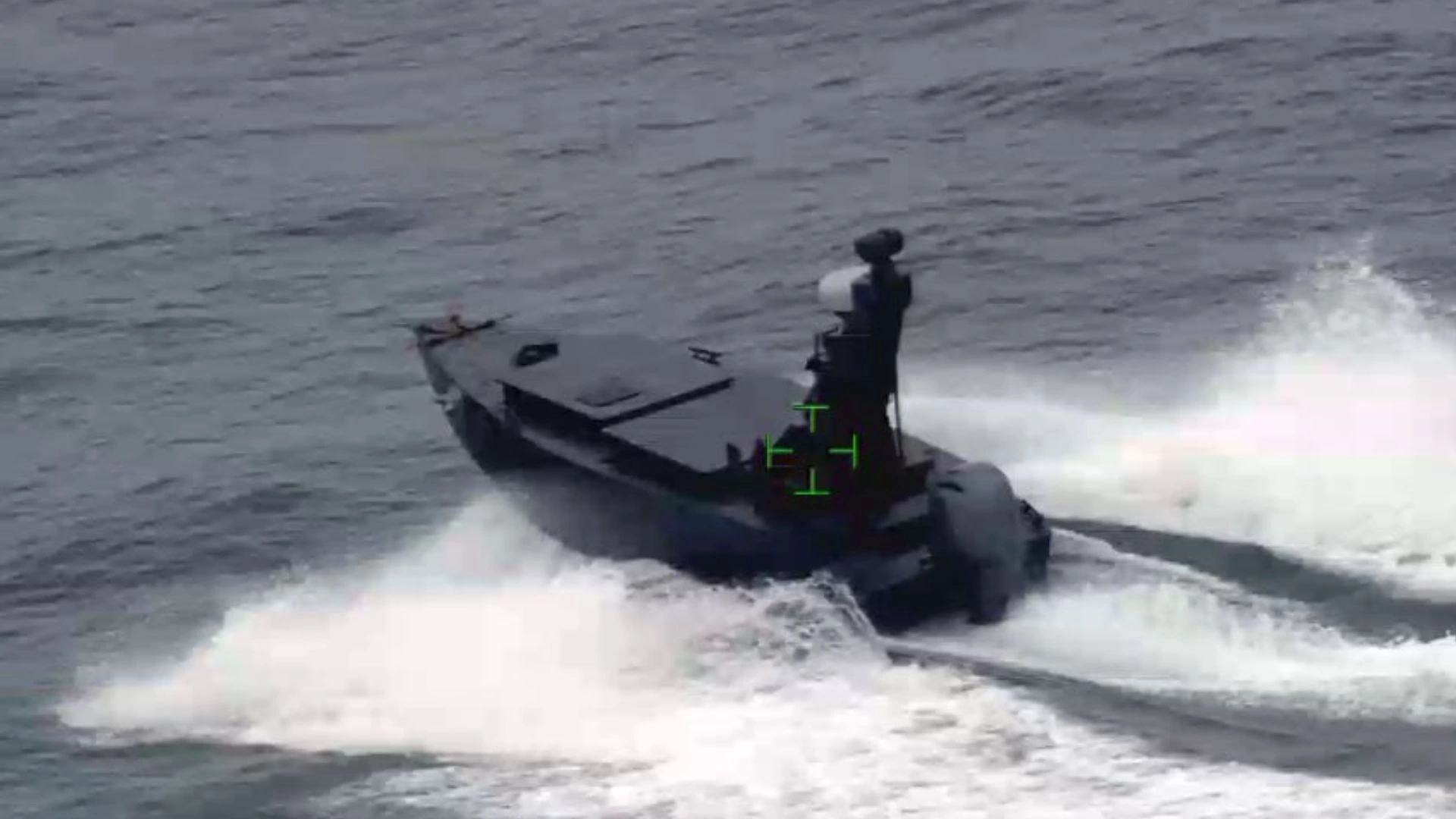
A French Navy Atlantique 2 maritime patrol aircraft detected three uncrewed surface vessels, or sea drones, closing on the Liberian-flagged container ship Contship Jet in the Black Sea on October 28, 2026, and raised the alarm that allowed Bulgarian naval forces to recover all 18 crew members after the drones struck, the French Armed Forces General Staff said.
The attack hit the Greek-managed ship roughly 17 nautical miles east of Cape Kaliakra, inside Bulgaria’s exclusive economic zone (EEZ) but outside its territorial waters. It was at least the fifth drone strike on merchant shipping in Bulgaria’s EEZ in October and roughly the ninth across the western Black Sea, a campaign that has left 34 seafarers dead or missing. No party has claimed responsibility. Bulgarian Prime Minister Rumen Radev has said the evidence points toward Russia but that Sofia cannot prove it.
How the French Atlantique 2 Tracked Three Uncrewed Surface Vessels
The Atlantique 2 was flying a routine surveillance sortie when its crew identified the threat. According to the French military, the aircraft warned the ship’s crew, relayed its position to Bulgarian authorities, helped coordinate the rescue and alerted other merchant ships in the area.
Bulgarian Navy commander Rear Adm. Kiril Mihaylov said the French crew first spotted two uncrewed boats, then a third, all heading west toward several merchant vessels. The first impact came at about noon. Bulgarian officials recorded three hits on the ship, while Mihaylov also said one drone was destroyed by small-arms fire; the two accounts have not been reconciled. An unconfirmed open-source estimate puts the warning time at about 40 minutes, which at the drones’ reported 26 knots (48 km/h) would imply detection roughly 17 nautical miles out.
That speed defined the outcome. The Bulgarian Navy said it had no units able to react quickly enough and no means to destroy the drones before impact. Mihaylov credited the early warning with saving the crew. The Pauk-class corvette Reshitelni (hull number 13), the rescue ship Proteo and fast boat 223 joined the search, and all 18 sailors, 14 Filipino and four Ukrainian nationals, were landed in Varna uninjured.
The 2007-built, 1,276 TEU vessel was sailing from Haifa, Israel, to Constanța, Romania, with 421 containers, some carrying fuel and hazardous cargo. The abandoned hull drifted southwest before sinking on October 29, according to Bulgaria’s maritime administration.
Atlantique 2 Standard 6 Sensors and the Black Sea Surveillance Gap
Publicly available specifications indicate the Dassault Atlantique 2 is powered by two Rolls-Royce Tyne turboprops rated at about 6,100 shp each. French Ministry of the Armed Forces figures give a top speed of nearly 600 km/h, about 12 hours of endurance and an eight-hour patrol at 600 nautical miles from base, enough for persistent coverage of the western Black Sea from Romania.
All 18 French Navy aircraft now fly in the Standard 6 configuration; the last was delivered on February 17, 2026. The upgrade centers on the Thales Searchmaster active electronically scanned array radar, built on Rafale antenna technology, which open-source data credits with a maritime detection range of about 200 nautical miles. It adds an L3Harris Wescam MX-20 electro-optical and infrared turret, a new tactical system and digital acoustic processing. Small, fast USVs are hard radar targets in sea clutter; pairing AESA surface search with stabilized optics lets a crew classify them rather than log an unknown contact.
The aircraft can carry AM39 Exocet missiles, MU90 torpedoes and GBU-12 bombs, but its Black Sea role is detection and tracking; interception rests with the coastal state. At Romania’s request, France has based the Atlantique 2 at the 57th Mihail Kogălniceanu Air Base near Constanța since October 18, with flights scheduled until November 6, while a U.S. Navy P-8A Poseidon patrols at Bulgaria’s request.
Analysis: The Contship Jet strike exposes a gap between sensing and shooting on NATO’s southeastern flank. Allied patrol aircraft can find and classify 26-knot USVs in time to evacuate a crew, but the coastal states lack a fast-reaction kill chain, such as armed helicopters, armed drones or interceptor craft, to finish the job. Because Türkiye has kept the Turkish Straits closed to warships under the Montreux Convention since 2022, an arrangement its defense minister said in Sofia would remain in place, allied aircraft carry much of the surveillance burden. Early warning now saves sailors; it does not yet save ships.
Three questions now frame the response. Paris must decide whether to extend the Atlantique 2 detachment beyond November 6. Bulgaria, Romania and Türkiye, whose defense ministers were meeting in Sofia when the drones struck, agreed to strengthen intelligence sharing, maritime situational awareness and early warning but announced no new patrols or air defense measures. Attribution remains open: Mihaylov declined to say whether the drones’ course indicated their origin or whether debris had been recovered.