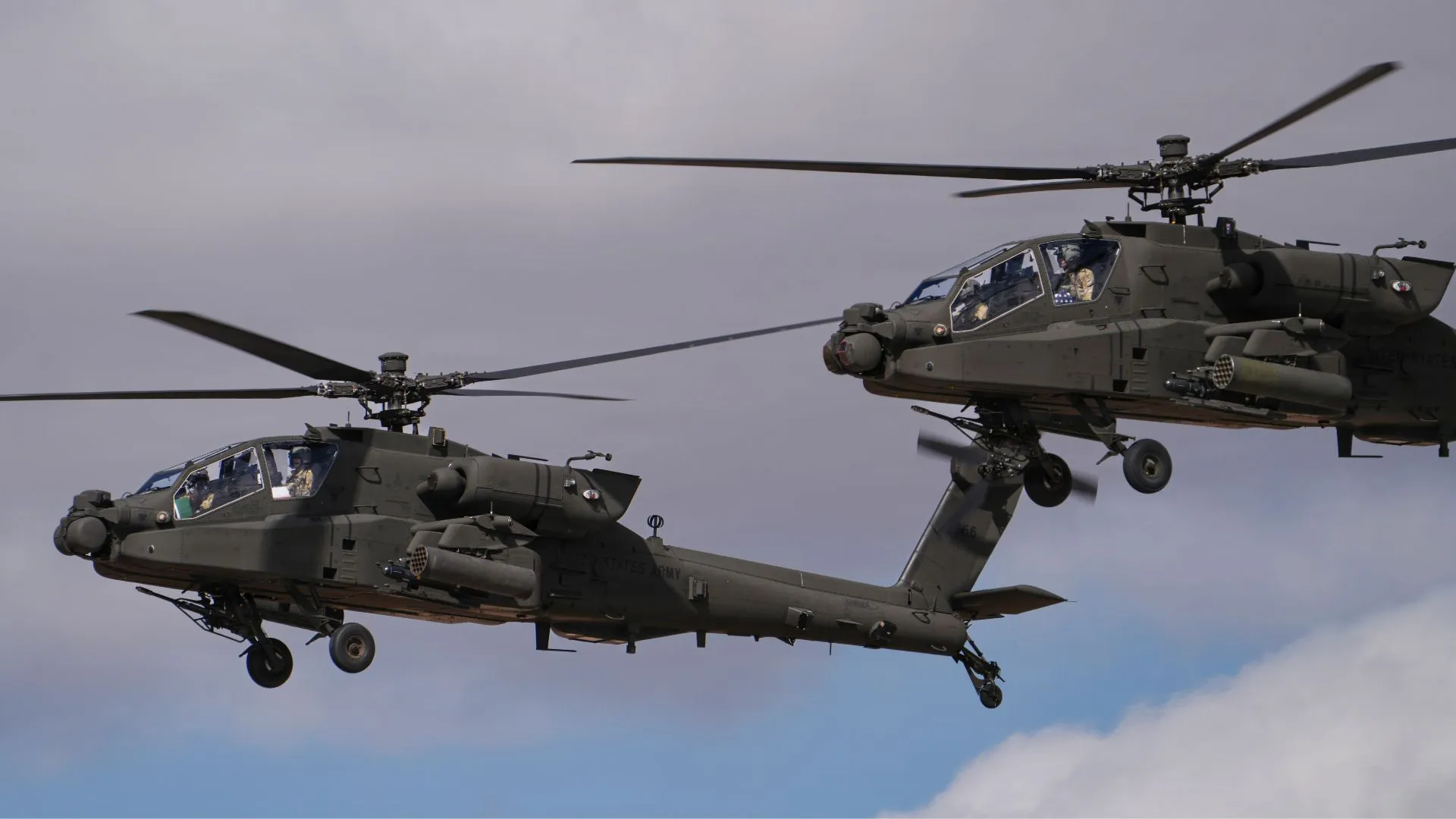
PV Labs, an optronics company based in Burlington, Ontario, will develop a next-generation Pilot Night Vision Sensor (PNVS) for the Boeing AH-64E Apache attack helicopter with a strategic investment from Lockheed Martin, the company announced on October 28, 2026. The funding was approved under Canada’s Industrial and Technological Benefits (ITB) Policy and Investment Framework. Neither company disclosed the value of the investment or a qualification timetable.
The investment flows from Canada’s purchase of 26 Lockheed Martin M142 High Mobility Artillery Rocket Systems (HIMARS). Ottawa finalized that Foreign Military Sales (FMS) agreement in January 2026 and made it public on June 2, 2026, valuing the package at roughly C$2.6 billion, with launcher deliveries expected from 2029 under the Long-Range Precision Strike (Land) project. The ITB Policy obliges Lockheed Martin Missiles and Fire Control to generate Canadian business activity and investment equal to the value of its work on the sale. Lockheed Martin’s 10-year industrial plan for the deal already listed advanced helicopter electro-optics among its target projects; the PV Labs framework now attaches a company and a platform to that commitment.
Inside the Staring-Array Apache Night Vision Sensor Program
The approved framework sets a multi-year roadmap to design and develop an advanced staring-array PNVS intended for operations in adverse weather, degraded visual environments (DVE), and darkness. PV Labs will cover design, prototyping, qualification, and production readiness.
The PNVS is the Apache pilot’s flying sensor, distinct from the Target Acquisition Designation Sight (TADS) the copilot-gunner uses for targeting. On current aircraft, both belong to Lockheed Martin’s Modernized TADS/PNVS, known as Arrowhead, which the company first delivered to the US Army in May 2005. Arrowhead’s detector technology traces back to sensor work for the cancelled RAH-66 Comanche, and its pilotage turret slews to follow the pilot’s head. Lockheed Martin later added the VNsight low-light camera to the modernized PNVS, blending visible and near-infrared imagery with the forward-looking infrared (FLIR) picture so crews can see lasers, beacons, and tracer fire registered inside the thermal scene.
A staring array captures the whole field of view on a two-dimensional focal plane rather than building the image line by line. Publicly available engineering literature associates the approach with higher thermal sensitivity and fewer moving parts, both relevant to a sensor pilots depend on for terrain and obstacle avoidance at low level. The announcement does not specify the detector format, spectral band, resolution, or field of view, nor whether the new sensor would replace or supplement the Arrowhead PNVS.
What PV Labs Brings to the AH-64E Apache Supply Chain
PV Labs was founded in 2004 by Mark Chamberlain, who previously served as president and CEO of Wescam, acquired by L-3 Communications in 2002. The company’s product line rests on its patented Fifth-generation Advanced Stabilization Technology (FAST), a gyro-stabilized gimbal architecture for airborne intelligence, surveillance, and reconnaissance (ISR) payloads. Lockheed Martin first invested in PV Labs in 2019, supporting the first full prototype of its PV-1520 airborne ISR camera system, and committed a further US$10 million in May 2024 to bring the FAST product line to full commercialization. In January 2023, Italy’s Civitanavi Systems agreed to acquire a 30% stake in the company for $2.5 million.
The PNVS effort moves PV Labs from mission payloads into a flight-critical pilotage system on a crewed combat aircraft, a far more demanding qualification environment. Chamberlain framed the opportunity as building “a world-class pilotage sensor capability” in Canada.
Analysis: The framework turns a land-fires purchase into rotary-wing sensor development, and its timing intersects Canada’s own attack helicopter question. The Royal Canadian Air Force’s next Tactical Aviation Capability Set (nTACS) project includes a second phase to acquire an attack and reconnaissance helicopter, and a March 2025 briefing put planned spending on new tactical helicopters at C$18.4 billion. Boeing is positioning the AH-64E for that requirement, while Leonardo is promoting the AW249. A Canadian-developed Apache pilotage sensor would strengthen any domestic content argument for the AH-64E, although nothing in the announcement links the two efforts, and integration on the Apache remains a development objective rather than a funded upgrade.
The next markers to watch are disclosure of the investment value, prototype and qualification milestones, and whether Boeing or the US Army, which manages the AH-64E configuration, commits to integration. nTACS, meanwhile, remains in options analysis, with National Defence planning to start definition in fiscal 2029-30 and industry awaiting a request for information.