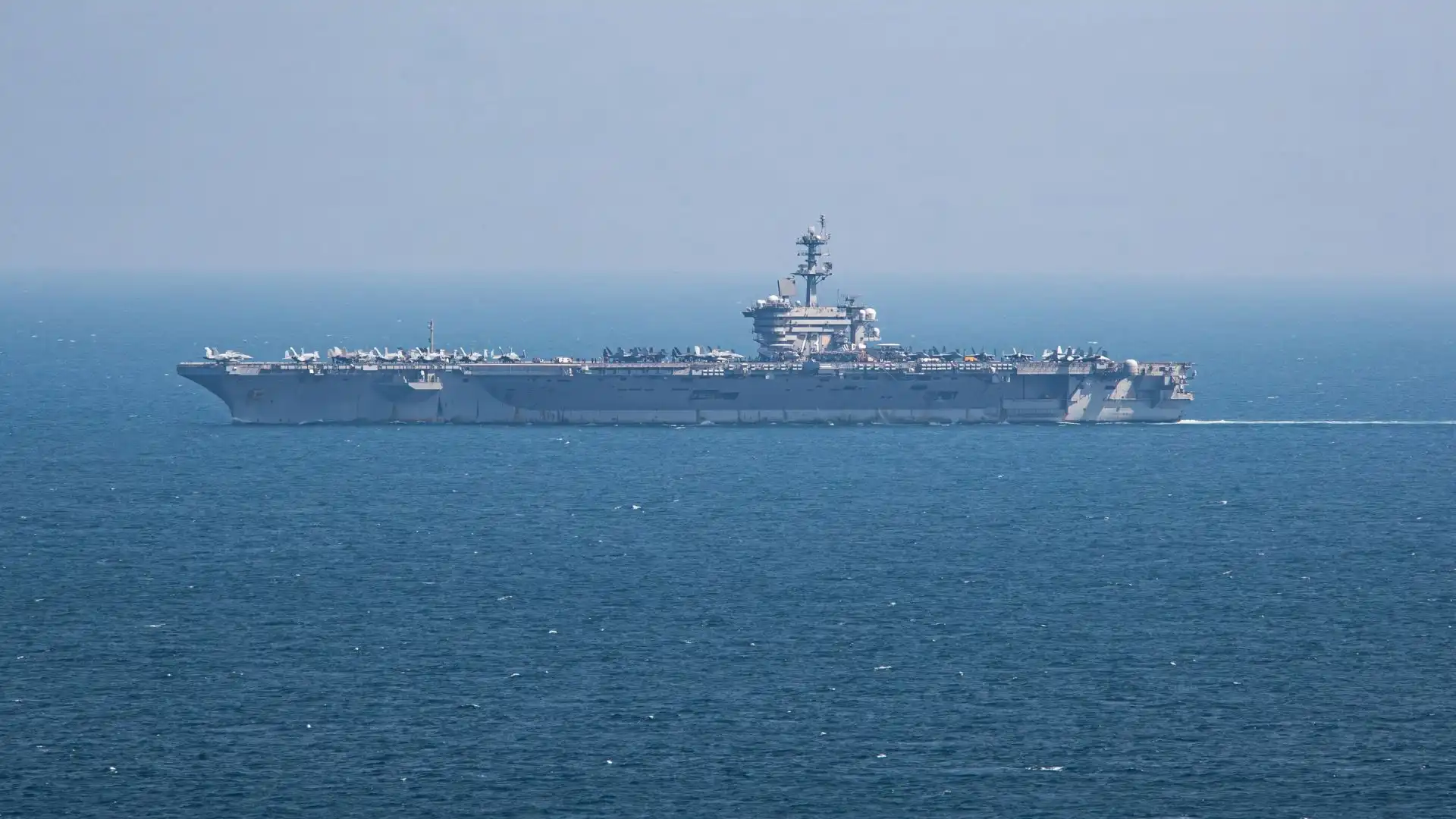
Chief of Naval Operations (CNO) Adm. Daryl Caudle told military leaders and industry partners at the U.S. Navy Memorial’s Fantail Breakfast in Washington, D.C., on October 26, 2026, that the service’s future edge depends on its ability to “adapt faster than the threat and endure longer than the fight.” He called for software, modularity, and uncrewed systems to reach the fleet at production scale, sustained investment in Sailor quality of service, and a force generation model no longer anchored to the carrier strike group.
The address builds on the U.S. Navy Fighting Instructions, which Caudle released at the Naval War College in Newport, Rhode Island, on February 9, 2026. That framework introduced a Hedge Strategy built on Tailored Forces and Tailored Offsets, scalable combinations of platforms and capabilities matched to specific operational problems. Caudle, a career submariner sworn in as the 34th CNO on August 25, 2025, followed the breakfast with the Navy Memorial’s SITREP Speaker Series, which for the first time took questions from in-person and online audiences in the same session.
CNO Caudle Presses Industry to Field Software-Defined Capability Faster
Caudle framed his vision around two words, adaptation and endurance. “Our advantage cannot depend on getting every prediction right,” he said. The fleet must instead reconfigure itself as problems change, a requirement that places as much weight on the industrial base as on operational commands.
The discussion centered on a highly responsive industrial base and a robust foundry of manufacturing capacity, echoing the Foundry, Fleet, and Fight construct Caudle set out in his first message to the force in August 2025. He called for closer work with industry partners to move commercial technologies, open architectures, and software-defined capabilities into deployed units.
“Innovation that cannot transition to the Fleet, scale in production, or be sustained in combat is not yet the warfighting advantage we need,” Caudle said. “Speed is a weapon. And in the next fight, the side that can translate learning into fielded combat power faster will create advantages its adversary struggles to overcome.”
The statement sets a three-part test for industry: transition, production scale, and combat sustainment. A successful demonstration no longer clears the bar on its own. The emphasis on modularity matches the containerized capability campaign plan Caudle launched in March 2026 to field modular weapons and payloads on existing hulls without lengthy overhauls. The Navy announced no new contracts, funding lines, or programs at the event.
Total Sailor: Fit to Fight Metrics Behind the Endurance Argument
On endurance, Caudle cited measurable results from the Total Sailor: Fit to Fight and quality-of-service initiatives. Wi-Fi coverage in unaccompanied housing stands at 90 percent and is expanding to 100 percent. Galley food service satisfaction rose from 56 percent to 80 percent after pilot improvements. The number of junior Sailors living aboard ships in homeport has dropped by more than 80 percent.
That last figure tracks Caudle’s first C-Note to the fleet in September 2025, in which he directed Navy leadership to take the steps needed to ensure that no Sailor lives afloat and rebranded the earlier Culture of Excellence initiative as Total Sailor: Fit to Fight. The Navy has not published the baseline number of Sailors living aboard, the scope of the galley pilot, or a completion date for full Wi-Fi coverage, which limits independent assessment.
“Ships do not generate combat power by themselves. People generate combat power,” Caudle said. “Quality of service is not separate from readiness. It’s foundational to our ability to recruit, retain, develop, and sustain the people we send into harm’s way.” The logic is operational: a fleet adding uncrewed systems and modular payloads needs experienced operators and maintainers, making retention of technical ratings a readiness variable.
Tailored Force Packages Beyond the Carrier Strike Group Model
During the SITREP question-and-answer session, Caudle challenged the default reliance on carrier strike groups. “For decades, our normal force generation model has been centered around strike groups. So, you lived in a have and have-not, a poor man rich man problem. A one or a zero,” he said. “Could the Navy do more than a one or a zero? And of course it can.”
Using U.S. Southern Command (SOUTHCOM) as an example, Caudle said a package for maritime domain awareness might combine uncrewed systems, Littoral Combat Ships (LCS), afloat forward staging bases, and U.S. Coast Guard integration instead of a carrier strike group. The Navy currently fills the afloat forward staging role with its Lewis B. Puller-class expeditionary sea base ships.
In October 2025, the USS Gerald R. Ford (CVN 78) Carrier Strike Group was redirected from Europe to the Caribbean, entering the SOUTHCOM area of responsibility on November 11 in a rare carrier deployment to the region, days before the Pentagon announced Operation Southern Spear. Caudle’s alternative assigns lower-end hulls, uncrewed sensors, and Coast Guard cutters to a detection and tracking mission, preserving carrier availability for high-end contingencies.
Analysis: The remarks expose the dependency chain behind the Hedge Strategy. Tailored packages relieve pressure on the carrier force only if three conditions hold together: industry fields modular, software-defined payloads at production scale; the fleet retains the Sailors needed to run a more heterogeneous force; and combatant commanders accept packages sized to their problem rather than to maximum capability. Caudle addressed all three in one appearance, treating them as a single problem. Naming the LCS in the SOUTHCOM example is also telling. It gives a defined mission to a class the Navy has partly retired early, suggesting tailored forces may become a way to extract value from lower-end hulls while carriers stay available for high-end deterrence.
Caudle said at the Surface Navy Association’s annual conference in January 2026 that the Navy still has to define what tailored force packages look like and how to certify them. The next markers include results from the first deployment of an uncrewed surface vessel alongside a carrier strike group, which got under way with the USS Theodore Roosevelt (CVN 71) Carrier Strike Group on October 8, 2026, Fiscal Year 2027 funding for uncrewed and modular systems, and whether SOUTHCOM formally adopts a tailored package in place of large-deck presence. The Navy set no timeline for those decisions.