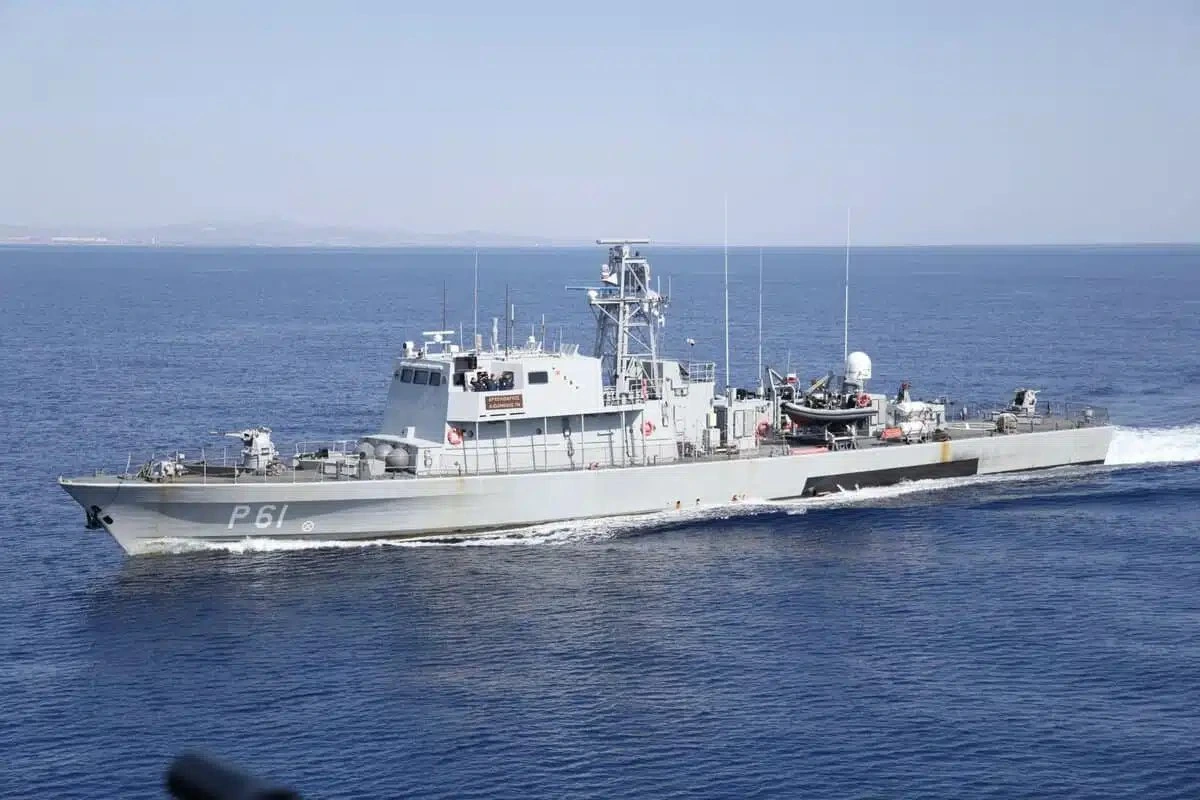
Cyprus will receive a new offshore patrol vessel (OPV) from Israel under a government-to-government agreement signed in Cyprus on October 26, 2026. Israel Shipyards will build the ship and Rafael Advanced Defense Systems will supply its naval systems, while a parallel package will upgrade the systems aboard the Cyprus Naval Command’s existing Israeli-built OPV, Commodore Andreas Ioannides (P61).
Israeli Ministry of Defense (IMOD) Director General Maj. Gen. (Res.) Amir Baram signed the deal with Stelios Kountouris, Acting Permanent Secretary of the Cyprus Ministry of Defence. The contract was negotiated by the IMOD International Defense Cooperation Directorate (SIBAT) and the Cypriot ministry’s Armaments and Defence Capabilities Development Directorate. Neither government disclosed the contract value, the vessel’s configuration or a delivery schedule. Israeli financial press reported days before the signing that the package was worth approximately €150 million. Cypriot Defence Minister Vasilis Palmas confirmed the purchase in remarks to state broadcaster CyBC reported on October 23, saying the new ship would be similar to the Ioannides and would give the navy two such vessels.
How the New Cyprus Offshore Patrol Vessel Builds on the OPV 62
The reference point is P61, an OPV 62 built by Israel Shipyards at Haifa Bay. Cyprus ordered the ship in December 2015 under a contract valued at tens of millions of euros. It was launched in September 2017 and commissioned on January 15, 2018, at the Evangelos Florakis Naval Base. The OPV 62 design is based on the Israeli Navy’s Sa’ar 4 and Sa’ar 4.5 missile boats and is also in service with Equatorial Guinea, Honduras and the Azerbaijan Coast Guard.
Publicly available specifications indicate a length of 61.8 meters, a beam of 7.62 meters, a draught of 2.77 meters and a standard displacement of 430 tonnes. Three diesel engines driving three shafts give a top speed of 32 knots, and open-source data list an endurance of 3,200 nautical miles at 16 knots. The ship carries a crew of 30 plus a special forces team.
As delivered, P61 carries two Rafael Typhoon stabilized naval weapon stations, a surveillance radar, electro-optical payloads, satellite communications and a command-and-control suite. That fit is sized for constabulary patrols across the Cypriot exclusive economic zone (EEZ), the mission Nicosia assigned the ship, with maritime and energy security as stated priorities. It gives the ship no anti-ship missile or air defense capability.
If the minister’s description holds, the new vessel will be a second OPV 62 hull, giving the Cyprus Naval Command common training, spares and maintenance across two ships. Whether Israel Shipyards will introduce design changes has not been disclosed.
Rafael Systems and the Commodore Andreas Ioannides Upgrade Package
The IMOD statement refers only to “a range of Rafael naval systems” for the new ship. Rafael’s naval portfolio for vessels of this size includes the Typhoon family of remote weapon stations, the Typhoon MLS NLOS launcher for Spike NLOS missiles, electro-optical sensors and decoy systems. A second OPV 62 that Cyprus reportedly ordered in late 2018 was specified with a Typhoon MLS NLOS system and an early 2020 delivery target, yet open-source fleet records show only P61 in Cypriot service. Whether the 2026 ship revives that missile configuration is unconfirmed.
The scope of the P61 upgrade is equally undefined. The ship’s sensors, weapon stations and command-and-control suite date from its original outfitting, and neither ministry has specified which systems will be replaced or when the vessel will be withdrawn from service for the work.
The deal extends an established supplier pattern. Cyprus displayed the Israel Aerospace Industries Barak MX air and missile defense system at its independence anniversary parade in Nicosia in early October 2026, and Nicosia agreed in 2023 to acquire Spike LR2 anti-tank missiles from EuroSpike, the consortium of Rafael, Diehl and Rheinmetall.
Analysis: The contract is modest in tonnage, but it shows Cyprus building its naval force around a single foreign supplier chain at the same time as Greece, its principal security partner, commits €3 billion to Israeli air defense under the Achilles Shield agreement signed in August 2026. A two-hull OPV force does not alter the naval balance with Türkiye, whose frigates and corvettes operate in the same waters. It does, however, let Nicosia sustain an armed presence over its EEZ blocks and offshore energy assets through maintenance cycles, something a single ship cannot do. For Israel, the agreement consolidates a European Union member state as a repeat naval customer and deepens the Israel-Greece-Cyprus defense alignment in the Eastern Mediterranean.
The open questions are the contract value, the combat system fit and delivery dates for both the new hull and the P61 upgrade. Infrastructure will also set the pace: Palmas said a Greek company is preparing a study to expand the naval base to accommodate warships and submarines, with work on the base and on Andreas Papandreou Air Base expected to begin in late spring 2027.