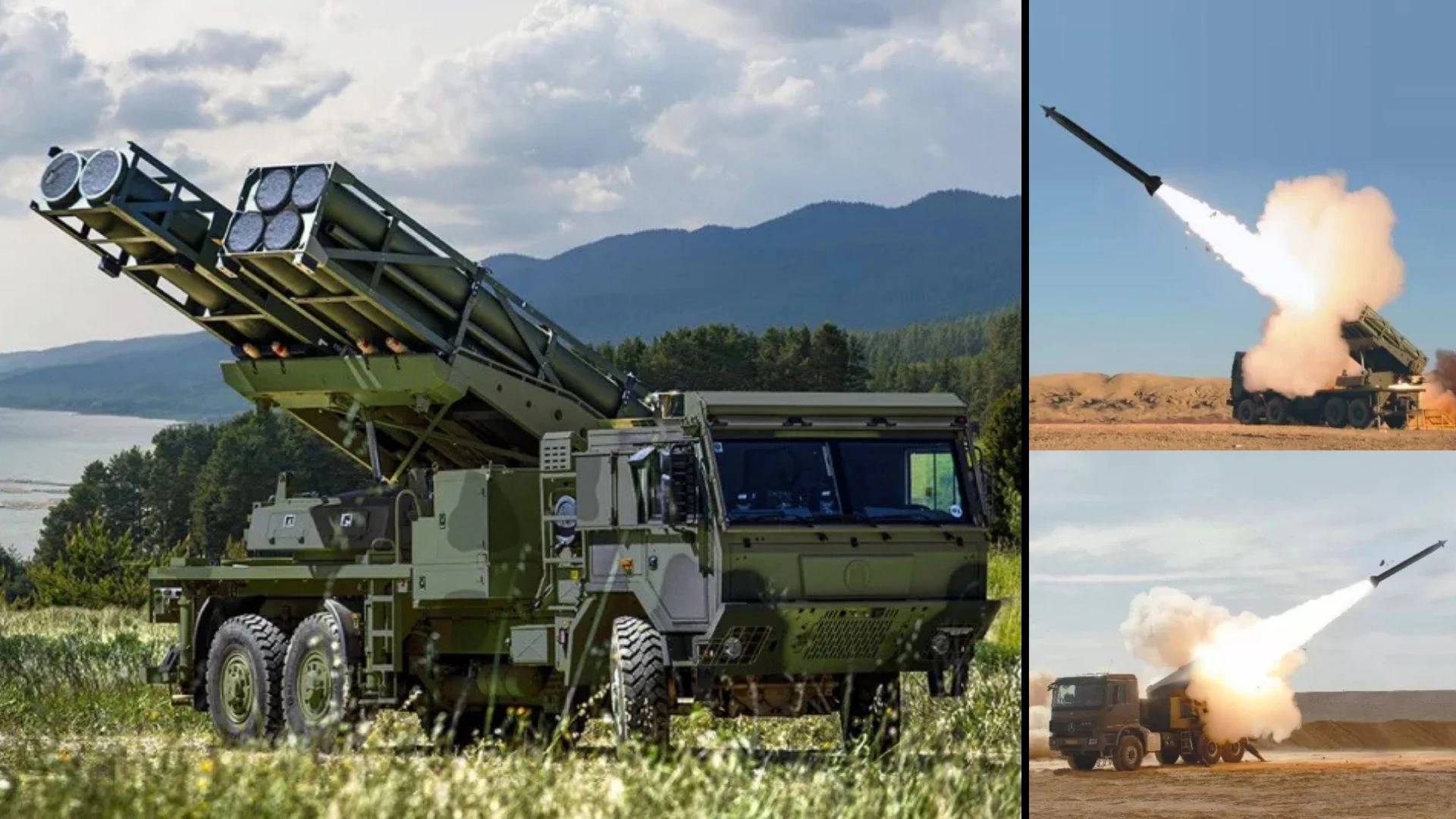
Elbit Systems has won a contract valued at approximately $235 million to supply EXTRA-MR (Medium Range) precision-guided rockets and Precise and Universal Launching System (PULS) launchers to an undisclosed European country, the Israeli company announced on October 19, 2026. The award falls under a government-to-government (G-to-G) agreement between the Israel Ministry of Defense and the customer’s defense ministry and will be performed over three years. It also covers additional rocket-artillery-related platforms and integrated logistics support.
The order lands as European armies rebuild long-range precision fires after Russia’s full-scale invasion of Ukraine, a market in which PULS has emerged as one of the leading alternatives to the US-built M142 High Mobility Artillery Rocket System (HIMARS). The Netherlands ordered 20 launchers for $305 million in May 2023, Denmark has received eight, and Germany ordered five initial operational capability (IOC) launchers as a partner under the Dutch G-to-G framework. Greece signed a deal worth roughly $750 million on April 6, 2026, and Serbia bought PULS alongside Hermes 900 drones in a $335 million package in November 2024. Spain moved the other way, cancelling its €697 million SILAM program, a PULS derivative, in September 2025.
Inside the $235 Million PULS Rocket Launchers and EXTRA-MR Package
Elbit did not name the buyer, disclose launcher or rocket quantities, identify the carrier vehicle, or publish a delivery schedule beyond the three-year performance window. Nor did the company define the “additional rocket-artillery-related platforms” in the package. That category could cover ammunition resupply vehicles, command posts or training systems, but its contents remain unconfirmed.
The G-to-G structure puts the Israel Ministry of Defense in the role of contracting counterpart, the same route used for the Dutch and Greek purchases. Unlike the Greek deal, which bundled launchers with training rockets, precision rockets of several ranges and loitering munitions, this award names a single munition type. Whether other PULS rounds fall under the logistics line or a separate contract is not stated.
At $235 million, the contract is modest against Elbit’s order backlog of $32.0 billion as of June 30, 2026, but it extends a steady run of European rocket artillery awards, including a $130 million PULS munitions order from an unnamed European customer, announced on April 1, 2025. President and CEO Bezhalel Machlis said the award “reflects the growing international demand for our advanced rocket and launcher capabilities.”
EXTRA-MR Adds an 80 km Precision Tier to PULS
Elbit describes EXTRA-MR as the medium-range variant of its supersonic EXTRA rocket family, built to engage high-value targets at ranges of up to 80 km and fully compatible with PULS and existing command, control, communications, computers and intelligence (C4I) architectures. The company has not released its diameter, mass, warhead weight or guidance architecture. Open-source reference data list the round at six rockets per pod and 12 per launcher with GPS/INS guidance; Elbit has not confirmed those figures.
The parent EXTRA provides the baseline. Per Elbit, the 306 mm rocket carries a 120 kg unitary warhead in controlled-fragmentation or penetration versions, engages targets between 30 km and 150 km with a 10 m circular error probable (CEP), and reaches maximum range in under five minutes. Publicly available specifications put its weight at about 570 kg, with four rockets per pod and eight per launcher.
If the six-per-pod figure holds, a PULS loaded with EXTRA-MR carries 12 precision rounds instead of eight, a 50 percent gain in magazine depth for targets inside 80 km. That band covers enemy artillery, air defense radars, command posts and logistics nodes, and it overlaps the US Guided Multiple Launch Rocket System (GMLRS), with a publicly cited range of about 70 km in six-round pods. EXTRA-MR closes the gap between the 40 km ACCULAR 160 and the 150 km EXTRA, so crews no longer have to expend full-range rockets on targets well inside their envelope.
Europe’s PULS Customer Base and the EuroPULS Industrial Track
Elbit’s announcement does not say whether the buyer is a returning operator or a new entrant. The company’s European PULS customer list now spans the Netherlands, Denmark, Germany, Greece and Serbia, and Elbit has kept several European customers anonymous at signing. Serbia was identified as the buyer of the $335 million PULS and Hermes 900 package only after Elbit’s November 2024 announcement.
Industrial localization is reshaping the program. KNDS Deutschland and Elbit Systems Land agreed on March 26, 2026, to form EuroPULS GmbH, a 50:50 joint venture headquartered in Kassel, Germany, to market the system to European armed forces. Diehl Defence separately agreed with Elbit in September 2024 to produce the EXTRA rocket, described as suited to GPS-degraded conditions with a range of up to 150 km, along with 122 mm training rockets for German and European customers. Neither arrangement has been publicly extended to EXTRA-MR production. Germany’s five IOC launchers are due for delivery and qualification in 2027. Berlin is also reported to be preparing a framework contract for up to 500 MARS 3/EuroPULS launchers, about half for the Bundeswehr and the rest open to allied nations, to succeed its MARS II fleet.
Analysis: EXTRA-MR is Elbit’s bid for the volume end of Europe’s precision fires market. Long-range rockets draw attention, but much of the target set for division-level fires sits inside 80 km, and that class is where GMLRS and the South Korean K239 Chunmoo already compete for European orders. A PULS-compatible round in that band lets Elbit compete on magazine depth and, by its own pitch, cost, not only on maximum range. The residual exposure is political: Spain’s SILAM cancellation showed that a signed program can still unravel over relations with Israel, a risk an anonymous announcement does nothing to remove.
The next markers are the buyer’s identity, which typically surfaces through parliamentary approvals or national procurement disclosures, and the launcher and rocket quantities behind the $235 million figure. The three-year performance window runs to roughly late 2029. Also open: whether EXTRA-MR production joins the European industrial lines forming around EuroPULS and Diehl, and whether existing operators add the round to their inventories.