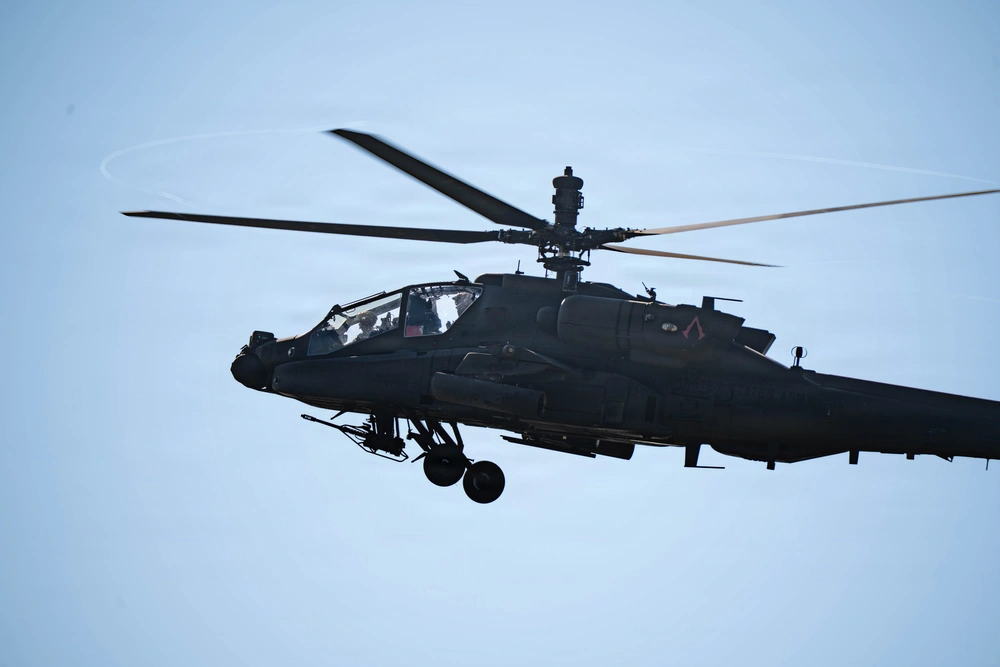
Israel’s Ministry of Defense (IMOD) signed a deal with the Pentagon on October 14, 2026, to procure 12 Boeing AH-64E Apache attack helicopters for the Israeli Air Force (IAF), with deliveries scheduled to begin at the start of the 2030s. IMOD Director General Maj. Gen. (Res.) Amir Baram instructed the ministry’s Mission to the United States to sign the agreement hours after the Israeli government approved its funding. Neither side disclosed the contract value or a firm delivery date.
The order covers 12 of the 30 AH-64Es the U.S. State Department cleared for Israel on January 30, 2026, in a Foreign Military Sale (FMS) package estimated at $3.8 billion. It targets the oldest layer of a 48-aircraft Apache force that includes 26 AH-64A Peten airframes up to 39 years old, flown at high tempo since Hamas’s October 7, 2023, attack on strike missions over Gaza and Lebanon and on drone interceptions.
Israel Apache Deal Financing and the Reported U.S. Deadline
Ministers approved the money by telephone vote that morning, transferring NIS 1.03 billion (just over $300 million) to the defense ministry for what it termed an “urgent classified procurement.” Most of the funds come from cuts to a five-year development plan for Israel’s Arab communities: NIS 169 million in 2027, NIS 342 million in 2028, and NIS 453 million in 2029.
The urgency was contractual. According to defense sources cited in Israeli reporting, Israel had already secured four extensions on the Apache agreement, the last deadline lapsed the previous week, and U.S. officials then set October 14 as the final signing date, with Israel’s production slot otherwise at risk of passing to another customer and deliveries slipping by several years.
Finance Minister Bezalel Smotrich proposed the budget transfer while opposing the purchase itself, arguing that advanced drones can fill the attack helicopter role; Prime Minister Benjamin Netanyahu insisted on the deal. The government had approved the acquisition in August on the basis of a financing plan, and Smotrich described the cut as a temporary source forced by a sudden payment requirement. The 2026 defense budget already stands at a record NIS 143 billion, about 17 percent of state spending.
“The execution of the Apache agreement was made possible thanks to creative solutions we developed together with our American partners, without compromising operational needs,” Baram said. Defense Minister Israel Katz called the purchase a “critical step in the IDF’s force buildup.” Whether the NIS 1.03 billion is the full national share or a first tranche, and what portion U.S. Foreign Military Financing (FMF) covers, remains undisclosed.
AH-64E Guardian Capabilities Versus Israel’s Aging AH-64A Peten Fleet
The AH-64E Guardian, the Apache’s current production standard, evolves directly from the AH-64D Longbow. The January FMS notification defines the configuration on offer: General Electric T700-GE-701D engines (70 for 30 aircraft, including 10 spares), AN/APG-78 Longbow fire control radars, AN/ASQ-170 M-TADS and AN/AAR-11 M-PNVS sights, AN/APR-48B Modernized Radar Frequency Interferometers, AN/AAR-57 Common Missile Warning Systems, 36 Common Infrared Countermeasure (CIRCM) sets, M-code embedded GPS/INS units, and a KOR-24A Small Tactical Terminal for Link 16.
Publicly available specifications indicate each 701D turboshaft produces roughly 2,000 shaft horsepower, paired with an upgraded face-gear transmission and composite main rotor blades that improve lift in hot conditions. The Longbow radar can detect and classify up to 256 potential targets, display 128 to the crew, and prioritize 16. Current Version 6 radar software adds a 360-degree surveillance mode, a detection range its manufacturers say is twice that of the previous version, and better detection of unmanned aerial vehicles, a direct gain for a fleet already used to hunt hostile drones. Armament remains the M230 30mm chain gun with 1,200 rounds, up to 16 Hellfire-class missiles on M299 launchers, and 2.75-inch rockets from M261 pods.
The package also lists Manned-Unmanned Teaming (MUMT) receivers and air-air-ground kits, which in U.S. Army service let Apache crews receive drone video and task drone sensors from the cockpit. IMOD has not said whether Israel will link MUMT to its own unmanned fleets.
The gap with the Peten is wide. The AH-64A, which the IAF began receiving in 1990, has no mast-mounted radar, and some airframes carry an external belly pod housing avionics added during local upgrades. The AH-64D Saraf, delivered from 2005, flies with 113 “Hornet” Squadron, while 190 “Magic Touch” Squadron operates the Peten. Twelve E-models will not replace 26 A-models one for one.
Analysis: The signing shows the IDF’s post-October 7 force design still treats the crewed attack helicopter as a core quick-reaction asset, despite ministerial arguments for drone substitution. MUMT blunts that debate, positioning the AH-64E as a node that directs drones rather than a rival to them. The harder constraint is fiscal: four reported extensions and a deadline met with money pulled from civilian programs show Israeli recapitalization is now limited less by U.S. approval than by domestic budget capacity. Losing the slot on Boeing’s Mesa, Arizona, line, which also carries large export orders such as Poland’s 96 AH-64Es, would have pushed first deliveries deeper into the 2030s.
Open questions remain: the contract value, the FMF share, and whether Israel orders the 18 remaining helicopters covered by the notification. Baram said IMOD will pursue further agreements for platforms, munitions, and interceptors. The October 27, 2026, general election will shape the next defense budget, while the current U.S.-Israel memorandum of understanding on military aid runs through fiscal year 2028.