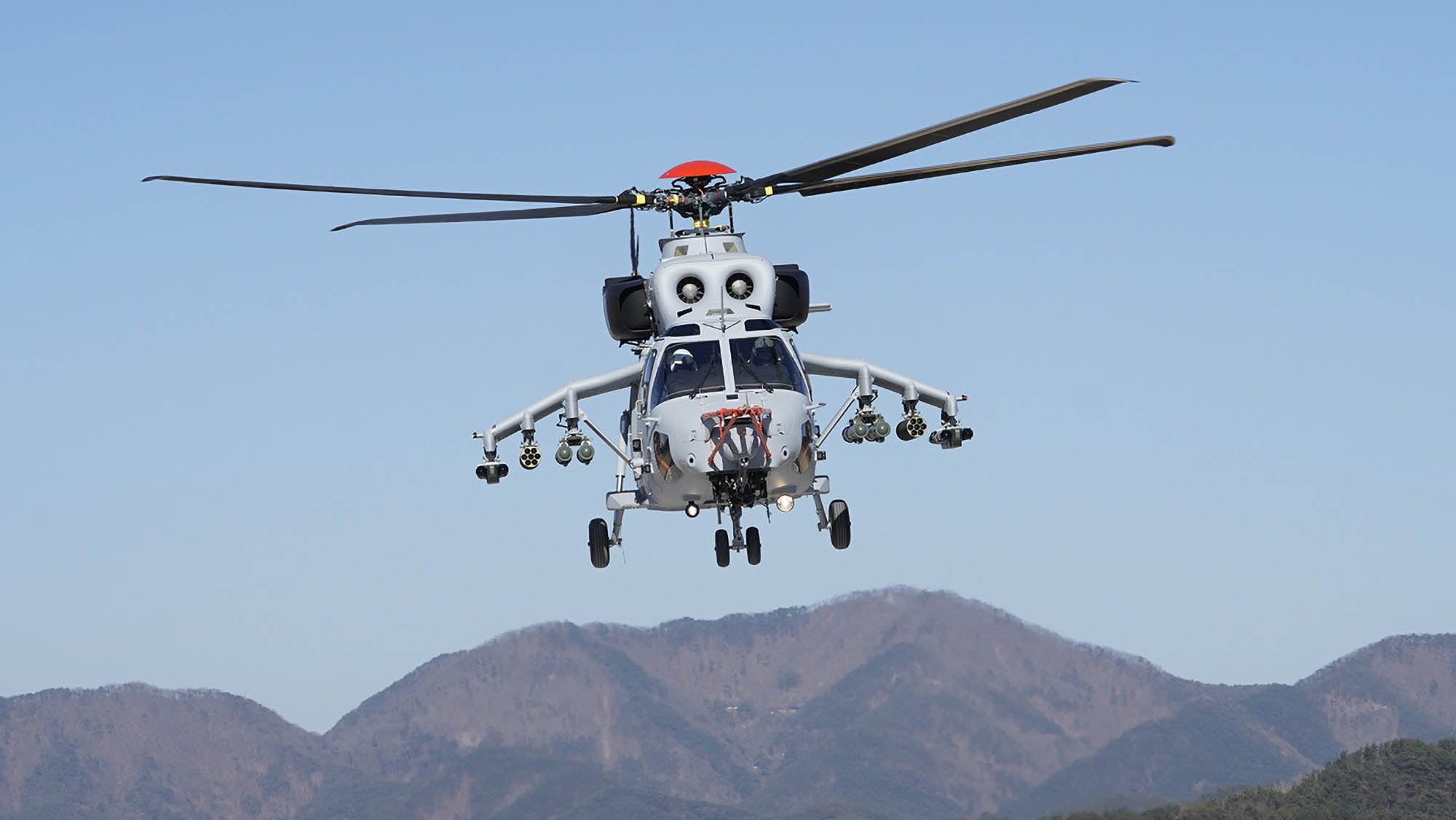
South Korea’s Defense Acquisition Program Administration (DAPA) announced on October 28, 2026 that it has completed development of the Marine Attack Helicopter (MAH), an armed derivative of the Korea Aerospace Industries (KAI) MUH-1 Marineon designed to escort assault helicopters and deliver fire support during Republic of Korea Marine Corps (ROKMC) amphibious operations. DAPA marked the milestone at KAI’s facilities in Sacheon, South Gyeongsang Province, and series production is scheduled to begin in 2027.
The program addresses a long-standing gap in ROKMC aviation. The Marineon, a navalized variant of the KUH-1 Surion utility helicopter, entered ROKMC service in 2017 for troop transport, ship-to-shore maneuver, and logistics, but the corps has lacked an organic armed escort to protect it. DAPA awarded KAI the MAH development contract in October 2022. The agency puts the program budget at around 450 billion won ($337 million), while a contract figure of 438.4 billion won ($307 million) has also been cited; the difference has not been publicly explained.
Marine Attack Helicopter Test Program From First Flight to Certification
The MAH flew for the first time in December 2024, and DAPA has said that KAI built three prototypes in 2024. DAPA said the aircraft subsequently completed weapons-firing, shipboard operations, and environmental test campaigns. Live-fire trials covered the turret-mounted gun, air-to-ground missiles, and guided and unguided rockets, and according to DAPA demonstrated the helicopter’s ability to engage both ground and airborne targets.
The maritime portion of the campaign carried as much weight as the weapons work. DAPA said the trials validated the corrosion resistance and shipboard operating capability required for sustained operations at sea, a baseline requirement for an aircraft that will operate alongside Marineons from amphibious shipping.
The MAH was assessed as suitable for combat in July 2026, when its military specifications were formally established. Airworthiness certification followed in August 2026. Reusing a certified, in-service airframe held the cycle from contract award to development completion to four years.
Stub Wings, Chin Gun, and Cheongeom: Inside the MAH Configuration
The MAH retains the Marineon’s medium-class airframe and, according to KAI, shares 96 percent commonality with the MUH-1, which the company says reduces program cost and improves operational capability. The armed conversion adds stub wings for external stores, a nose-mounted targeting system, and a chin-mounted gun. According to specifications KAI previously provided to Janes, the aircraft has a maximum takeoff weight of 8,709 kg, measures 19 m in length with rotors turning, stands 5 m high, and spans 6.1 m across the stub wings. The main rotor diameter is 15.8 m. Publicly available specifications for the Surion family indicate power from two GE Aerospace T700-701K turboshafts, assembled and tested in South Korea by Hanwha Aerospace; DAPA has not published powerplant data specific to the MAH.
The weapons suite mirrors that of KAI’s LAH-1 Miron light armed helicopter, in Republic of Korea Army service since December 2024: a 20 mm Gatling-type chin gun, 70 mm guided and unguided rockets, MBDA Mistral missiles in the Air-to-Air Mistral (ATAM) configuration, and the Cheongeom air-to-ground missile, also known as TAipers. Developed by the Agency for Defense Development and produced by Hanwha Aerospace, Cheongeom weighs 35 kg, has a 150 mm diameter, and carries a tandem high-explosive anti-tank warhead. It pairs an electro-optical and infrared dual-mode seeker with a fiber-optic datalink for operator-in-the-loop updates, and publicly available data indicate an effective range of about 8 km. The missile completed final certification testing in March 2026.
The LAH carries up to four Cheongeom rounds. The War Zone (TWZ) has reported, citing earlier reports, that the larger MAH can carry up to eight in four-round clusters, though DAPA has not confirmed a standard loadout. Weapons commonality with the Army’s LAH fleet gives the ROKMC an existing munitions supply chain and integration baseline, removing a major source of cost and schedule risk.
Escort, Fire Support, and Counter-Drone Roles for ROK Marine Aviation
DAPA defines the MAH mission set in three parts: escorting Marineon helicopters during amphibious operations, providing fire support to marines ashore, and countering enemy helicopters and drones. The Mistral air-to-air missile and the turreted 20 mm gun give the aircraft a layered response to rotary-wing and unmanned threats.
The design carries inherent trade-offs. As a utility-derived platform with side-by-side cockpit seating, the MAH does not offer the maneuverability, narrow frontal profile, or protection of a purpose-built tandem-seat attack helicopter such as the Boeing AH-64E Apache, which the Republic of Korea Army operates. The MAH is cheaper than an imported dedicated attack helicopter, but how it performs in a dense air defense environment remains an open question.
Sustainment is already being structured around the shared airframe. On October 8, 2026, KAI signed a 1.145 trillion won performance-based logistics contract with DAPA covering the MUH-1 fleet through December 2031. With 96 percent commonality, much of that support architecture should carry over to the MAH.
Analysis: The MAH follows the logic the US Marine Corps applied with its UH-1Y and AH-1Z pairing, which share more than 84 percent of components according to publicly reported program data: minimize the logistics footprint aboard space-constrained amphibious ships by building lift and escort aircraft on a common backbone. Seoul has pushed that principle further, deriving its attack helicopter directly from the transport it protects. The approach buys affordability, rapid fielding, and a domestic industrial loop linking KAI airframes with Hanwha-built munitions. The cost is survivability margin. Against North Korea’s layered short-range air defenses and growing drone inventory, the MAH’s combat value will depend less on its airframe than on its sensors, standoff weapons, and integration with the ROKMC’s wider surveillance network.
Series production is set to begin in 2027. Production figures differ: DAPA has said it plans to build some 20 aircraft, while Asian Military Review has reported around 24 airframes, with deliveries completed by 2031. The production contract value, unit cost, designation and performance of the nose-mounted targeting system, and any defensive aids suite have not been disclosed. The next milestones are a production contract award to KAI and first delivery to the ROKMC.