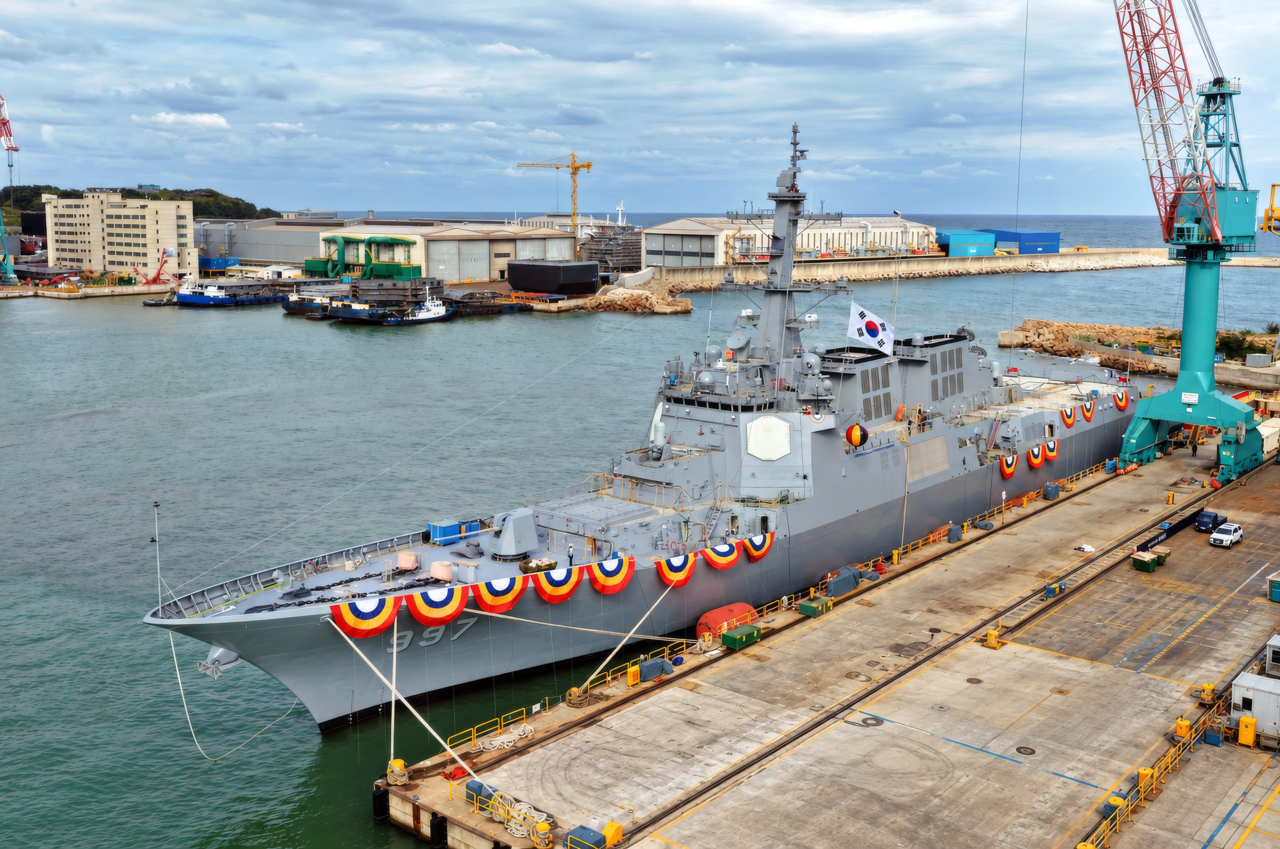
HD Hyundai Heavy Industries (HD HHI) launched Daeho Kim Jong-seo, the third and final KDX-III Batch-II Aegis destroyer for the Republic of Korea Navy (ROKN), at its Ulsan shipyard on September 30, 2026. President Lee Jae Myung attended the ceremony with about 350 government, military and industry officials. The 8,200-ton warship now begins outfitting and sea trials ahead of a scheduled December 2027 delivery.
The launch closes hull construction for the Jeongjo the Great class, a three-ship program HD HHI has built under contracts awarded by the Defense Acquisition Program Administration (DAPA) since October 2019. Lead ship ROKS Jeongjo the Great (DDG-995) was commissioned in November 2024, and Dasan Jeong Yak-yong (DDG-996), launched on September 17, 2025, is due to join the fleet by the end of 2026. Once the third ship delivers, the ROKN will operate six Aegis destroyers, adding three Batch-II hulls to the three Sejong the Great-class Batch-I ships commissioned between 2008 and 2012. HD HHI built five of the six. The new ship honors Kim Jong-seo, an early Joseon-era general who pushed Korea’s northern frontier; Daeho was his pen name.
Inside the KDX-III Batch-II Destroyer: Aegis Baseline 9 and 88 Cells
Daeho Kim Jong-seo measures 170 meters long with a 21-meter beam, about 3 meters longer than the Batch-I design. The quoted 8,200 tons is a standard displacement figure roughly 600 tons above the 7,600-ton Batch-I ships; publicly available data put full-load displacement above 10,000 tons. Four gas turbines combined with a hybrid electric drive (HED) deliver a top speed of 30 knots, while the electric mode cuts fuel consumption and radiated noise during low-speed anti-submarine work. The crew numbers about 300.
The combat system pairs Lockheed Martin’s Aegis Baseline 9.C2, in a Korea-specific KII software variant with BMD 5 capability, with the AN/SPY-1D(V) multifunction radar. DAPA officials have credited Baseline 9 with substantially greater computing power than the Baseline 7 fitted to Batch-I ships, which matters for tracking ballistic targets through the dense littoral clutter around the Korean peninsula. HD HHI supplies the domestically developed integrated sonar suite, and the ship embarks MH-60R Seahawk helicopters and carries both long-range and lightweight anti-submarine torpedoes.
Publicly available specifications indicate 88 vertical launch cells, 40 fewer than the 128 aboard Batch-I: 48 Mk 41 cells for the Standard Missile family; 16 Korean K-VLS cells for the K-SAAM point-defense missile, the Hong Sang Eo anti-submarine rocket and the Haeryong land-attack cruise missile; and 24 larger KVLS-II cells grouped in six four-cell modules. The KVLS-II cells are sized for heavier domestic munitions, including a ship-to-surface ballistic missile, making the class the first ROKN surface combatant designed for ballistic strike. The operational status of that missile has not been publicly confirmed.
SM-3, SM-6 and the Batch-II Role in the Three-Axis System
Seoul describes the Batch-II ships as core assets of its sea-based mobile three-axis system, the maritime arm of a national strategy built on preemptive strike, Korea Air and Missile Defense (KAMD) and massive retaliation. Unlike the Sejong the Great class, which detects and tracks ballistic missiles, the new ships are designed to intercept them, adding a mobile upper tier above land-based layers such as Patriot PAC-3, Cheongung II and L-SAM. The role extends below the surface: integrated sonar, HED quieting and embarked MH-60R helicopters target a North Korean submarine force that now includes Hero Kim Kun Ok, unveiled in September 2023 as a missile-launching boat.
The interceptors trail the hulls. On April 26, 2024, DAPA approved a KRW 803.9 billion ($581 million) Foreign Military Sales (FMS) purchase of SM-3 missiles running through 2030. HD HHI materials describe SM-3 midcourse engagements at altitudes up to 500 kilometers. On May 22, 2026, DAPA’s acquisition committee finalized selection of the SM-6 in a project valued at about $352 million, targeting operational service by 2034, with Dasan Jeong Yak-yong and Daeho Kim Jong-seo named as the launch platforms. The SM-6 covers terminal-phase defense and adds anti-ship and quasi-ballistic surface attack options. DAPA has acknowledged that the SM-6 schedule slipped from an original 2023 to 2031 window.
Until those rounds arrive, the SM-2 Block IIIB, acquired through FMS, remains the class’s primary area air-defense missile. It offers no ballistic missile intercept capability, so in the interim the ships would supply tracking data while land-based batteries handle ballistic engagements.
Analysis: The Batch-II program is delivering hulls faster than the magazines that define them. With SM-3 procurement running to 2030 and the SM-6 not slated for operational service until 2034, the ROKN’s most capable missile defense ships will spend their first years primarily as sensors and cueing nodes rather than upper-tier shooters. That role still carries weight, given the US-Japan-ROK real-time missile warning data-sharing mechanism activated in December 2023. Six Aegis hulls also give planners a rotation that can typically sustain two ships on station under a standard readiness cycle. The binding constraint on Seoul’s sea-based missile defense has shifted from shipbuilding capacity to interceptor stocks and integration schedules.
Dasan Jeong Yak-yong’s delivery by the end of 2026 is the next program milestone, followed by Daeho Kim Jong-seo’s sea trials and December 2027 handover. Beyond the hulls, the decision points to watch are the first ROKN SM-3 live fire, SM-6 integration against the 2034 target, a demonstrated KVLS-II ballistic missile launch, and any confirmed retrofit of the Batch-I ships to fire SM-3 and SM-6, a plan reported since 2024.