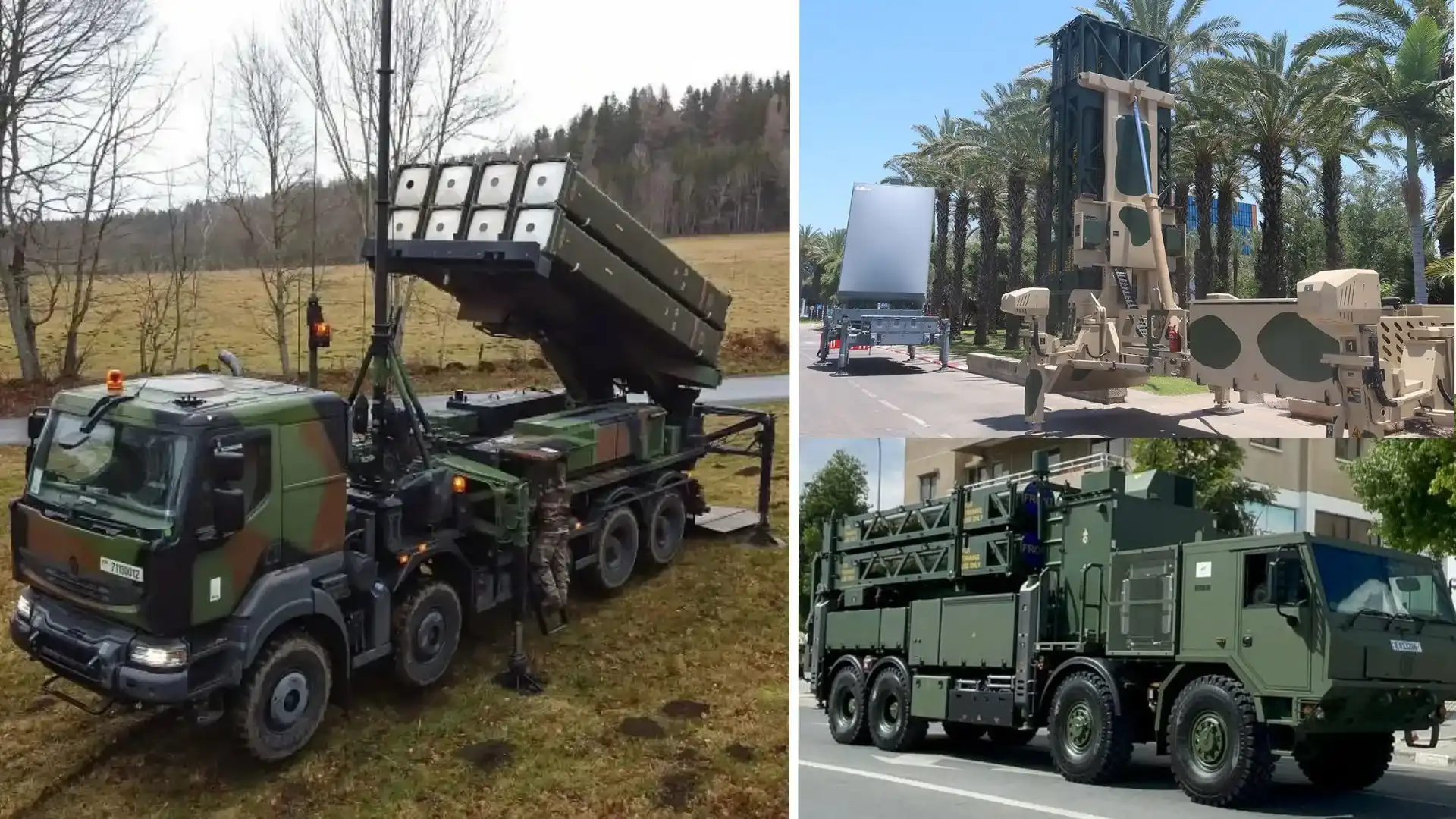
Switzerland’s Federal Council on October 28, 2026, narrowed its search for a second long-range ground-based air defense system to Israel Aerospace Industries’ (IAI) Barak MX and the Franco-Italian SAMP/T NG built by Eurosam, while confirming it will keep its existing order for the US-made Patriot. The government said the additional system must extend the area under protection and reduce Swiss dependence on a single supplier and a single supply chain.
The shortlist follows offers from four manufacturers in France, Israel and South Korea. The Federal Department of Defence, Civil Protection and Sport (DDPS) will now assess both candidates against military, technical, procurement and security criteria, as well as foreign and economic policy considerations. Bern expects to decide how to proceed in early 2027, once Parliament has ruled on military funding. The Federal Council considers a long-range ground-based layer central to Swiss air defense and impossible to replace by other means, particularly against ballistic missiles.
Patriot Delays Reshape the Swiss Air Defense Timeline
Switzerland ordered five Patriot fire units in 2022 under its Air2030 program, after the US system beat SAMP/T in a 2021 evaluation. Deliveries were planned for 2026 to 2028. Washington has since prioritized countries that supplied Ukraine with Patriot systems from their own inventories, and Urs Loher, director of armasuisse, the Federal Office for Defence Procurement, said in September that the systems would not arrive before the early 2030s. The DDPS now expects Patriot to cost between CHF 3.7 billion and CHF 6.3 billion, against roughly CHF 2 billion originally approved, as later delivery adds inflation and upgrades become more expensive.
On September 4, 2026, armasuisse announced that a bridging arrangement under which Germany would cede part of its own delivery queue had fallen through. The Federal Council nevertheless considers cancelling Patriot without an alternative unacceptable under current security conditions. Following instructions issued on June 24, 2026, Swiss officials continue to negotiate delivery terms with Washington while seeking to limit further delays and costs.
The search for a second system began on March 6, 2026, when the Federal Council directed the DDPS to examine an additional long-range system, preferably produced in Europe. Armasuisse sent requests for information to manufacturers in Germany, France, Israel and South Korea, all of which had responded by late May. By June 24, contract talks had narrowed to French, Israeli and South Korean suppliers, with Loher ruling out Israel’s Arrow. Bern has not named the two other bidders.
SAMP/T NG and Aster 30 B1NT: The European Option
SAMP/T NG is the next-generation version of the system Eurosam, the MBDA and Thales joint venture, developed for France and Italy. A firing unit carries up to 48 ready-to-fire Aster missiles across as many as six eight-round launcher modules, paired with a multifunction radar and an engagement module. The French configuration uses the Thales Ground Fire 300 radar, and Eurosam says the firing unit can detect and identify targets beyond 350 km.
The system fires the Aster 30 B1 and the newer Aster 30 B1NT. The B1NT introduces a Ka-band seeker and new interception algorithms, which the manufacturer says deliver hit-to-kill capability against short- and medium-range ballistic missiles. Eurosam gives an engagement range beyond 150 km.
For Bern, the attraction is industrial and political proximity. France has ordered 12 SAMP/T NG firing units and Denmark has signed a contract, giving Switzerland a European user base for training, munitions and spares. In February, Eurosam secretary general Jérôme Dufloux told the Swiss weekly NZZ am Sonntag that the company could deliver by 2029 if Switzerland ordered immediately. Supply hinges on Aster output, which MBDA plans to double in 2026 amid what its chief executive called very high demand.
Barak MX Interceptor Family and Its Growing European Footprint
IAI’s Barak MX takes a different approach. Developed by IAI from its Barak 8 experience, it is a multi-layered system built around a battle management center and ELM-2084 multi-mission radars. It can integrate three interceptors: the Barak MRAD, with a 35 km range and a single-pulse motor; the Barak LRAD, reaching 70 km with a dual-pulse motor; and the Barak ER, which adds a booster to reach 150 km. Together they cover threats ranging from drones and cruise missiles to ballistic targets.
The system has built export momentum in Europe. Slovakia signed a €560 million contract in December 2024 to replace its Soviet-era 2K12 Kub systems, with six batteries planned, and received its first battery in April 2026. Greece selected Barak MX alongside David’s Sling and Spyder under a €3 billion agreement signed on August 31, 2026, for its Achilles Shield network. Morocco and Azerbaijan have ordered the system, and Cyprus has reportedly deployed it.
The record is not uniform. Denmark, which selected SAMP/T NG over Patriot in September 2025, dropped plans to buy Barak MX the following month on its Defence Command’s recommendation.
Analysis: The shortlist turns Switzerland’s air defense problem into a question of supply chain resilience rather than raw capability. Both finalists cover a 150 km class engagement envelope, so the decision will hinge on delivery slots, interceptor availability, industrial participation and political exposure. SAMP/T NG ties Bern into an emerging European long-range air defense base with production in neighboring states, but depends on an Aster line MBDA is still scaling up. Barak MX offers a layered interceptor mix and a running export line, yet would rest on a non-European design unless production is localized in Europe, as Bern’s armaments policy prefers. Every option still leaves a multi-year gap before Switzerland fields an operational long-range layer.
Parliament is expected to debate the request for an additional CHF 24 billion for the armed forces during its winter 2026 session, including CHF 6 billion for the second long-range system and at least part of Patriot’s extra costs. The National Council’s refusal, disclosed on October 5, to treat the file as urgent already ruled out completing the procurement before year-end. After the vote, the Federal Council will consider a procurement proposal for the selected system and any supplementary credit for Patriot.