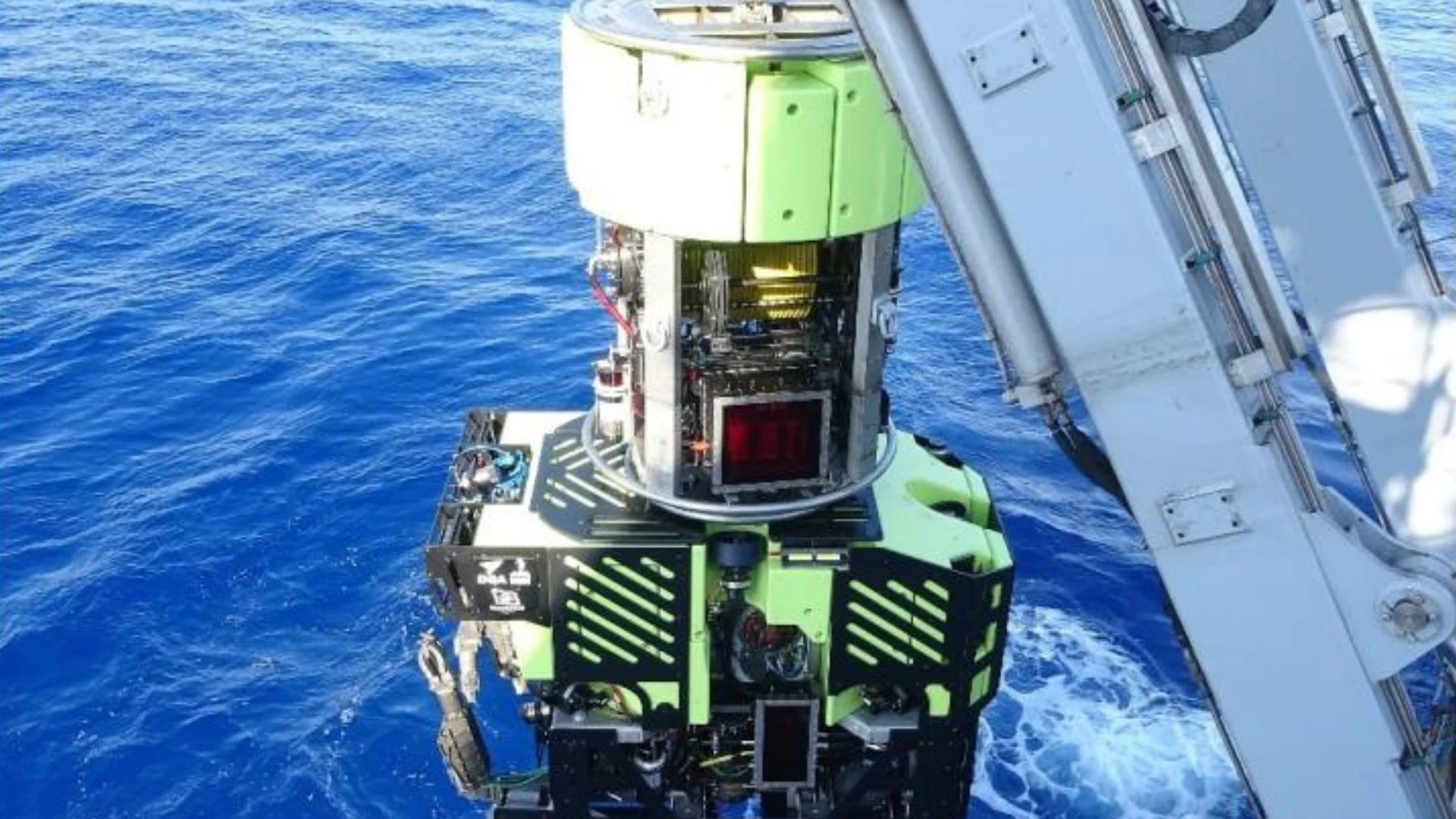
France’s Directorate General of Armaments (DGA) has completed qualification trials of the ROV-DeepSea (ROV-D), a deep-sea remotely operated vehicle developed by LD Travocean for the French Navy, after the system dove beyond 5,000 meters off Greece in September 2026. Announcing the milestone on October 29, 2026, the DGA said it is now preparing an order for a second ROV under the Navy’s seabed mastery program.
The milestone is part of the roadmap of the Seabed Mastery (Maîtrise des fonds marins, MFM) strategy, which the Ministry of the Armed Forces published in February 2022. That strategy called for the first autonomous and remotely operated vehicles able to work down to 6,000 meters by 2025 and organized the requirement around three functions: knowing the seabed, monitoring it, and acting on or from it. The gap was stark. Roughly three quarters of the ocean floor lies deeper than 3,000 meters, while the Navy’s tethered robots in service in 2022 could not operate beyond 2,000 meters.
How the French Navy ROV Reached 5,000 Meters in 21 Months
The program originated in 2023, when the General Secretariat for Investment (SGPI) assigned the DGA the development of a deep-sea ROV under the France 2030 investment plan objective dedicated to the deep seabed, a domain the ministry describes as concentrating economic, environmental, and security stakes. The DGA notified two contracts on September 27, 2024: one to Exail for an autonomous underwater vehicle (AUV), the A6K-M, derived from the Ulyx drone co-developed with the French ocean research institute Ifremer, and one to LD Travocean for the ROV.
LD Travocean is a subsidiary of shipping group LD Armateurs that specializes in subsea works, including submarine cable installation. The company designed and built the ROV-D in 21 months, a compressed schedule for a vehicle rated to abyssal depth. Qualification followed in two stages. In July 2026, a shallow-to-medium depth campaign off Toulon cleared the system to 2,500 meters. In September, the deep campaign moved to waters off Greece, where the vehicle passed the 5,000-meter mark.
DGA Techniques navales, the agency’s naval test and expertise center, conducted the trials in partnership with the French Navy. The development team also included the Navy staff and the Underwater Intervention Group (GISMER), a component of the Expert Center for Human Diving and Underwater Intervention (CEPHISMER).
ROV-DeepSea Design and Its 6,000-Meter Intervention Role
The ROV-D is rated to 6,000 meters, a depth that gives access to about 97% of the ocean floor. According to the DGA, it carries a wide range of tools and instruments and was developed specifically for the Navy’s knowledge, surveillance, and action missions on the seabed. When the contract was awarded in 2024, the ministry described it as a deep-water adaptation of LD Travocean’s compact ROV range, fitted with high-performance optics.
Key specifications remain undisclosed. The DGA has not released the vehicle’s mass, dimensions, thruster power, manipulator configuration, umbilical length, launch and recovery system, or designated host vessel. The engineering challenge is nonetheless clear from physics alone: ambient pressure at 6,000 meters approaches 600 bar, which drives the design of every pressure housing, connector, and buoyancy element on the vehicle.
The division of labor with the AUV defines the ROV’s operational value. Under the MFM architecture, the A6K-M handles the knowing and monitoring functions, mapping wide areas and detecting objects of interest autonomously. The tethered ROV-D covers the action function: close inspection of a contact, manipulation, and intervention on objects or infrastructure such as submarine cables. The pairing mirrors standard deep-sea practice, in which the AUV finds and the ROV acts. The DGA’s October 29 release did not report on the A6K-M’s own qualification status.
Analysis: The qualification gives France a sovereign intervention capability at depths the Navy could not previously reach with its own assets, at a time when undersea cables and pipelines have become a recognized vulnerability across Europe. A February 2023 parliamentary report noted that the Navy had begun leasing autonomous underwater vehicles while awaiting its own systems. Equally notable is the industrial model: by selecting a cable-laying specialist rather than a traditional defense prime, the DGA imported commercial subsea know-how and reached deep trials within two years of contract award. The ministry explicitly presents LD Travocean as a new entrant to the national defense industrial and technological base.
The next step is a second ROV, which the DGA is preparing to order under the MFM major program; no contract value, delivery date, or configuration changes have been disclosed. Several questions remain open, including the date of entry into operational service, the vessels that will deploy the system, and how both the ROV-D and the A6K-M will feed the Navy’s wider seabed mastery capability.