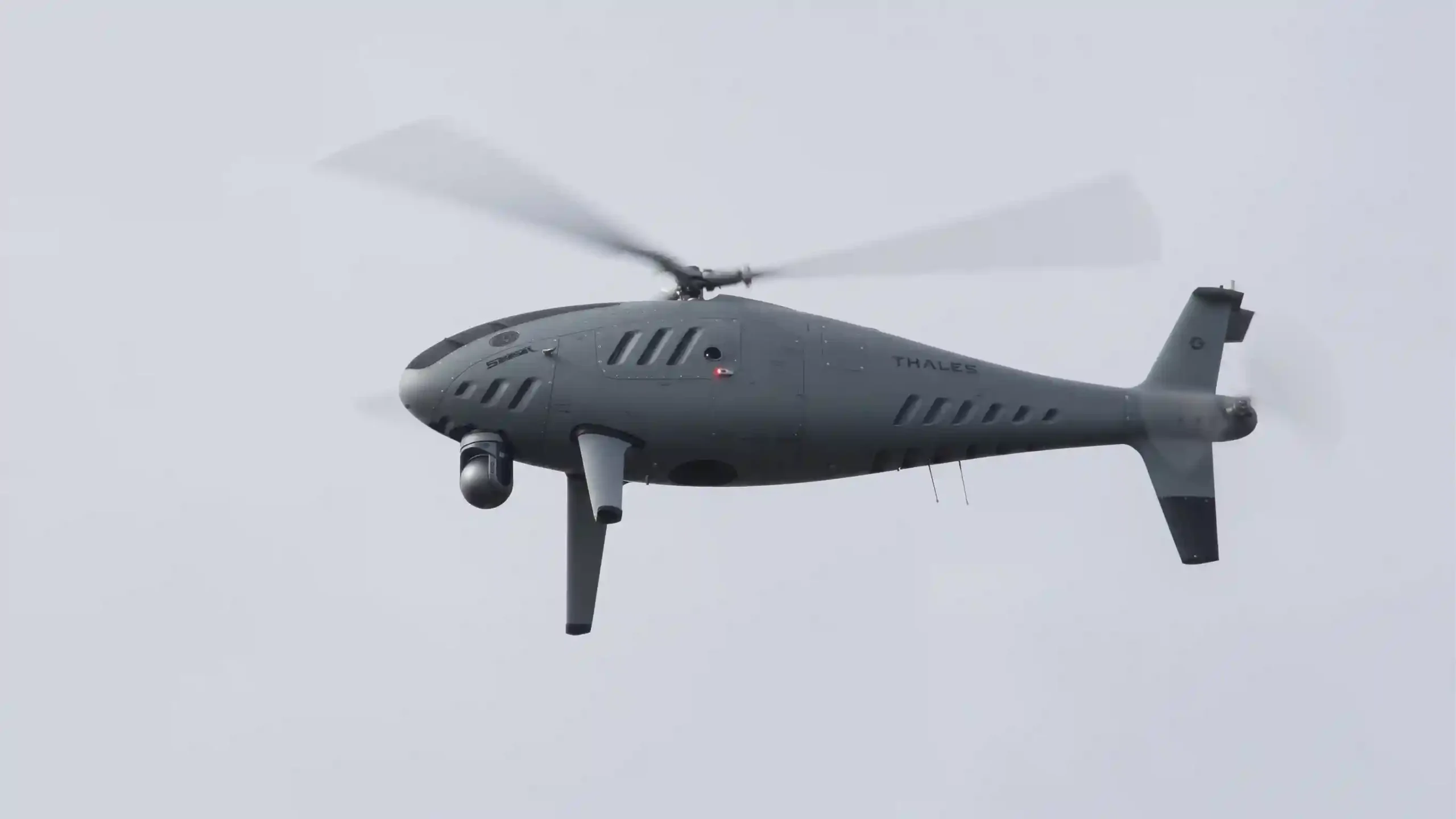
Thales UK said on October 29, 2026, that it is ready to deliver a “Minimal Deployable Capability” to the British Army under Project NYX, the programme to field autonomous uncrewed aircraft alongside the Boeing AH-64E Apache attack helicopter. The statement comes as the Ministry of Defence (MoD) prepares to narrow a four-way competition to the teams that will build prototypes.
Launched in November 2025 with UK Defence Innovation (UKDI) as delivery agent, Project NYX seeks a Land Autonomous Collaborative Platform able to support Apache crews in reconnaissance, target acquisition, precision strike and electronic warfare in contested airspace. The MoD shortlisted seven companies in January 2026, then on May 15, 2026, retained Anduril UK, BAE Systems, Tekever and Thales UK, which share £10 million in concept development funding. Up to two vendors are expected to be selected in autumn 2026 to develop prototypes, and an initial operational capability is targeted around 2030.
How Thales and Schiebel Are Positioning for Project NYX
The October 29 statement is framed around delivery risk rather than new hardware. Thales cites more than 20 years of experience in integrated uncrewed air systems (UAS) and 200,000 combined flight hours, and says it would field an initial core system and mature it through spiral development. The company does not specify what the Minimal Deployable Capability would include, nor how the flight-hour figure is distributed across programmes.
Thales points to two references. The first is the Royal Navy’s Peregrine programme, awarded in February 2023, under which Thales acts as lead systems integrator for a Schiebel Camcopter S-100 fitted with the Thales I-Master radar, operable in synthetic aperture radar and maritime moving target indication modes, for Type 23 frigate operations. The second is unspecified deployments in the Gulf region. On that basis, Thales says it has delivered complex rotary-wing weapons integration in under eight months, without identifying the platform or customer.
Industrial weight is the third pillar. Thales says the offer is backed by more than 200 UK suppliers and over £500 million of annual UK spend. Its UK uncrewed heritage also includes the Watchkeeper WK450, contracted in 2005 and now scheduled to leave British Army service in March 2027.
Camcopter S-301 Specifications and the Apache Teaming Problem
Thales and Schiebel confirmed in May 2026 that their NYX bid is built around the Camcopter S-301, unveiled at DSEI 2025 as the militarized derivative of the S-300. Manufacturer data lists a maximum takeoff weight of 700 kg, up to 350 kg of payload including fuel, endurance of up to 24 hours with a 50 kg payload or roughly six hours with 250 kg, a datalink range of up to 200 km and a never-exceed speed of 120 knots.
The armed configuration carries two Thales FZ602 launchers firing 70 mm FZ275 semi-active laser-guided rockets, giving the aircraft an organic designate-and-strike capability. At Eurosatory in June 2026, Thales added an electromagnetic spectrum operations package with electronic support measures and a land-oriented sensor fit, and indicated that a radio frequency jammer could follow. That payload mix maps directly onto the NYX task list: find, fix, jam and strike ahead of the crewed aircraft.
Speed is the integration question. Boeing lists the AH-64E’s maximum level flight speed at more than 150 knots, meaning a rotorcraft wingman limited to 120 knots would need to pre-position or work a forward screen rather than escort in formation. NYX’s “commanded not controlled” doctrine, in which crews assign objectives rather than fly the drone, partly accommodates that gap, but transit speed will still shape tactics.
Analysis: Thales is selling maturity in a competition that also includes clean-sheet bids, notably Anduril UK’s self-funded hybrid-electric design developed with Archer Aviation and GKN Aerospace. The MoD faces a choice between a derivative of a fielded rotorcraft family with a weapons integration record and newer architectures that promise more growth but carry more schedule risk. Thales’s sovereignty argument rests on UK integration, mission systems and supply chain, since the S-301 airframe is Austrian; how the MoD weighs that definition of sovereign capability may prove as decisive as performance.
The immediate milestone is the autumn 2026 down-select, which had not been publicly announced at the time of writing. Selected teams will move into prototype development, with the concept demonstration phase due to conclude in early 2028. Open questions remain on the contents of the Thales Minimal Deployable Capability, the cockpit interface Apache crews will use to task their wingmen, and the scale of any follow-on production award.