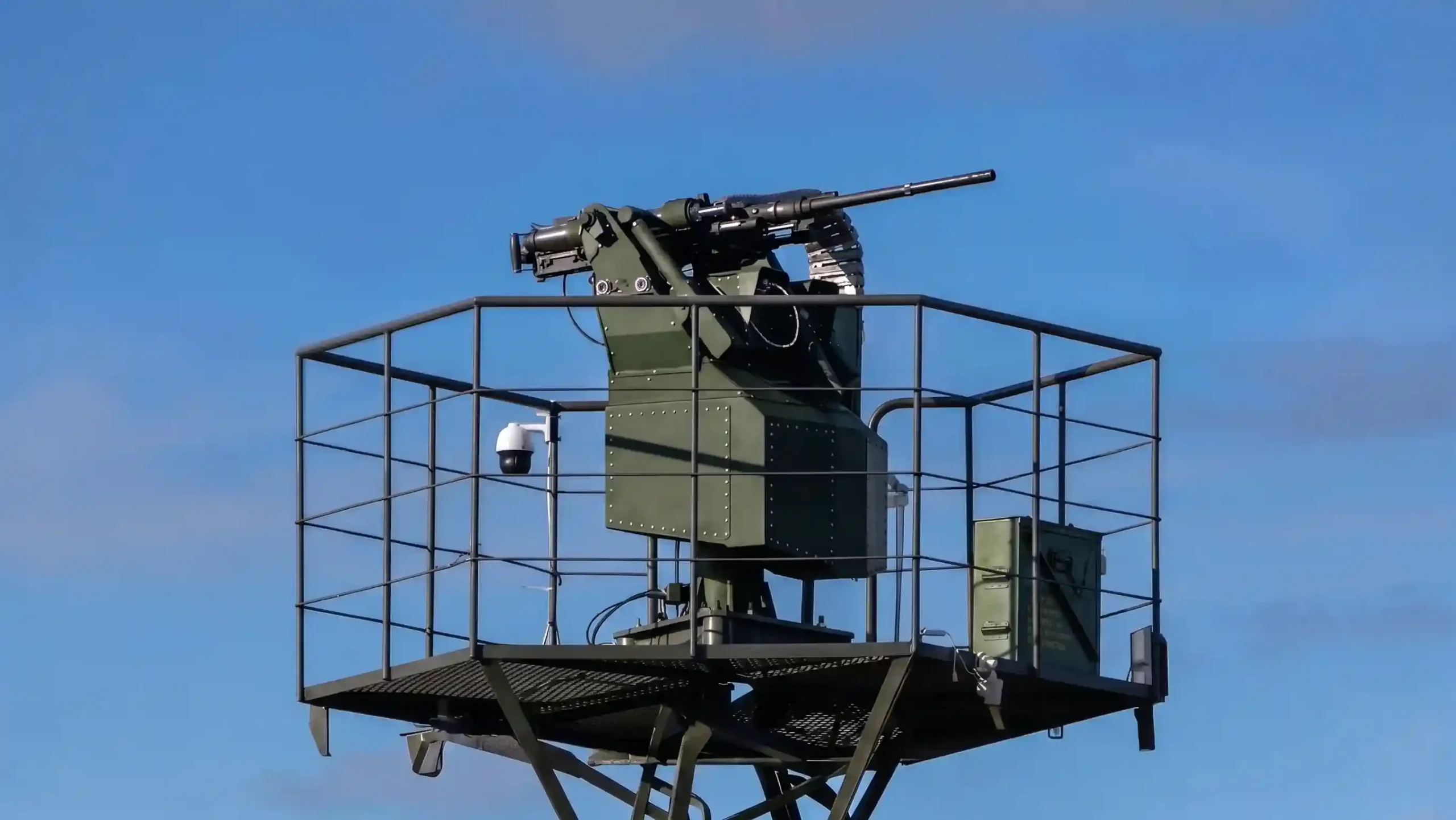
Automated gun turrets operating under Ukraine’s Private Air Defense initiative have destroyed more than 60 aerial targets, the Brave1 defense innovation cluster and Ukraine’s Ministry of Defense announced on October 29, 2026. The systems also brought down dozens of Russian unmanned aerial vehicles (UAVs) over Kyiv in the past month alone, while turrets in Ukrainian Air Force service are engaging jet-powered S8000 Banderol munitions and Geran-5 attack drones.
The announcement marks a status change for a capability Brave1 began developing in 2024, which the cluster now describes as no longer an experimental technology but an integral part of Ukraine’s air defense network. The timing matters. Russia has shifted a growing share of its long-range strike mix from piston-engined Shahed-type drones to turbojet-powered weapons flying at up to 650 km/h, compressing reaction windows for the mobile fire groups and interceptor drones that carried Ukraine’s lower-tier defense through 2024 and 2025. According to President Volodymyr Zelensky, Russia launched more than 2,100 missiles and 63,000 attack drones against Ukraine in the first nine months of 2026.
How Private Air Defense Groups Field Automated Turrets
The Private Air Defense project rests on Cabinet of Ministers Resolution No. 1506 of November 19, 2025. It allows companies, regardless of ownership structure, to finance and equip their own air defense groups to protect personnel, production sites, and energy facilities that Russian drones target repeatedly. Crews consist of trained civilian employees holding the required certifications and clearances, and may include personnel not subject to mobilization. They do not operate independently: each group employs designated assets only within sectors and time windows approved by the Air Command of the Ukrainian Air Force.
Uptake has accelerated through 2026. Private groups began flying combat missions in spring. The ministry counted 24 participating companies in April and 30 with formal authorization by June 8. More than 80 firms were approved by mid-September, and nearly 100 had joined by mid-October, spanning critical infrastructure operators, logistics and manufacturing groups, and licensed security providers. Under rules introduced in March 2026, participants can also temporarily receive military air defense equipment.
Sky Sentinel Fire Control and Engagement Parameters
Neither Brave1 nor the ministry has specified which turret models account for the 60-plus kills. The best documented system in this role is Sky Sentinel, a turret running Ukrainian-developed fire-control software and fielded in the private air defense role by operators including Carmine Sky. More than 12 Sky Sentinel turrets are on combat duty around Kyiv, and Zelensky said in early October that eight more were planned for the capital region. On October 19, he said Ukraine was increasing turret orders.
Publicly available specifications indicate that Sky Sentinel is built around the 12.7mm M2 Browning heavy machine gun on a mount capable of 360-degree rotation. Radar data cues the turret, an electro-optical tracker acquires the target, and onboard software computes speed, trajectory, wind correction, and the required lead, while machine vision separates drones from birds. The operator, who can sit at a remote post, monitors the engagement and authorizes fire rather than aiming manually. The developer reports engaging test targets at roughly 800 km/h. Unit cost is about $150,000, and the developer estimates 10 to 30 turrets are needed to cover one city. A vehicle-mounted variant fielded by the 1021st Anti-Aircraft Missile and Artillery Brigade surfaced on October 26, 2026.
Banderol and Geran-5 Jet Threats Compress the Engagement Window
Those parameters matter against the two threats Brave1 named. The S8000 Banderol, built by Russia’s Kronshtadt Group, is a jet-powered hybrid of loitering munition and cruise missile driven by a Chinese Swiwin SW800Pro turbojet, with a reported range of about 500 km and a warhead of up to 150 kg. Ukrainian intelligence assesses Russian output at up to 80 per month. The Geran-5, first identified in January 2026, abandons the Shahed delta wing for a cylindrical fuselage roughly 6 meters long, a wingspan of up to 5.5 meters, a Telefly TF-TJ2000A turbojet rated at 200 kgf, a 90 kg warhead, and a range of 950 to 1,000 km, according to Ukrainian intelligence assessments.
The Geran-5 flies at up to 600 km/h and the Banderol at up to 650 km/h, roughly 167 to 180 meters per second. Against an M2 effective envelope of about 1.5 km versus aerial targets, that leaves an engagement window of roughly eight to nine seconds on an inbound track. Gunners with manual sights struggle inside that window; automated tracking and ballistic computation are what keep a heavy machine gun relevant against it. Air Force spokesperson Yurii Ihnat confirmed on October 5 that turrets had downed jet-powered drones, including the Geran-5.
Analysis: The significance lies less in the 60-plus tally than in the cost and manpower arithmetic behind it. A reusable $150,000 turret firing 12.7mm ammunition competes against Banderols estimated at $50,000 to $150,000 each and jet Gerans assessed at $100,000 to $200,000, an exchange rate surface-to-air missiles cannot match. By shifting terminal point defense onto privately financed, civilian-crewed systems under military command, Kyiv is building a lower tier that scales without new conscripts and preserves Patriot, NASAMS, and IRIS-T interceptors for ballistic and cruise missiles. The model has limits: kilometer-scale envelopes make turrets a last line of defense, and every protected site needs its own coverage. For NATO planners weighing how to defend dispersed infrastructure against mass-produced jet drones, it is a template worth close study.
Brave1 and the ministry say they will keep expanding turret deployment nationwide. Key unknowns remain turret production rates, the breakdown of kills by system and by private versus military operator, and how turrets will cope as Russia pushes jet-drone speeds toward the 750 km/h some Ukrainian analysts expect. The next ministry update on private air defense participation will show whether the program can keep pace with Russian output.