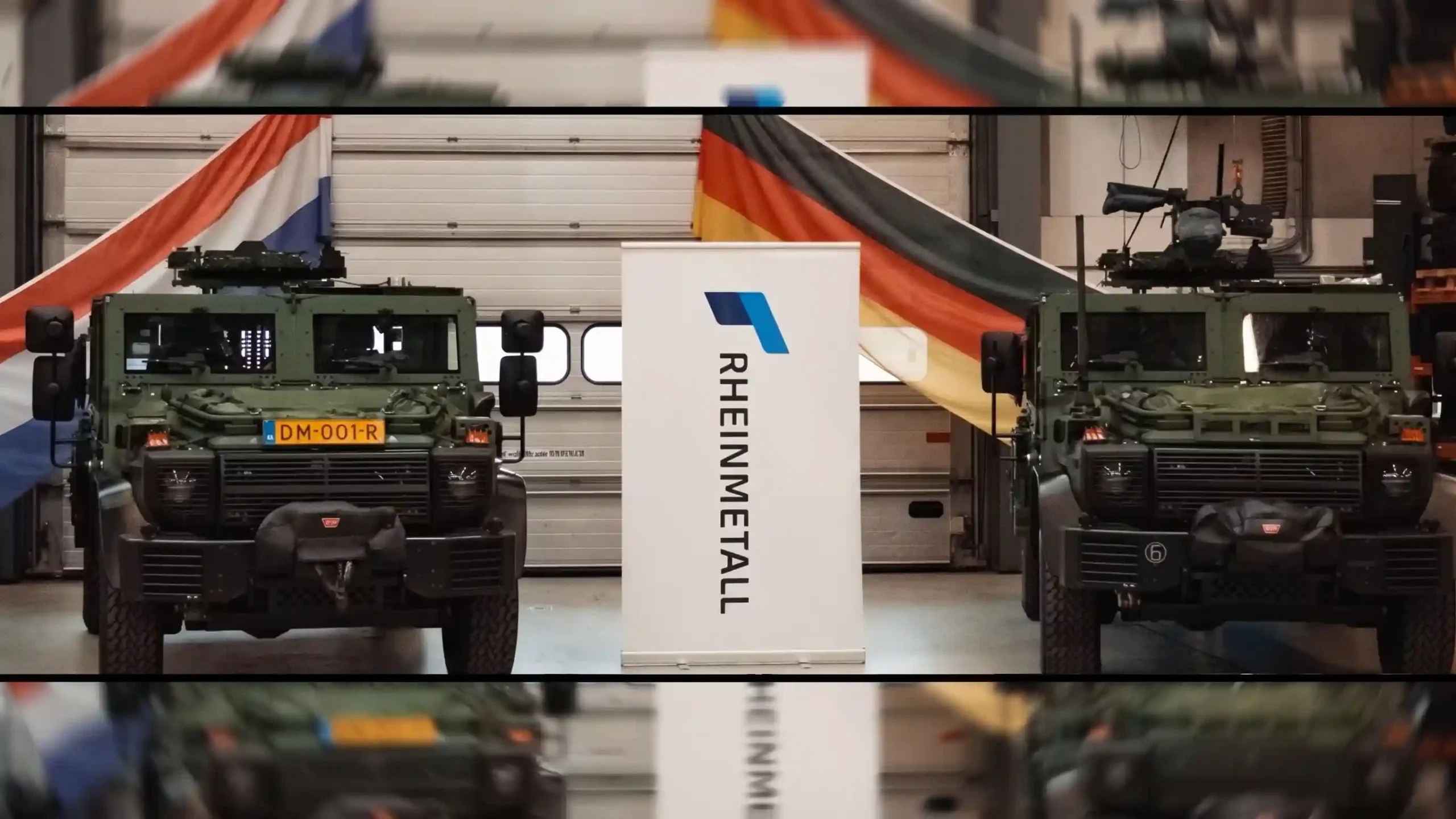
Rheinmetall handed over the first series-production Caracal air assault vehicles to the German and Dutch armed forces on October 29, 2026, during a ceremony at Rheinmetall Defence Nederland’s production site in Ede, the Netherlands. Rheinmetall Landsysteme GmbH and its Dutch subsidiary delivered the vehicles to Germany’s Federal Office of Bundeswehr Equipment, Information Technology and In-Service Support (BAAINBw) and to the Dutch Ministry of Defence, which had already received a first vehicle for driver training on September 29, 2026. More than 1,500 vehicles are due to reach both countries by 2030.
The handover is the first series output of a framework contract signed on July 10, 2023, covering up to 3,058 vehicles: 2,054 for Germany and 1,004 for the Netherlands, worth up to €1.9 billion including value added tax. A first firm order covered 1,508 vehicles for about €870 million, with the German share financed from the €100 billion special fund created after Russia’s full-scale invasion of Ukraine. Designated Einsatzsystem Luftlandeplattform (Deployment System Airmobile Platform) in Bundeswehr service, the Caracal replaces the airborne variants of the Wolf and Mungo vehicles, primarily in Germany’s Rapid Forces Division (Division Schnelle Kräfte, DSK) and in the Royal Netherlands Army’s 11 Airmobile Brigade, which has been integrated into the DSK since 2014.
Caracal Air Assault Vehicle: G-Class Chassis, Powerpack, and Mobility
The Caracal is built on the latest-generation Mercedes-Benz G-Class military production chassis of the 464 model series, the same base used for the Wolf 2. Rheinmetall developed the vehicle with Mercedes-Benz and Armoured Car Systems (ACS), which supplies the lightweight modular superstructures, each tailored to a specific role. Final assembly takes place in Ede; the 2023 contract also designated VDL Special Vehicles in Eindhoven as a partner assembly site, giving the program two Dutch production lines to draw on.
Publicly available Rheinmetall specifications indicate a Mercedes-Benz six-cylinder diesel rated at 183 kW (249 PS) and 600 Nm of torque, for a maximum road speed of 130 km/h. The manufacturer lists a 60 percent gradient, 30 percent side slope, 700 mm fording depth and 330 mm vertical step. Its current brochure gives a vehicle weight of 3,700 kg, a payload of up to 1,200 kg and an air-transport weight of up to 4,900 kg. Earlier company literature cited a 2,900 kg vehicle weight and up to 2,000 kg of payload, and neither government has published the figures for the German and Dutch production standard.
In its basic configuration, the Caracal carries four soldiers with personal and mission-specific equipment. That payload margin is the defining engineering constraint: every kilogram of protection, weapons or ammunition added to the vehicle competes directly with the lift limit of the helicopter meant to carry it.
Air Transport, Protection, and Armament for Airborne Units
Rheinmetall says the compact design allows the Caracal to be carried, depending on configuration, inside a cargo hold or as an underslung load beneath a heavy-lift transport helicopter. Company data indicates a CH-47F Chinook can carry one vehicle internally and one externally, while a CH-53K King Stallion can carry one internally or externally; the vehicle is also cleared for the A400M, C-130, C-17 and KC-390. The Chinook compatibility matters most: the Netherlands already operates the CH-47F, and Germany selected it to replace its CH-53G fleet, so both armies will lift the same vehicle with the same helicopter type.
Protection is modular and scalable against mines and ballistic threats, allowing units to trade armor for payload or air-transport weight by mission. Rheinmetall lists optional Level 1 ballistic and mine protection under STANAG 4569. The ring mount accepts weapons ranging from the 7.62 mm MG5 machine gun and heavy machine guns to automatic grenade launchers and anti-tank weapons, while a second machine gun sits on a co-driver’s weapon mount. Rheinmetall showed the vehicle with a Spike missile launcher at its 2022 debut, which illustrates the intent: an airborne section inserted by helicopter can carry its own anti-armor reach rather than relying on dismounted teams alone.
28 Equipment Kits and the Caracal 6×6 Growth Path
Rheinmetall says the program currently covers 28 different equipment kits. The 2023 contract specified four vehicle variants for transporting personnel, groups and materiel, plus medical vehicles, and the company indicated in January 2026 that it was producing four versions to cover those 28 roles. The contract also includes full life-cycle support over 20 years. Björn Bernhard, Managing Director of Rheinmetall Landsysteme, called the Caracal “one of the most versatile vehicles in our portfolio.”
The family is already expanding. Rheinmetall unveiled a Caracal 6×6 at Eurosatory in June 2026, developed with Mercedes-Benz and MAGNA International, which extends the W464 G-Class chassis with a third axle and a modular flatbed. Rheinmetall quotes a payload of up to 3,200 kg; specifications reported at the show add a 6.1-meter length, a 1.85-meter width and a 3,200 kg vehicle weight. The company says the vehicle can be loaded into the A400M, the CH-47F and the CH-53, and pitches it for reconnaissance, fire support, counter-UAS, special forces and logistics missions. The existing framework contract allows Germany to add 6×6 vehicles for group and materiel transport, but no German or Dutch order has been announced.
Analysis: The production arithmetic is the key issue. The 2023 plan called for series deliveries from early 2025, with the Dutch share expected at 100 vehicles a year and the German share at about 200; the formal handover of series vehicles came in October 2026. Delivering more than 1,500 vehicles by 2030 now implies an average above 350 a year, faster than the original rate, which puts the dual Ede and Eindhoven assembly setup to the test. The payoff is operational: a single fleet, common chassis, shared 20-year support and a common lift platform give the binational DSK the logistics backbone that airmobile forces need to deploy as one formation within NATO’s rapid reaction structure.
Next milestones include the production ramp-up in Ede, driver and crew conversion in German and Dutch units, and call-offs against the roughly 1,550 vehicles remaining under the framework ceiling. Neither government has published initial operational capability dates or the allocation of the 28 kits by unit. Germany’s decision on the 6×6, and the arrival of its CH-47F fleet, will determine how fully the DSK can exploit the Caracal’s airmobile design.