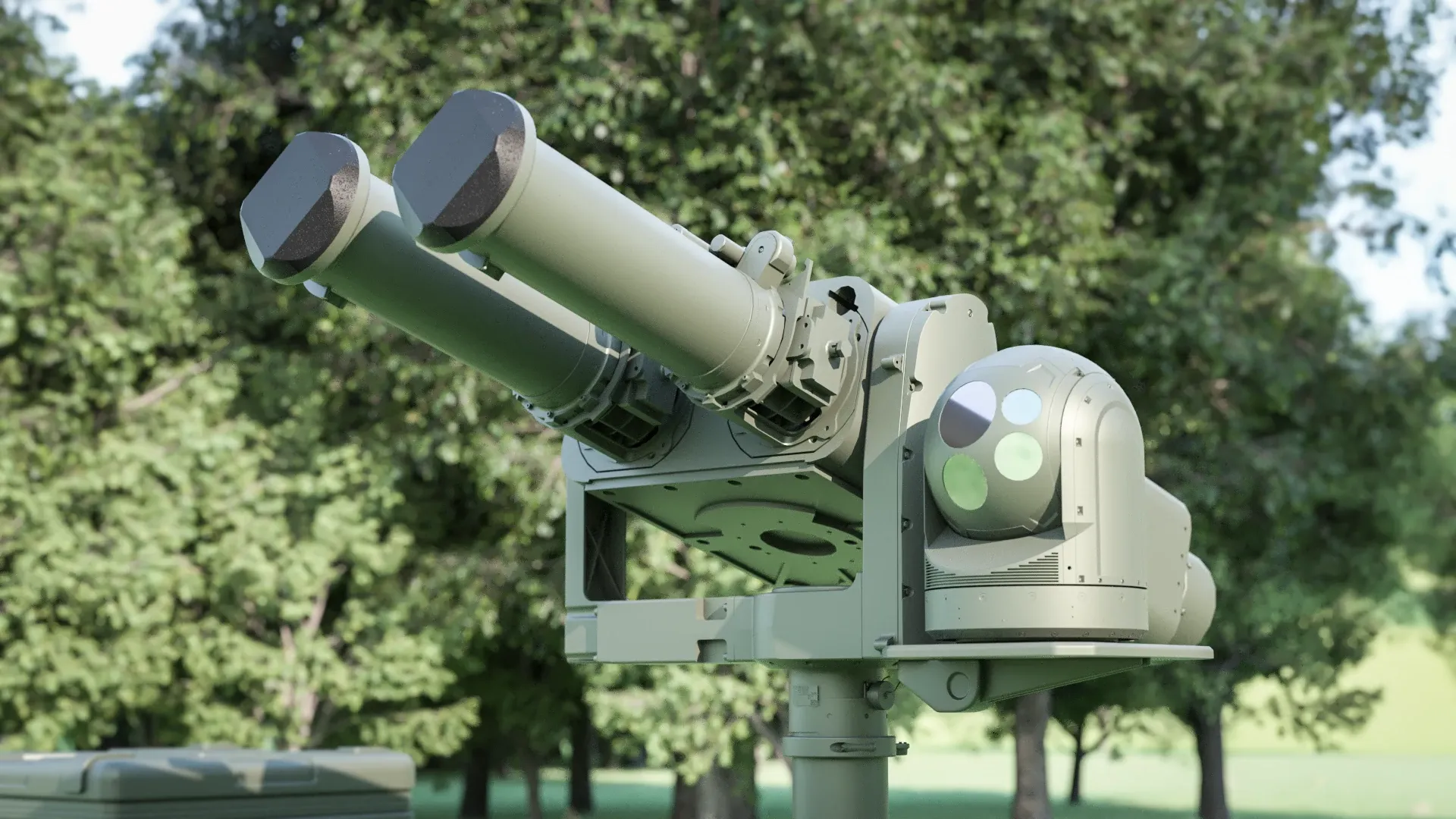
Thales UK has conducted the first live firing of a new remote launcher for its ForceShield UK air defense architecture, launching a Lightweight Multirole Missile (LMM) during a demonstration held the week of October 26, 2026. The company disclosed the firing on October 29, 2026, as part of a series of trials intended to validate a route to attritable, uncrewed Short Range Air Defence (SHORAD) and surface attack.
The demonstration comes as the British Army works to replace its Stormer High Velocity Missile (HVM) self-propelled system, the tracked platform that carries Thales Starstreak missiles in the mounted SHORAD role. UK government project reporting has indicated that the original December 2026 target for a Stormer successor will not be met, while the Army’s 20-40-40 force design pushes planners toward uncrewed and expendable systems. Thales is positioning the new launcher against both pressures.
Thales Remote Launcher Architecture and the LMM Effector
According to Thales, the launcher can be deployed in static, mechanized, and mounted configurations across both the land and maritime domains. Two Thales systems were integrated to execute the firing: the Agile C4I @ Edge (ACE) engagement control technology and the company’s multi-mission fire control system. ACE is Thales’s command and control software designed to link any sensor to any effector, and the company has positioned it at the tactical edge of the UK’s Digital Targeting Web.
Thales has not published the launcher’s magazine depth, sensor fit, or mass.
The effector is better documented. Publicly available specifications indicate the LMM weighs 13 kg, carries a 3 kg warhead combining pre-fragmented blast and shaped-charge effects, and uses a two-stage solid-propellant motor to exceed Mach 1.5. Thales quotes a ground-launched range beyond 6 km. Guidance relies on laser beam riding, paired with a laser proximity fuze that allows engagement of small, low-signature unmanned aerial systems (UAS) as well as light vehicles and fast inshore attack craft.
That combination explains the dual SHORAD and surface attack billing. A single relocatable node can engage a drone or helicopter, then turn to a surface target with the same munition. Its speed also shortens time of flight against fast UAS. The UK has supplied large LMM quantities to Ukraine, where the missile has been fired in the surface-to-air role. Thales produces the LMM in Belfast, and the Royal Navy fields it as Martlet on the AW159 Wildcat helicopter.
How the Launcher Fits 20-40-40 and the MSHORAD Competition
Thales frames the launcher as a sovereign capability aligned with the Army’s 20-40-40 vision in the SHORAD domain. The model, championed by Chief of the General Staff General Sir Roly Walker, envisions 20% survivable crewed platforms, 40% attritable, reusable uncrewed systems, and 40% single-use consumables such as loitering munitions. A remotely operated, relocatable missile node sits squarely in the middle tier.
Thales states the design aims to raise survivability, mass, and lethality without increasing personnel requirements. That matters because every crewed SHORAD fire unit places soldiers inside the threat envelope it protects.
The program context is competitive. In May 2025, Defence Equipment and Support (DE&S) issued a pipeline notice for a £48 million Mounted SHORAD Fire Unit and Multi Mission System assessment phase, and Thales received a contract in March 2026 extending its Mounted SHORAD (MSHORAD) assessment work. Moog is offering its Reconfigurable Integrated-weapon Platform (RIwP), a turret pairing a cannon with Starstreak or LMM missiles. Thales, already the incumbent missile supplier, now fields a launcher concept of its own.
Funding remains internal. Thales confirmed the capability is being built and tested through self-funded research and development, and no Ministry of Defence (MoD) contract has been announced for the launcher itself.
Analysis: The launcher’s value depends less on the LMM, a mature and combat-employed round, than on how ACE manages engagement authority. Thales uses the word “autonomous” without defining it. Automated engagement modes are established in air defense, but an uncrewed node operating ahead of crewed forces raises two practical risks: fratricide against friendly aviation and magazine depletion on low-value targets. For a launcher whose ready-round load has not been disclosed, target prioritization logic and human authorization rules will determine whether the system adds genuine mass or simply exposes scarce interceptors.
Thales has not disclosed the trial location, the target engaged, or the number of further firings planned. Milestones to watch include the next MSHORAD decision point, any British Army field experimentation with uncrewed air defense nodes, and a demonstration of the maritime configuration. Until a funded requirement emerges, the launcher remains a company-led proposition.