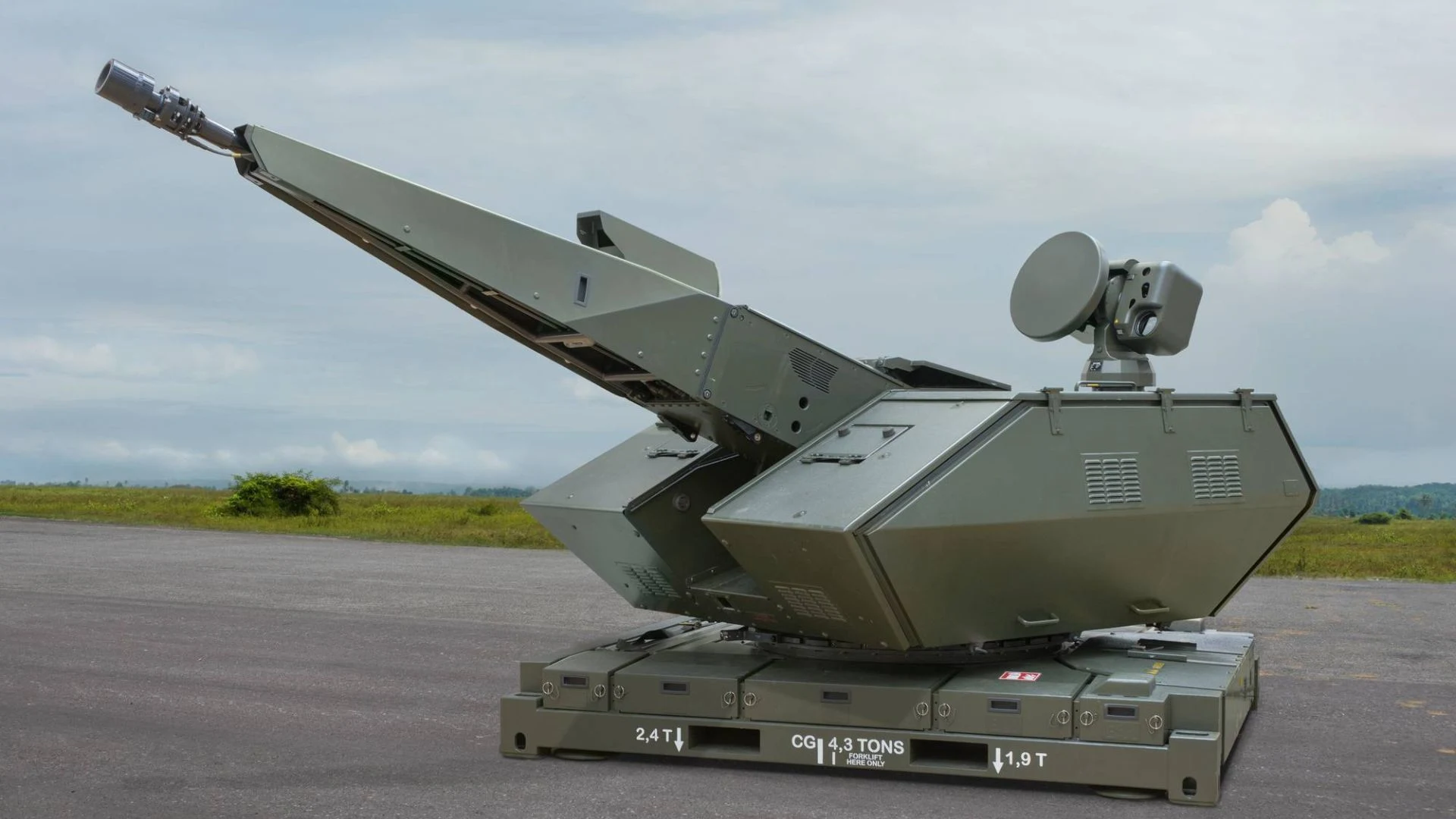
Rheinmetall Air Defence AG has signed an agreement with Silvus Technologies to integrate the US firm’s RFeye passive radio frequency (RF) sensors into the Skynex ground-based air defense system and its Skymaster command and control (C2) platform, the German group announced on October 30, 2026. The sensors add a detection layer that locates aerial platforms from their emissions without transmitting, leaving the defending system’s own position undisclosed.
The deal comes as cannon-based short-range air defense (SHORAD) climbs the priority list across Europe. Ukrainian officials reported Skynex on combat duty in 2023, Italy became the first NATO member to field it with a system handed over on December 18, 2025, and Romania signed for seven Skynex systems on May 29, 2026. All face the same problem: small, low-flying unmanned aircraft that radar alone struggles to detect and classify in cluttered airspace. Rheinmetall Air Defence CEO Roman Köhne said traditional detection methods “can struggle with identifying new and novel threats in complex operating conditions.”
How Passive RF Sensing Fits the Skynex Air Defense Architecture
Skynex is built around a separation of sensors, C2 and effectors. Publicly available specifications indicate a baseline configuration of one Skynex Control Node housing the Skymaster battle management system, an Oerlikon X-TAR3D search radar, and up to four remotely controlled Oerlikon 35mm Revolver Gun Mk3 mounts. Each gun fires up to 1,000 rounds per minute of programmable 35mm AHEAD ammunition, with a reported effective range of up to 4 km against aerial targets.
Through Skymaster, Skynex is designed to integrate sensors from different manufacturers, and Rheinmetall markets the system as able to incorporate active and passive electronic warfare means. The RFeye agreement formalizes that passive layer. According to Rheinmetall, the sensors identify and locate aerial platforms from their RF emissions and feed Skymaster alongside radar tracks, giving operators a more persistent air picture and a recognized electromagnetic picture (REMP).
The operational logic is straightforward. A search radar is the most detectable element of any SHORAD battery and a priority target for anti-radiation weapons and loitering munitions. Passive sensors let a battery cue on drone control links, video downlinks and telemetry while reducing the time its radar must radiate. The limitation is equally clear: passive RF cannot detect a target that is not emitting, such as a drone flying a pre-programmed route under radio silence or one guided by fiber-optic cable. RFeye complements radar; it does not replace it.
RFeye Sensor Lineage: CRFS, Silvus and Motorola Solutions
RFeye did not originate at Silvus. The sensor line was developed by CRFS, an RF intelligence specialist founded in 2007 and operating from Cambridge, UK, and the United States. Motorola Solutions completed its acquisition of Silvus on August 6, 2025, for $4.4 billion in upfront consideration plus up to $600 million in performance-based earnouts, and CRFS joined Motorola as part of that transaction.
The announcement does not specify which RFeye variant will be integrated. Publicly available specifications for the RFeye Node 100-18 indicate coverage from 9 kHz to 18 GHz with 100 MHz of instantaneous bandwidth, while the RFeye Node 100-40 extends coverage to 40 GHz. RFeye networks geolocate emitters using time difference of arrival (TDoA), angle of arrival (AoA) and power on arrival (PoA) techniques, generally requiring several distributed nodes for accurate fixes. How many sensors a Skynex battery will field, and at what spacing, has not been disclosed.
Peter Moss, director of strategic NATO accounts at Silvus, described the agreement as a commitment to “resilient air defence systems for allied forces.” His title is telling: Silvus and its parent are positioning RF sensing as a NATO-facing air defense business, not only a tactical networking one.
Analysis: The agreement reflects a shift in SHORAD design from a radar-centric model to a multi-sensor one, in which emissions control is treated as a survivability requirement rather than a doctrinal preference. Operational experience in Ukraine, where air defense radars are systematically hunted, is accelerating that shift. For Rheinmetall, sourcing a mature passive sensor through a partner is faster than developing one in-house and strengthens Skynex’s position in a European SHORAD market that is expanding quickly. For Motorola Solutions, embedding RFeye in a fielded NATO air defense architecture validates the defense thesis behind its Silvus acquisition.
Key details remain unpublished: contract value, delivery schedule, whether existing Skynex operators will receive retrofits, and which customers drove the requirement. The next indicators to watch are a first operator announcement, integration test results, and whether Rheinmetall extends RFeye to other air defense products in its portfolio. Until then, the agreement is an integration commitment, not a fielded capability.