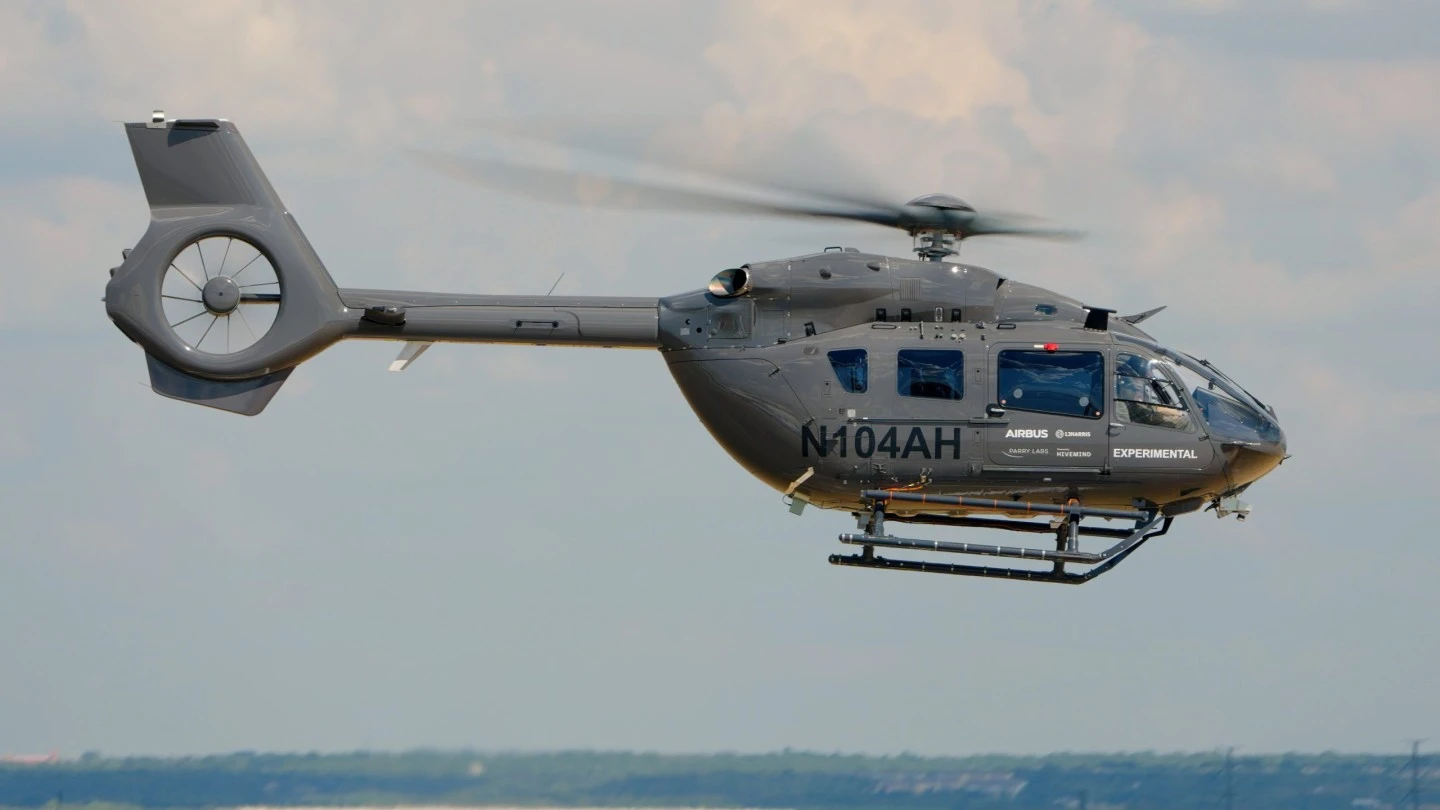
Airbus U.S. Space & Defense has shown that operators more than 20 kilometers from its primary flight test team can take control of its unmanned UH-72 Lakota Connector, fly it through a series of autonomous behaviors and hand it back, the company announced on October 28, 2026. The trial, the program’s seventh flight test event, took place in September 2026 at Grand Prairie, Texas, with partners Shield AI, L3Harris Technologies and Parry Labs.
The test advances the Airbus bid for the U.S. Marine Corps Aerial Logistics Connector (ALC) program, a Middle Tier of Acquisition (MTA) Rapid Prototyping effort meant to supply prototypes for operational demonstrations and experiments. Airbus is now in the program’s third year. Naval Air Systems Command (NAVAIR) awarded the company a Phase I Other Transaction Authority (OTA) agreement through the Naval Aviation Systems Consortium in 2024, based on an unmanned concept derived from the UH-72 Lakota. The ALC is one of several Department of Defense efforts to sustain forces operating in distributed environments during conflict with a peer or near-peer adversary.
How the Lakota Connector Handed Off Control Across 20 Kilometers
The September event centered on the ground control segment. The team integrated a Man-Packable Control System tablet into the aircraft’s ground control station, allowing a geographically separated operator to assume command. The remote crew took control, directed the aircraft through autonomous behaviors and then transferred authority back to the primary ground control station.
The handover answers a practical requirement. In a distributed force, the unit launching a resupply sortie is often not the unit receiving it. A receiving element able to take control on approach, adjust the landing point or retask the aircraft reduces dependence on a single, fixed control node that an adversary could locate and target.
“The latest flight test marks an important step toward delivering an autonomous logistics capability that gives Marines the flexibility to move critical supplies where they are needed most,” said Alex Veneziano, CEO of Airbus U.S. Space & Defense. “By demonstrating the ability to transfer control between geographically separated teams, we are showing how this technology can support Marines in challenging operational environments.”
The team also reported more precise autonomous takeoffs and landings, improved beyond-line-of-sight (BLOS) connectivity and validated thermal-management modifications intended to prepare the aircraft for high-temperature environments. Airbus did not disclose the datalink used, the latency of the handover, the range of the BLOS link or the temperature thresholds tested.
MQ-72C Airframe, Autonomy Stack and the Partner Team
Airbus markets the aircraft as the MQ-72C Lakota Connector, an unmanned variant of the UH-72 Lakota light twin-engine helicopter, itself a militarized derivative of the commercial H145. Publicly available specifications indicate a length of about 13.5 meters, a height of about 4 meters, a cruise speed of 135 knots and a maximum takeoff weight of 3,800 kg (8,378 lb). The UH-72B from which it draws is powered by two Safran Arriel 2E turboshafts. Airbus has not published a payload figure for the unmanned configuration. During the program’s second ALC demonstration, held at Marine Corps Air Station Yuma in 2025, Airbus validated the UH-72B’s ability to load and carry specialized cargo.
Each partner holds a defined layer. Shield AI supplies Hivemind, the mission autonomy software that flew the first autonomous test in August 2025 on an H145 surrogate, working alongside the Airbus Helionix avionics suite. L3Harris provides platform system integration under a teaming agreement announced in May 2025, while Parry Labs contributes edge computing and autonomy-enabling software infrastructure. The fourth test, announced in April 2026, combined all four companies’ technologies on one aircraft for the first time and focused on perception for landing-zone obstacle detection and rerouting. Airbus has not stated whether the seventh test used the H145 surrogate or whether safety pilots were aboard.
Analysis: The control handover matters more than the autonomy milestones that preceded it. The Marine Corps concept of Expeditionary Advanced Base Operations spreads small units across islands and littorals, where a centralized logistics hub becomes both a bottleneck and a target. An aircraft that can be passed between operators with a tablet lets the supported unit, not a distant control station, shape the final leg of a resupply run. The test does not yet answer the harder question: how the BLOS link and the handover protocol perform under electronic attack, the condition the ALC program is explicitly built for.
Airbus has not announced the date of the next flight test. Under MTA rules, rapid prototyping efforts aim to field a prototype with residual operational capability within five years; if that clock started with the 2024 award, the window closes around 2029. Key unknowns remain the program’s payload threshold, the number of prototypes the Marine Corps intends to evaluate and whether a Phase II agreement will follow.