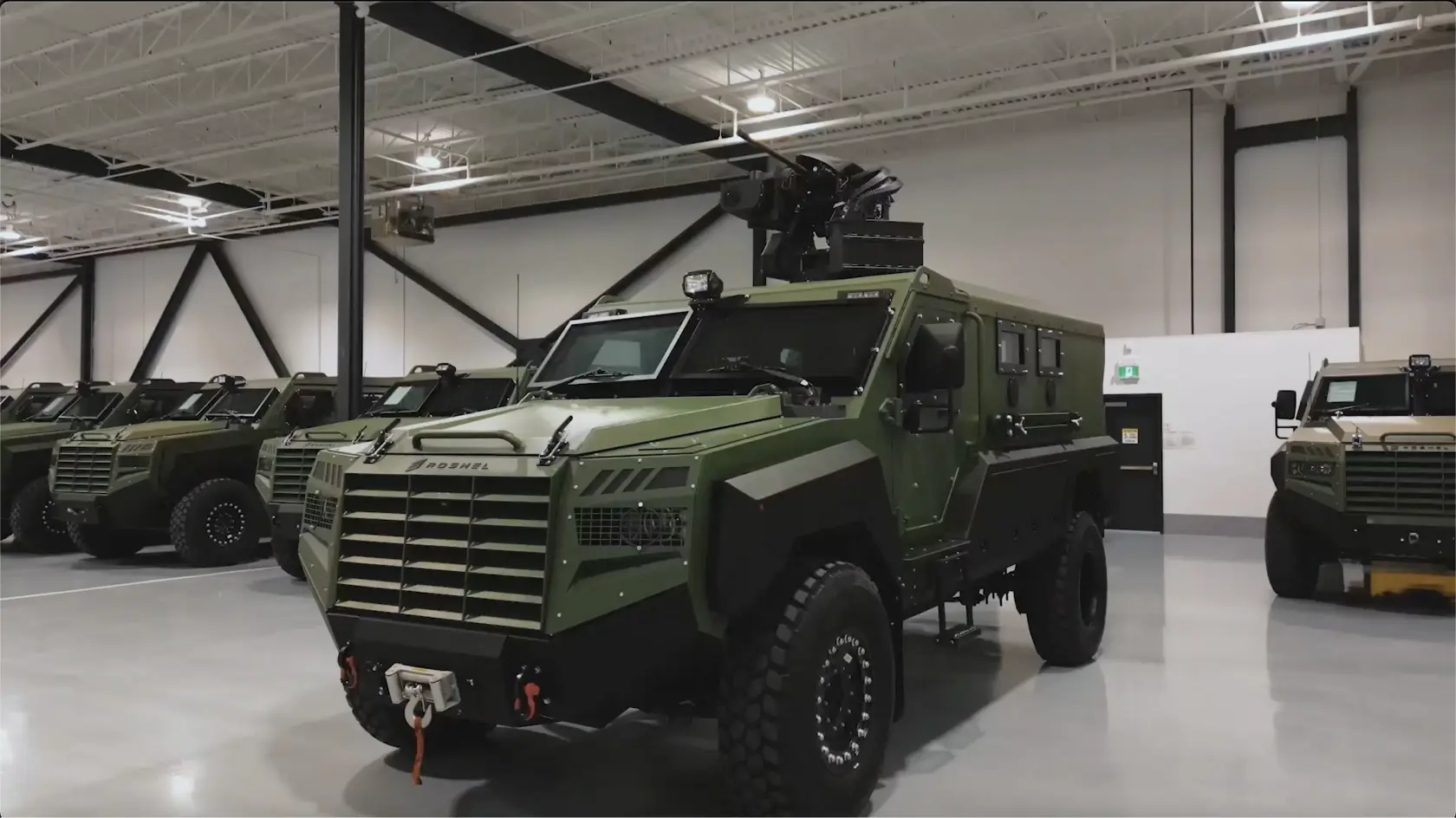
Canadian manufacturer Roshel says nearly 3,000 of its Senator armored vehicles have now been delivered to Ukraine, a figure the company released on October 29, 2026, as a first-generation Senator MRAP went on permanent display at the Canadian War Museum in Ottawa. Roshel did not give an exact count or say how many vehicles were funded by Canada, other donors or Ukraine itself.
The tally has climbed steadily since Russia’s full-scale invasion in February 2022. Ottawa bought an initial eight vehicles in spring 2022, then committed 200 Senators worth CAD 90 million in January 2023. Roshel passed 1,000 deliveries at the end of 2023, reported about 1,400 by fall 2024 and more than 2,000 by December 2025. In February 2026, Canada pledged a further 383 Senators alongside 66 LAV 6 armored vehicles from General Dynamics Land Systems Canada. That volume makes the Senator one of the most numerous Western-supplied armored vehicles in Ukrainian service.
Roshel Senator MRAP Design: Ford F-550 Chassis and V-Hull Protection
The Senator is built on a Ford F-550 heavy commercial truck chassis, a choice that trades some of the survivability of a purpose-built military vehicle for speed and cost of production. Founded in 2016 in Brampton, Ontario, Roshel began building the Senator in 2018 for police and security agencies in North America. Publicly available specifications indicate a 6.7-liter Power Stroke V8 turbo-diesel producing 330 hp and 750 Nm of torque, paired with a 10-speed automatic transmission and 4×4 drive, for a top speed of 120 km/h.
The MRAP variant, unveiled in 2023 and shaped by Ukrainian combat feedback, adds a V-shaped hull, underbelly blast armor and impact seating. The Canadian War Museum lists it at NATO STANAG 4569 Ballistic Level 2 and Blast Level 3, a rating designed to withstand up to 8 kg of explosives. It carries two crew and eight passengers, while the APC variant seats up to 10 passengers. Payload ranges from 1,200 to 2,000 kg.
Casualty Evacuation, Patrols and Demining: The Senator’s Roles in Ukraine
Ukraine’s Armed Forces and State Border Guard Service use the Senator to move troops, evacuate wounded personnel and conduct patrol and reconnaissance tasks. In May 2026, the State Special Transport Service, part of Ukraine’s Ministry of Defence, received 20 Senator MRAPs for humanitarian mine clearance through the Demining Capability Coalition.
The vehicle fills a specific gap. Ukraine’s front line is saturated with first-person-view (FPV) drones, artillery and mines, which makes unarmored pickups and vans highly vulnerable on the final kilometers to forward positions. The Senator provides protected mobility on that last stretch for casualty evacuation, infantry rotation and resupply, without tying up scarcer tracked infantry fighting vehicles or heavier MRAPs. Ukrainian units have reported Senators surviving FPV drone strikes, including one case in which the windshield resisted a direct hit; these accounts are anecdotal and have not been independently verified.
Analysis: The Senator’s value to Ukraine lies less in its protection than in its volume. Level 2 ballistic armor stops rifle-caliber fire, not anti-tank weapons or direct artillery hits, but a production line rated by the company at up to 140 vehicles per month has allowed donors to field protected mobility at a scale that purpose-built platforms could not match in the same timeframe. For NATO planners, the program shows that militarized commercial chassis can close protected-mobility gaps quickly in a high-attrition war, provided users accept the protection ceiling that comes with them.
Deliveries under Canada’s February 2026 package continue, and Roshel’s customer base is widening beyond Ukraine. Mexico selected the Senator MRAP in 2026 after trials with its armed forces and national guard, and Moldova’s military is due to receive more than 100 European Union-funded vehicles by May 2027. The exact delivery count and Ukrainian loss rates remain undisclosed.