The U.S. Navy has awarded Advanced Acoustic Concepts (AAC), the U.S.-based undersea warfare subsidiary of Thales, a $53.9 million contract to produce and deliver two integrated Remote Mine Hunting (RMH) modules and associated engineering support, Thales announced on November 2, 2026. Options for additional modules could lift the cumulative contract value to approximately $196.2 million.
The award supports the Navy’s push to move mine countermeasures (MCM) away from crewed ships working inside the minefield and toward remote, stand-off operations. Thales frames the RMH capability around the Navy’s established “Find, Fix and Finish” sequence: detect, locate and classify undersea mines from a safer distance, then support rapid engagement.
Inside the Remote Mine Hunting Module: Multiview Sonar and AI Classification
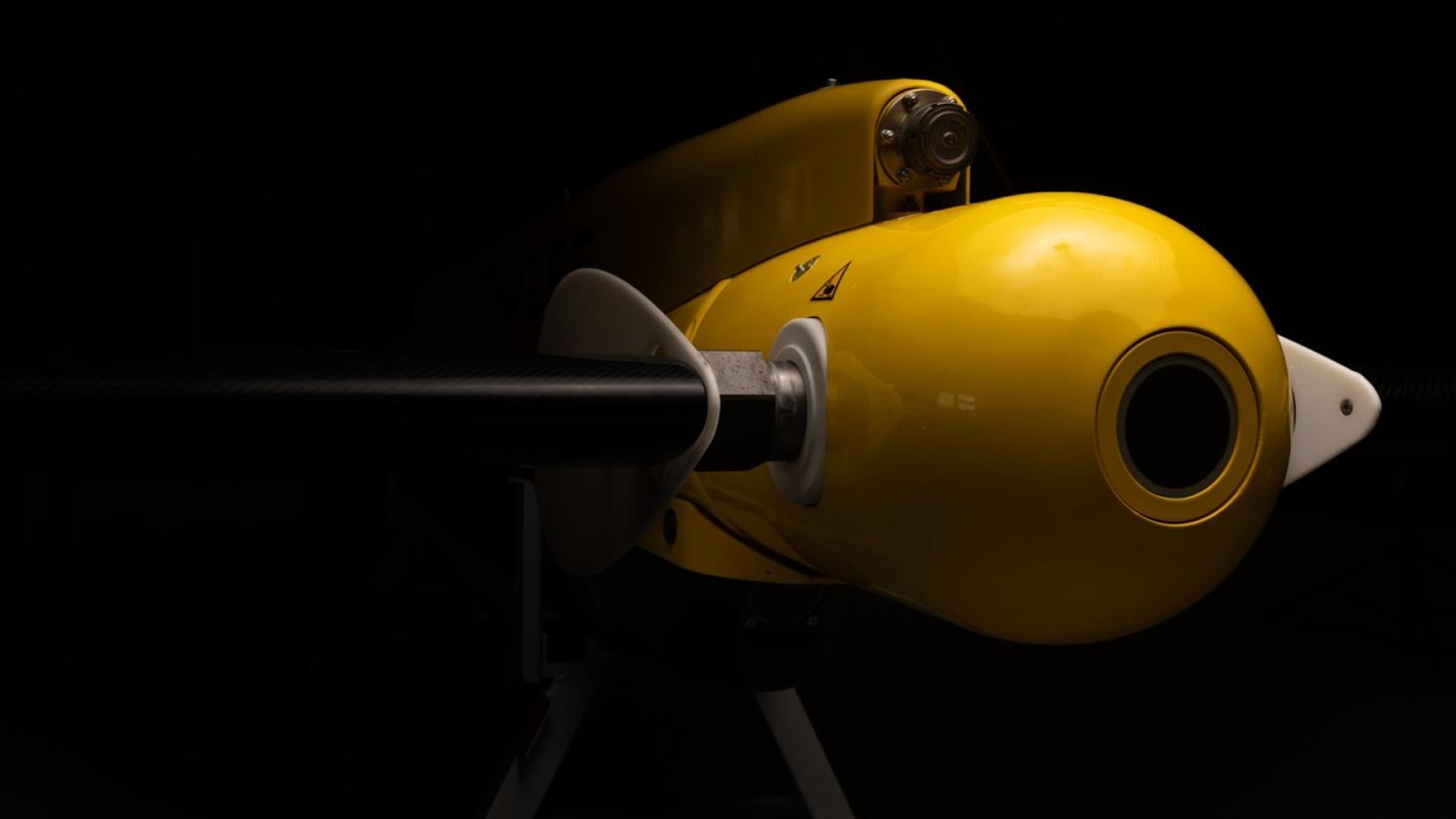
Thales describes the RMH suite as a combination of advanced sonar, mission management software and remotely operated vehicle technology. Its primary sensor is a multiview towed synthetic aperture sonar (SAS) intended to deliver high-resolution detection and imaging while cutting false target rates. The company did not name the sensor, but publicly available information indicates its multiview SAS line is SAMDIS (Synthetic Aperture and Mine Detection Imagery Sonar), carried in the TSAM towed body, which images seabed objects from several aspects in a single pass.
That geometry targets the slowest phase of mine hunting. Cluttered littoral seabeds force conventional sonar into repeated reacquisition runs; every avoided pass shortens the detect-to-engage timeline and the time assets spend in contested water.
The second core element is AI-augmented Automatic Target Recognition (ATR) software that lets operators process, classify, map and manage mine-hunting data. Thales says the tools reduce the time to “find and fix” while raising the probability of target certainty. Open-source descriptions of the Thales architecture identify the ATR application as Mi-Map and the mission management layer as M-Cube, although the announcement does not specify the delivered software baseline.
From Franco-British MMCM to a US Navy Mine Countermeasures Buy
The RMH suite draws on technology already fielded in Europe. SAMDIS and TSAM form the detection core of the Franco-British Maritime Mine Counter Measures (MMCM) program, managed by OCCAR, under which Thales was contracted in 2020 to deliver eight unmanned systems, four each to France and the United Kingdom. Each MMCM system pairs an unmanned surface vessel (USV) with the towed sonar, a remotely operated neutralization vehicle and a portable operations center.
AAC, which Thales Defense & Security Inc. (TDSI) brought under full ownership from Leonardo DRS in 2022, handles US integration. TDSI operates under a Department of Defense proxy agreement that mitigates foreign ownership, control or influence (FOCI) concerns, the mechanism that allows a French-owned group to deliver undersea warfare systems to the Navy.
Mike Carnovale, president of AAC, said the program brings together “sonar, classification software and future remote neutralization capabilities into a single operational solution” for both crewed and uncrewed surface vessels. AAC markets ANGLER, a reusable micro remotely operated vehicle armed with a 66 mm shaped charge or 20 mm projectiles, as its neutralization effector, but the announcement does not say whether it is part of this award. The Navy’s current Littoral Combat Ship (LCS) MCM mission package relies on Raytheon’s AN/AQS-20C towed minehunting sonar, and Thales has not said whether RMH is intended to complement or compete with that sensor.
Analysis: The contract structure matters more than the base value. At $53.9 million for two modules, the award is an entry ticket; a cumulative ceiling roughly 3.6 times the base signals the Navy wants a path to scale if the modules perform. Buying a sensor and classification chain already in production for two NATO navies, integrated through a US-domiciled subsidiary, lets the Navy cut development risk on the weakest link of its MCM kill chain, which is classification throughput rather than raw detection.
Key unknowns remain the host platform, whether the MCM USV, the LCS mission package or vessels of opportunity, along with delivery dates, the test and evaluation plan and the timing of option exercises. The next public indicators will be module delivery, at-sea evaluation results and any funding for additional modules in fiscal 2027 appropriations and the Navy’s fiscal 2028 budget request.