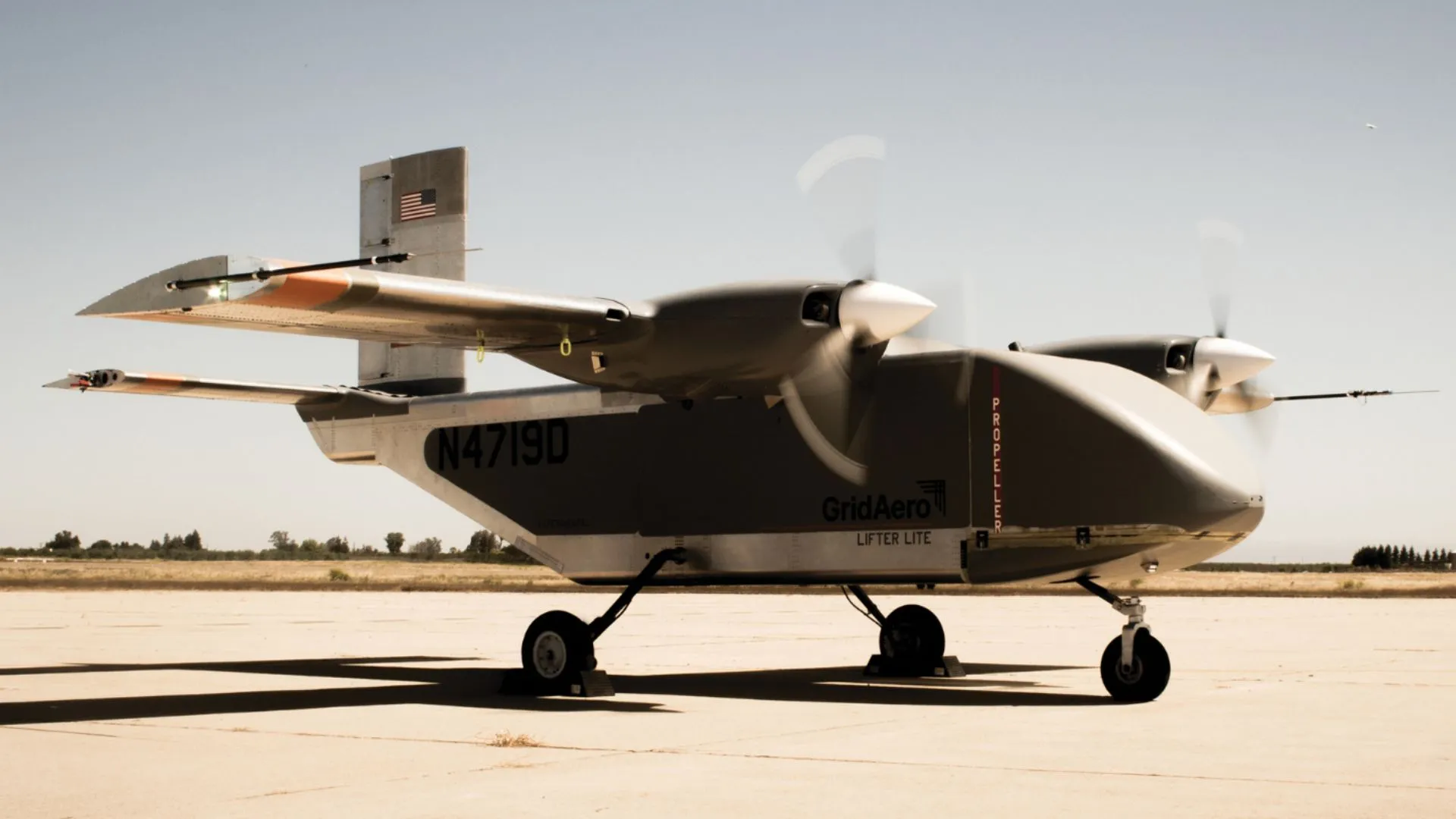
Oshkosh Defense and Grid Aero announced a strategic partnership on November 2, 2026, to move Grid Aero’s Lifter autonomous cargo aircraft from prototype to production at scale. Under the agreement, the Wisconsin-based Oshkosh Corporation subsidiary will support design for manufacturability, production planning and supply chain optimization, and will ultimately build Lifter aircraft. Neither company disclosed financial terms, production rates, a manufacturing site or a delivery schedule.
The deal lands as the Department of War pushes affordable mass from policy into procurement. The department has called for low-cost Group 4 and Group 5 unmanned aircraft, the classes above 1,320 pounds maximum gross takeoff weight, that it can buy in quantity, produce at scale and adapt as payloads change. On July 7, 2026, the Defense Innovation Unit (DIU) opened its Massed Modular Aircraft (MMA) solicitation for a cheaper, modular successor to the MQ-9A Reaper, targeting 20 operational aircraft by fiscal year 2031.
How Oshkosh Defense Plans to Industrialize the Grid Aero Lifter
Initial work under the partnership covers production engineering, design for manufacturing and customer engagement. The stated end state is a demonstration of production-ready autonomous logistics aircraft to defense customers, drawing on Oshkosh’s Wisconsin manufacturing infrastructure, workforce and production capacity.
Oshkosh brings a tactical wheeled vehicle portfolio that includes the Joint Light Tactical Vehicle (JLTV), the Family of Medium Tactical Vehicles (FMTV) and the Heavy Expanded Mobility Tactical Truck (HEMTT), programs defined by high-rate production, deep supplier networks and military quality systems. It has no history as a fixed-wing aircraft manufacturer. The partnership rests on the premise that the Lifter is built more like a truck than a conventional airframe.
Grid Aero CEO Arthur Dubois framed it in exactly those terms, describing the Lifter as “simple, rugged, piston-powered, and built from ubiquitous materials, borrowing as much from military trucks as from traditional aircraft.” Low-complexity structures and commercially available materials translate into tooling, supplier qualification and assembly processes that a vehicle-scale integrator already runs. Oshkosh Defense Chief Growth Officer Logan Jones described the arrangement as pairing Grid Aero’s autonomy work with Oshkosh’s “industrial capability to make it real at scale.”
The parent company adds adjacent depth. Oshkosh Corporation employs more than 19,000 people, and its portfolio includes Pratt Miller, an advanced engineering firm, and Oshkosh AeroTech, an airport ground support equipment business. What remains undisclosed is whether Lifter production will run on an existing defense line or a dedicated cell, and how airworthiness will be managed in a plant that has never built aircraft.
Range, Payload, and Powertrain: Inside the Lifter Lite Design
Grid Aero, founded in 2024 and based in San Leandro, California, was formed by engineers from Joby Aviation, Xwing, Northrop Grumman and the U.S. Air Force. The company unveiled the Lifter Lite prototype on August 18, 2025, saying it had designed and built the full-scale airframe in roughly six months, alongside a $6 million seed round and an AFWERX Small Business Innovation Research (SBIR) Phase II contract. A $20 million Series A led by Bison Ventures and Geodesic Capital followed on January 26, 2026, to fund flight testing and early operational deployments.
The Lifter Lite is a twin-engine cargo aircraft designed for autonomous operation from austere airstrips. Grid Aero has not published a full specification sheet. Company statements have cited payloads between roughly 1,000 and 10,000 pounds, most recently 1,000 to 8,000 pounds in October 2026, and ranges of thousands of miles, with payload traded directly against distance; Dubois has described range reaching up to 4,000 nautical miles in lighter configurations and cited Guam to Japan as a representative route. Engine type and output remain undisclosed; some earlier descriptions referred to turboprops, not the piston powertrain Dubois now cites.
Grid Aero positions the Lifter as a companion to the Lockheed Martin C-130, not a replacement: a low-cost aircraft that pushes cargo to dispersed island airstrips where a crewed tactical transport would be exposed. The prototype entered ground and taxi testing in early 2026, and the company had not reported a first flight as of October 2026. For reference, the MMA solicitation calls for at least 2,800 pounds of payload, a threshold inside the Lifter’s stated envelope, although MMA targets intelligence, surveillance, reconnaissance and strike missions rather than logistics. Grid Aero is nonetheless one of seven companies selected on September 30, 2026, to continue in the MMA competition, Air & Space Forces Magazine reported, and has not said whether Lifter Lite or another design is its entry.
Analysis: The partnership tests a thesis the Pentagon has asserted but not yet proven: that attritable autonomous aircraft can be priced and produced like ground vehicles. Startups can design airframes in months, but few can stand up factories, qualify suppliers and sustain production rates. Oshkosh, which lost the JLTV follow-on production contract to AM General in February 2023, has a clear incentive to turn its tactical vehicle industrial base toward new lines of business. If truck-style manufacturing can push Lifter unit costs low enough to accept losses over the Western Pacific, contested logistics gains a production model rather than another prototype.
The near-term markers are concrete: published flight test data, Lifter participation in military exercises, and the outputs of the production engineering phase, including a site and a target rate. Grid Aero has publicly aimed to put aircraft in service with U.S. forces in 2027, and it holds a letter of intent from Everts Air to evaluate the Lifter for cargo and fuel deliveries in Alaska. Neither firm has identified a program of record or contract vehicle for military production.