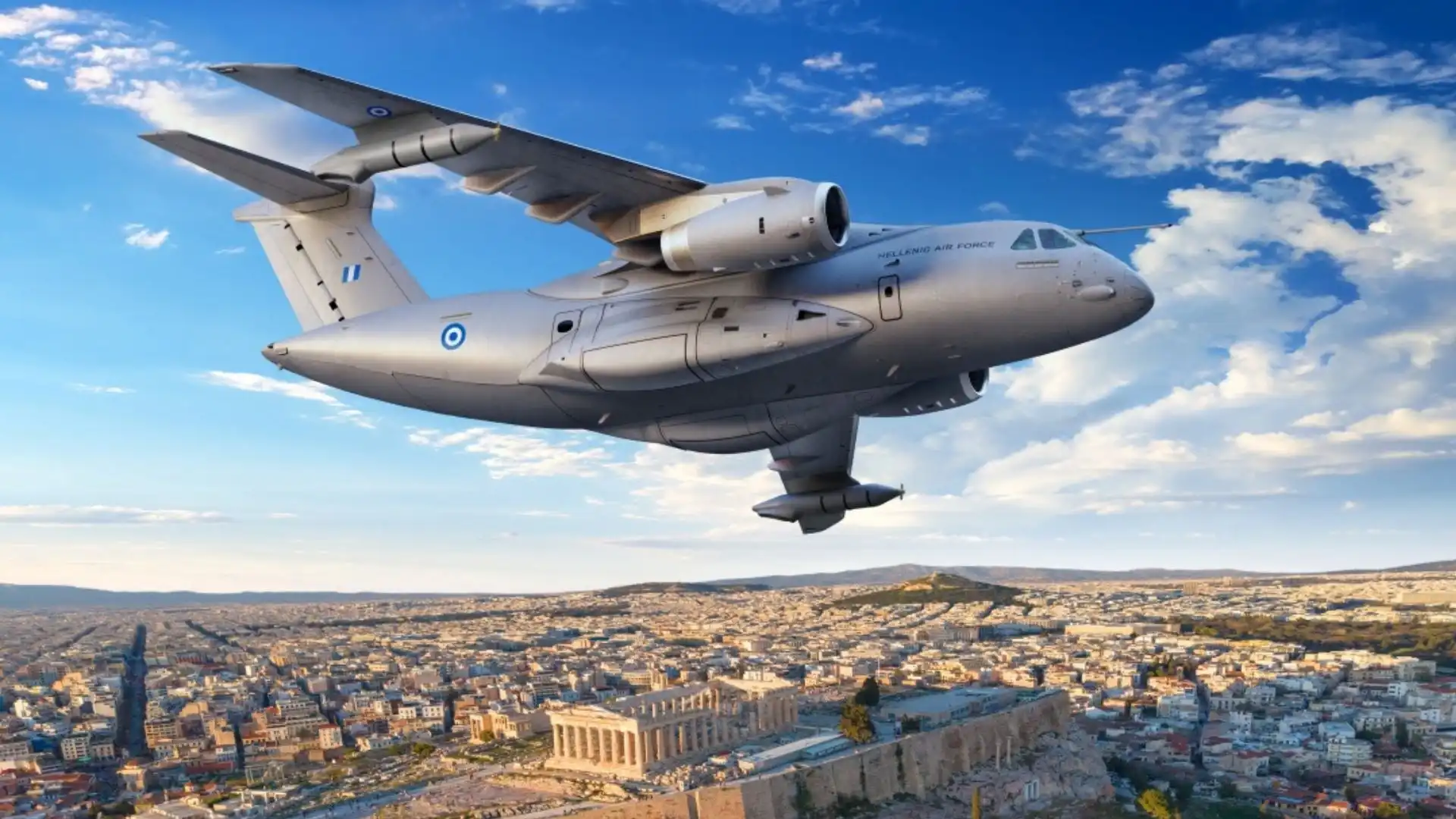
Greece signed a contract in Athens on November 2, 2026, to acquire three Embraer KC-390 Millennium multi-mission transport aircraft, with options for three more, through a government-to-government agreement with Portugal. The agreement was signed at the Hellenic Ministry of National Defence in the presence of Greek Defense Minister Nikos Dendias and Portuguese Defense Minister Nuno Melo, and the Hellenic Air Force (HAF) will receive its first aircraft in 2027, according to Embraer.
The order targets one of the HAF’s most persistent capability gaps. Greek tactical airlift relies on aging C-130B and C-130H Hercules, backed by C-27J Spartans. Dendias said in November 2025 that five C-130s were operational, up from a low of one. Athens had also explored second-hand and new C-130J Super Hercules options. A Greek parliamentary committee approved the procurement in June 2026, and the Government Council for National Security (KYSEA) cleared it, together with the three options, in July.
Inside the Greece KC-390 Deal: Funding, Delivery and Basing
Portugal’s Council of Ministers approved the arrangement on October 14, 2026, and the authorization was published in the official gazette on October 22. The package is valued at €590 million excluding VAT: €533 million for the aircraft and initial logistics support, and €57 million for electronic warfare systems, training, maintenance and program management. A Greek defense official put the cost of the three aircraft at €550 million to €600 million.
Under the mechanism, Lisbon buys the aircraft from Embraer and transfers them to Athens. The airframes are reportedly drawn from the 10 options Portugal secured when it expanded its own KC-390 program in 2025, making Greece the first customer to use this framework. Portugal’s OGMA, 65% owned by Embraer, produces central fuselage sections shipped to Brazil for final assembly.
The first aircraft arrives in 2027. Embraer has not disclosed delivery dates for the second and third aircraft, and no timeline or value has been disclosed for the three options; Portugal’s spending authorization for the program runs through 2031. The aircraft are expected to join the 356 Tactical Transport Squadron at Elefsis Air Base near Athens, the current Hercules unit. Hellenic Aerospace Industry (HAI) signed an agreement with Embraer in May 2026 to establish maintenance and support capabilities for the Greek fleet, and Greek crews are expected to begin training at Beja Air Base in Portugal.
Embraer counts Greece as the seventh European nation to select the aircraft, after Portugal, Hungary, the Netherlands, Austria, the Czech Republic and Sweden. Brazil, South Korea, Uzbekistan, the United Arab Emirates and Colombia have also ordered the type.
KC-390 Payload, Speed and Tanker Role Against the C-130H
Embraer rates the KC-390 at 26 tonnes of payload and 470 knots. Publicly available specifications indicate two IAE V2500-E5 turbofans, full fly-by-wire flight controls, a length of about 35.2 meters and a wingspan of about 35 meters. The cargo hold accommodates up to 80 troops, 66 paratroopers or 74 litters, and published range figures are roughly 2,820 kilometers with 23 tonnes and 5,020 kilometers with 14 tonnes.
Open-source figures for the C-130H show a maximum payload near 19 tonnes and a cruise speed around 290 knots. For Greece, that gap means fewer sorties to resupply Aegean islands and faster reach for noncombatant evacuations across the Eastern Mediterranean and North Africa. The type can also operate from unpaved runways and perform medical evacuation, search and rescue and firefighting missions; whether Athens will buy a firefighting kit has not been disclosed.
The tanker role depends on a quick-install air-to-air refueling kit with wing-mounted hose-and-drogue pods, and the aircraft can also receive fuel. Greece has no dedicated tanker fleet, and Dendias described the KC-390 as the country’s first tanker aircraft. He said it would initially refuel the HAF’s probe-equipped Rafale and Mirage 2000-5 fighters, and its F-16s about a year later. The F-16 uses a boom receptacle rather than a refueling probe, and Greek officials have not explained how the hose-and-drogue system would serve it. The F-35A on order also uses a boom receptacle.
Analysis: The procurement channel matters as much as the aircraft. By drawing on Portugal’s option pool, Athens avoided a full tender and secured a 2027 delivery slot, creating a template other NATO buyers can reuse. The capability gain is real but bounded: three airframes, delivered over several years, will likely leave one or two available at any given time, split between airlift and tanking. For an air force whose F-16s, and the F-35s to come, make up most of its combat fleet, the KC-390’s aerial refueling value will depend on whether the F-16 integration Dendias announced materializes.
The next milestones are the 2027 handover, the training pipeline, which is expected to begin at Beja and which Embraer says will draw on European synergies, and the decision on the three options. Also unresolved are the number of refueling kits included in the package, the path to F-16 refueling, and the retirement schedule for the C-130B/H fleet.