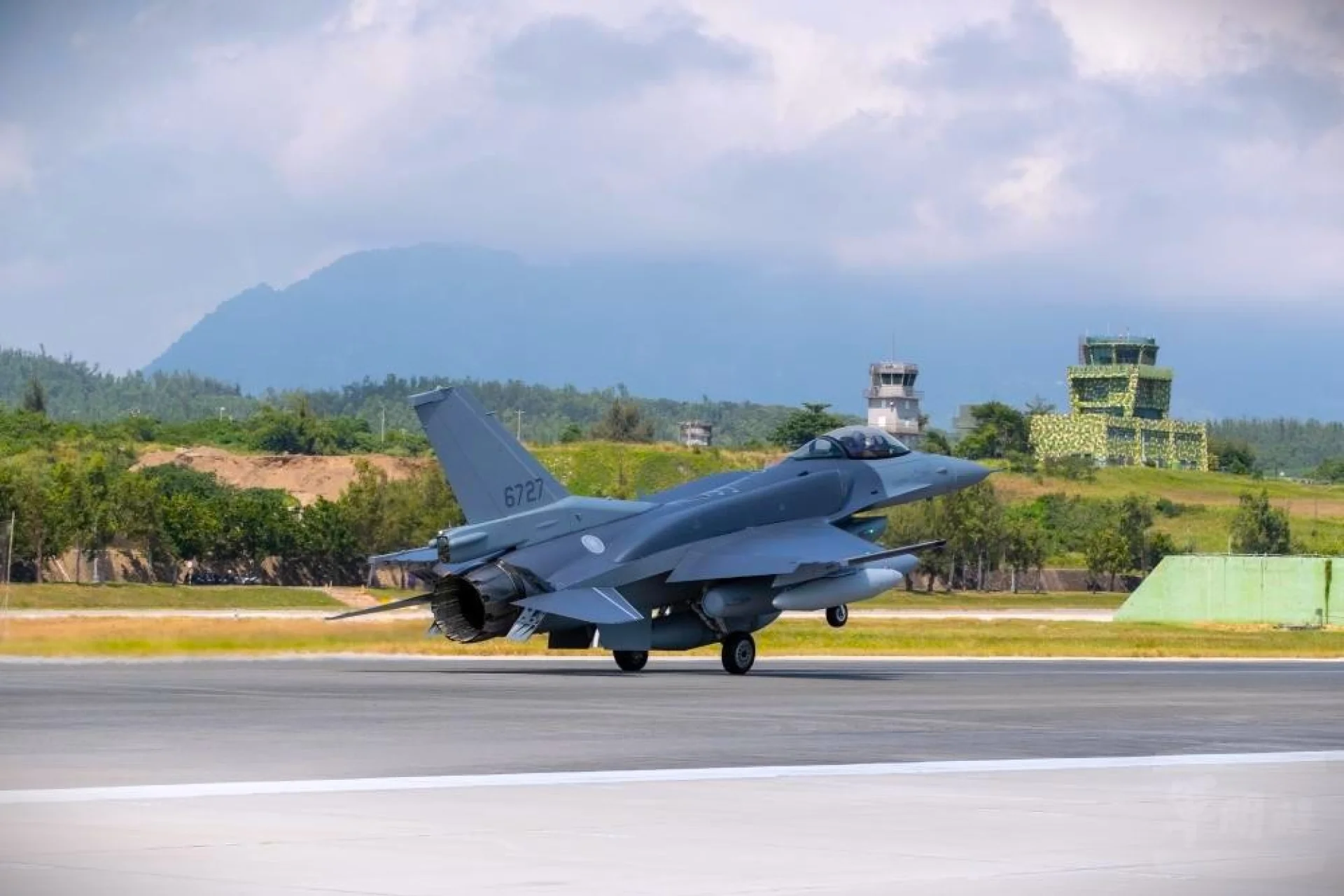
The U.S. Air Force has awarded CAE USA Inc. of Arlington, Texas, a $14,800,647 hybrid firm-fixed-price contract for contractor logistics support (CLS) of Taiwan’s Republic of China Air Force (ROCAF) F-16 Block 20V and Block 70 Mission Training Center (MTC) program through January 30, 2032. The sole-source award, signed on October 28, 2026 and announced by the Pentagon on November 2, involves Foreign Military Sales (FMS) to Taiwan, with $2,234,180 in FMS funds obligated at signature.
The contract follows by four weeks the ROCAF’s acceptance of its first two new-build F-16C Block 70 fighters, tail numbers 6727 and 6728, at Chihhang Air Base in Taitung on October 2, 2026. They are the first of 66 jets ordered under a roughly $8 billion FMS case approved in 2019, whose deliveries were originally due to begin in 2023. With the Block 70 now arriving alongside roughly 140 F-16A/B jets already upgraded to the Block 20V standard, Taipei’s training enterprise is shifting from device acquisition to long-term sustainment.
Taiwan F-16 Training Support Spans Three Bases and Tucson
The contract covers CLS, spares management, travel, data and dislocation. Work will be performed at three sites in Taiwan, Chiayi, Hualien and Taitung, and at Morris Air National Guard Base in Tucson, Arizona.
The Taiwanese sites map directly onto the ROCAF’s F-16 order of battle. Chiayi hosts the 4th Tactical Fighter Wing, the first unit commissioned with the upgraded F-16V in November 2021. Hualien is home to the 5th Tactical Composite Wing, which operates the eastern half of the Block 20V fleet from hardened mountain shelters. Chihhang hosts the 7th Tactical Fighter Wing, established on December 1, 2023 to receive the Block 70 and organized into squadrons in three phases.
Morris is the U.S. leg of the pipeline. The Arizona Air National Guard’s 162nd Wing serves as the Air Force’s hub for international F-16 pilot training, and the 21st Fighter Squadron, which trains ROCAF pilots and maintainers, relocated there from Luke Air Force Base in 2022. The ROCAF is sending aircrew and maintenance personnel to the United States in batches for Block 70 transition training.
The announcement does not specify how many training devices are covered, how effort is divided between the Block 20V and Block 70 simulators, or what the CLS-futures designation entails. The obligated amount equals about 15% of the contract value, consistent with incremental funding of a multiyear effort.
How CAE Inherited and Expanded Taiwan’s F-16 Simulator Base
The sole-source rationale traces back to the original hardware. The Block 20 MTC was awarded in March 2016 to the Link Simulation and Training division of L-3 Communications in Arlington, Texas, under contract FA8621-16-C-6378, itself a sole-source action initially valued at $36.3 million. CAE absorbed that business when it acquired L3Harris Technologies’ military training unit in 2022, inheriting the Arlington site and the engineering baseline behind the ROCAF devices.
CAE has since extended that position. In January 2023, the Air Force Life Cycle Management Center awarded it contract FA8621-23-C-0023 for F-16 Block 70 training simulators; a definitization modification in early 2026 raised its value to about $128 million, with work running to August 29, 2028. The Block 70 suite comprises full-mission trainers replicating the cockpit, controls and displays, weapons and tactics trainers, and instructor operator stations. In 2025, a separate not-to-exceed $18.4 million action funded new software for the Block 20V MTCs.
The two fleets share core avionics but not airframes. Both carry the Northrop Grumman AN/APG-83 Scalable Agile Beam Radar active electronically scanned array and a modernized mission computer. Publicly available specifications indicate the Block 70 adds the General Electric F110-GE-129 engine, conformal fuel tanks and a structure rated for 12,000 flight hours. Every software or hardware change on either jet requires a matching update on the trainers, which is why sustainment and concurrency work follows device delivery.
Analysis: At $14.8 million over more than five years, the award is modest, but it addresses a constraint that airframe deliveries cannot solve. The ROCAF will run two F-16 configurations across three wings while absorbing 66 new aircraft, and live flying is limited by airspace, airframe fatigue and the operational tempo imposed by People’s Liberation Army air activity around the island. Simulator availability will therefore shape how quickly Block 70 squadrons reach operational status. Securing support through 2032 also gives Taipei a stable training baseline that outlasts a delivery schedule which has already slipped by about three years.
The next indicators are the pace of the remaining 64 Block 70 deliveries, with Defense Minister Wellington Koo stating that more than two jets will arrive before the end of 2026, and whether additional device purchases follow as the 7th Tactical Fighter Wing activates its squadrons. Further funding modifications to contract FA8621-27-C-B001 will show how fast the MTC workload grows.