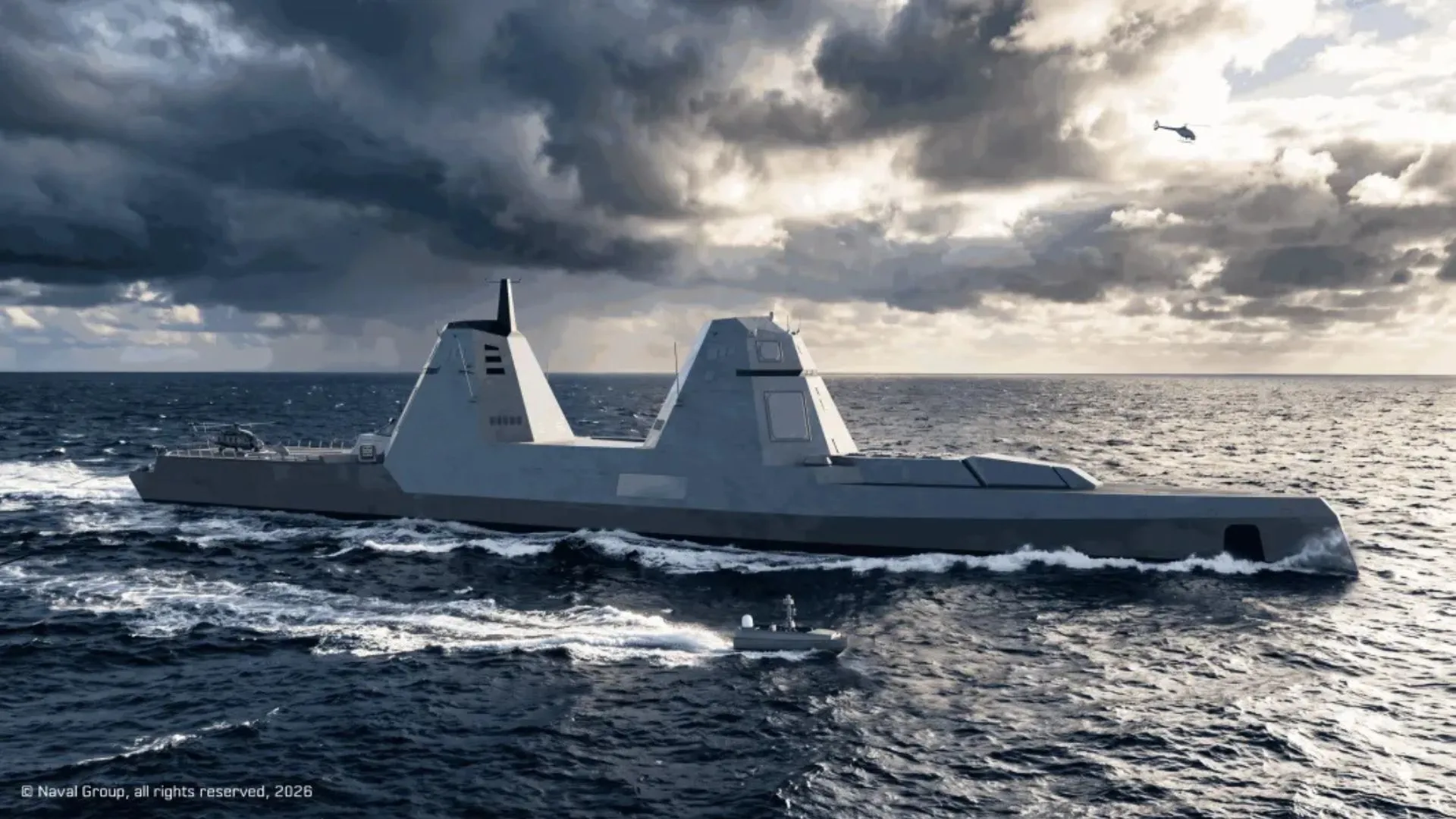
Naval Group unveiled the SCX 26 on November 3, 2026, an 8,000-tonne surface combatant concept that pairs more than 100 vertical launch system (VLS) cells with an electromagnetic gun, a 100-kilowatt laser and a dedicated drone mission bay. The French shipbuilder presented the design at Euronaval 2026, held November 3 to 6 at Paris Nord Villepinte, as its answer to high-intensity naval combat shaped by aerial, surface and underwater drones, saturated defenses, electronic warfare, cyberattacks and ballistic and hypersonic threats.
The SCX 26 is not a procurement program. In its official announcement, Naval Group describes the concept ship as a forward-looking exercise that explores technologies, architectures and operational approaches, and states that it is not necessarily tied to a future build. The SCX 26 arrives as European navies absorb lessons from the Red Sea, where frigates expended high-end interceptors against low-cost drones, and as several of them move toward larger, more heavily armed combatants.
SCX 26 Concept Ship Design: 170 Meters, 8,000 Tonnes, 30 Knots
The SCX 26 measures 170 meters and displaces 8,000 tonnes, with a design speed of 30 knots and a range of more than 8,000 nautical miles. That places it firmly in destroyer territory. Publicly available specifications indicate that Naval Group’s Amiral Ronarc’h-class defense and intervention frigate (FDI) measures 122 meters and roughly 4,460 tonnes, with a top speed of 27 knots and a range of about 5,000 nautical miles at 15 knots. The French Navy’s Horizon-class air defense destroyers measure about 153 meters and 7,050 tonnes.
The hull is organized around two integrated modules separated by a flex zone, designed to absorb new operational capabilities in a modular format over the ship’s service life. The aft section houses a large mission bay that serves as a centralized facility for launching, recovering and updating drones. Integrated lifting systems and a large-capacity elevator allow the crew to load, maintain, deploy and recover drones and helicopters. Naval Group lists intelligence, surveillance, electronic warfare, anti-submarine warfare and force protection as candidate drone roles, positioning the ship as a node in a distributed force of ships, aircraft and unmanned systems rather than a standalone shooter.
Naval Group sizes the crew at 150 sailors, with an additional 100 berths for senior officers and specialist personnel, which points to a flagship or task group command role. The company has not disclosed the propulsion architecture, installed power, generation capacity or cooling arrangements. Those figures are central to assessing the design, since both the laser and the electromagnetic gun depend on large and sustained electrical loads.
Sensors and Weapons: VLS Density, Electromagnetic Gun and 100 kW Laser
The sensor suite combines an ultra high frequency (UHF) radar designed for ballistic missile defense, a full sonar suite for anti-submarine warfare and advanced electronic warfare capabilities. Suppliers and detection ranges are undisclosed.
The main missile battery comprises more than 100 VLS cells of various classes. Launcher family and missile types are unspecified. Open-source figures put the scale in perspective: the Horizon class carries 48 cells, the French FDI ships enter service with 16 cells and a planned growth path to 32, Italy’s future DDX destroyer is slated for 80 cells, and a US Navy Arleigh Burke-class destroyer carries 96 Mk 41 cells.
The electromagnetic gun is described only as capable of rapid fire, with no caliber, muzzle energy or range figures. The technology remains immature at sea: the US Navy ended funding for its railgun effort in its fiscal 2022 budget request, while Japan’s Acquisition, Technology and Logistics Agency reported at-sea firings in 2023. The 100-kilowatt laser would also exceed the roughly 60-kilowatt class HELIOS system fielded on the US destroyer USS Preble.
Close-range protection combines two Rampart multipurpose modular launchers with the 100-kilowatt laser, complemented by remotely operated munitions and 360-degree remotely operated secondary artillery. Publicly available data indicate that Rampart uses four interchangeable modules and can carry up to 80 guided 68 mm rockets; it completed its first at-sea firings aboard the amphibious ship FS Tonnerre during the French Navy’s WILDFIRE 26.2 counter-drone exercise, held from September 28 to October 2, 2026. Survivability rests on segregation and redundancy, with two masts and launchers distributed between bow and stern.
Analysis: The SCX 26 is built around cost per engagement rather than raw firepower. A layered mix of laser, electromagnetic gun and Rampart rockets is meant to handle cheap drones and swarms, preserving a deep VLS magazine for ballistic, hypersonic and high-end air threats. That logic directly addresses the Red Sea problem of firing interceptors costing more than $1 million at drones costing a fraction of that. The concept also signals that Naval Group intends to compete in the destroyer-class market, not only the mid-size frigate segment where the FDI sits. Its credibility, however, depends on the undisclosed power and thermal architecture: neither a 100-kilowatt laser nor a rapid-fire electromagnetic gun is operational on any European warship today.
Naval Group has not released a cost estimate, timeline, propulsion design or prospective customer for the SCX 26. Key indicators to watch include whether elements of the concept migrate into FDI evolutions, how Rampart progresses after its WILDFIRE trials, and how the French Navy frames its long-term requirement for a successor to the Horizon-class destroyers.