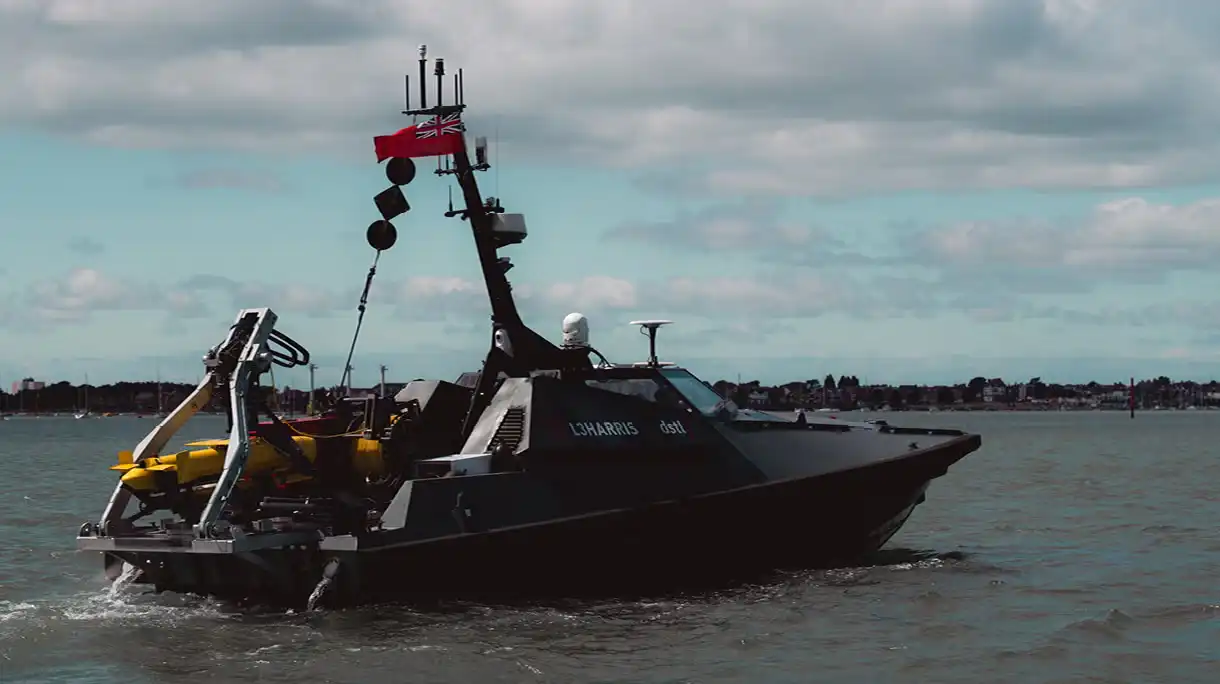
L3Harris Technologies on November 3, 2026 detailed Hunterwater, an unmanned surface vehicle (USV) that conducts the full minehunting cycle of search, identification and neutralization without placing sailors or divers in the minefield. The company describes the system as fielded rather than a concept or prototype, though it has not named an operating navy.
Mine clearance remains one of the most personnel-intensive missions in naval warfare, still built largely around crewed mine countermeasures vessels, helicopters and clearance divers. The US Navy is replacing its Avenger-class (MCM-1) ships and MH-53E helicopters with the Mine Countermeasures Unmanned Surface Vehicle (MCM USV), a program that has delivered nine craft, with 18 more under contract toward a final inventory of 48, according to the Navy. “Hunterwater is our answer to a question the Navy has been asking for decades: How do you clear a minefield without putting sailors in it?” said Nino DiCosmo, President, Maritime, Space and Mission Systems, L3Harris. The system was developed by Italy-based subsidiary L3Harris Calzoni and unveiled at Seafuture 2023 in La Spezia.
Inside L3Harris Hunterwater: ROVSCAN, Acoustic Markers and Disposable VGAs
Hunterwater is a system-of-systems built around a compact USV that company literature lists at 8 meters long, 2.2 meters wide and 4 tons fully loaded. The craft carries and manages an onboard Mine Countermeasure Kit (MCM Kit) made up of two vehicle types: the ROVSCAN and a set of four acoustic guided vehicles (VGA). The boat can operate unmanned under remote command and monitoring or with a crew aboard, and L3Harris states it can work more than five nautical miles from its host vessel. Company literature credits the craft with a top speed above 18 knots and more than eight hours of standoff endurance.
The ROVSCAN merges the mobility of a remotely operated vehicle (ROV) with sidescan sonar detection, allowing a single vehicle to perform site survey, detection and identification. It operates in both towed and tethered scanning modes. For identification it carries a multibeam imaging sonar and a high-definition camera, supported by laser pointers for precise target positioning. Once a mine-like contact is confirmed, the ROVSCAN performs precise acoustic localization (PAL) and lays an acoustic marker on the target; its base payload holds four markers.
Neutralization falls to the VGA, a disposable, lightweight vehicle launched from the USV. It reacquires the marked target autonomously using onboard acoustic arrays and destroys it. Company literature lists the VGA at 0.8 meters long and 20 kilograms, with neutralization by direct impact using a small shaped charge; its speed and endurance have not been published.
The architecture carries direct operational weight. Combining search and identification in one vehicle shortens a detect-to-engage chain that conventional minehunting splits across sonar platforms, ROVs and divers. Marker-based handoff to a one-shot neutralizer also avoids risking a costly identification vehicle at the point of detonation. With four markers and four VGAs in the published load, however, company literature cites at least four neutralizations per mission, a load that would require frequent rearming in dense minefields.
Container Portability and Iver4 Teaming Shape Hunterwater Employment
The complete Hunterwater USV system fits in a single 40-foot ISO container. That footprint allows movement by commercial sealift, road or rail, and L3Harris cites low impact for installation on the host ship. For navies that must surge countermine capacity into a theater on short notice, it reduces dependence on scarce specialized hulls.
Hunterwater is designed to work in parallel with other USVs and autonomous underwater vehicles (AUVs), including the L3Harris Iver4. In that concept, the vehicles can run multiple or parallel search and identification operations. L3Harris also markets the MCM Kit for installation on other types of USVs.
The system enters a crowded field. The US Navy MCM USV tows a sonar for minehunting and an influence sweep for minesweeping, with neutralization listed among its future payloads. Exail is supplying Indonesia with Inspector 90 USVs carrying Seascan and K-Ster mine identification and disposal systems, while Singapore has contracted ST Engineering for an unmanned suite that will progressively replace its Bedok-class vessels. Hunterwater sits at the compact end of that spectrum, trading the size and endurance of larger craft for a self-contained kill chain.
Analysis: Hunterwater’s value proposition is not range or endurance but closure of the full detect-to-engage loop on one small, containerized platform, targeting the step that still depends most on divers. Its description as fielded, without a named customer, quantity or contract value, leaves operational maturity unverified in open sources. For the US Navy, whose MCM USV program lists neutralization as a future payload, a kit of this type reads as a plausible complement rather than a competitor.
Sea-state limits, VGA warhead weight and unit cost remain undisclosed, and the published speed and endurance figures come from 2022 company literature rather than the November release. The identity of current operators, and whether L3Harris will offer Hunterwater into US or allied countermine recapitalization efforts, are the next points to watch, alongside any exercise or contract announcement confirming the system in service.