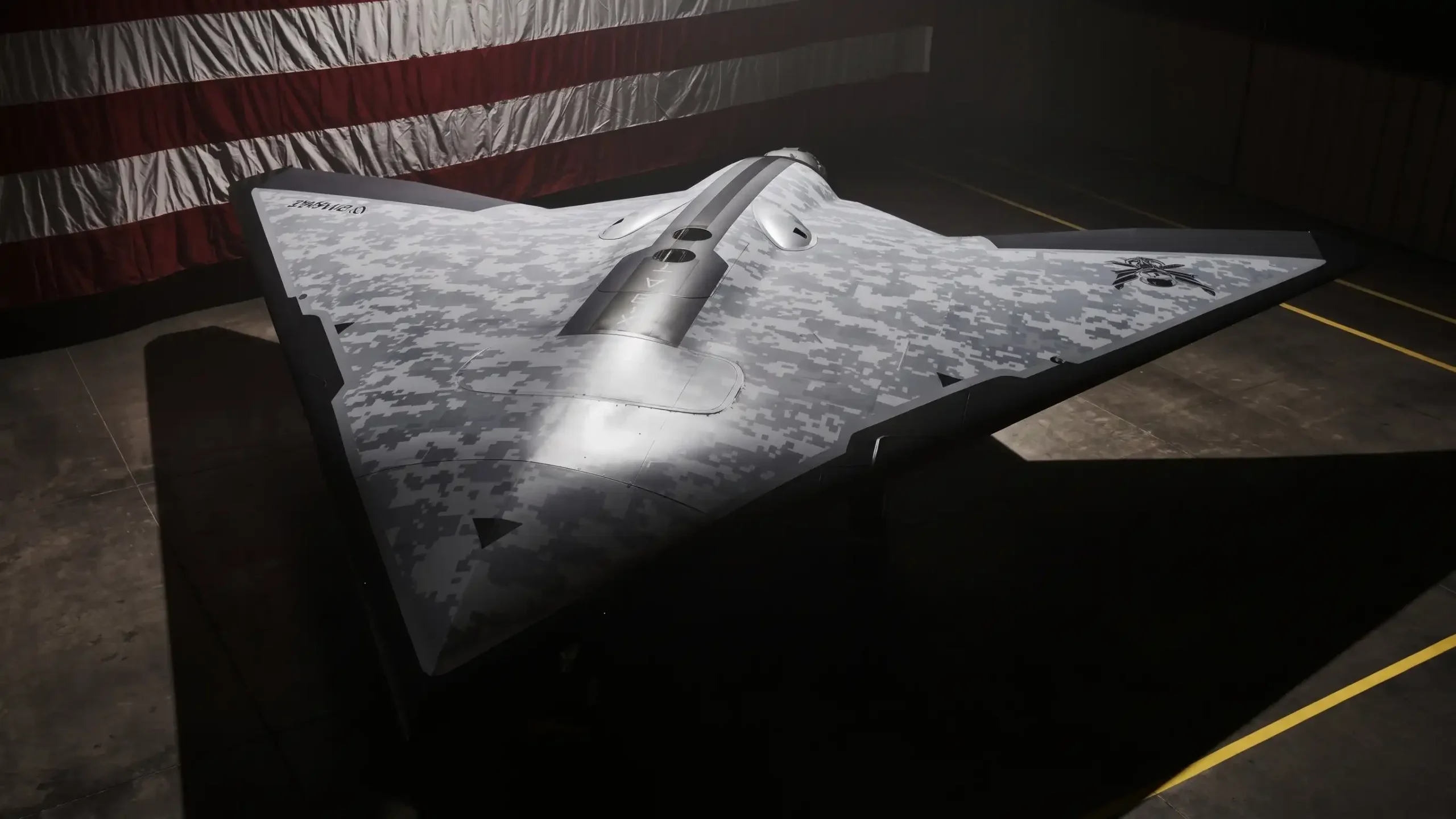
Shield AI has completed the first full-scale prototype of its X-BAT vertical take-off and landing (VTOL) combat drone, releasing imagery on November 3, 2026, as the aircraft, designated X-BAT 001, moved from the company’s Frisco, Texas, production hub to its flight test site in Newton, Kansas. A company official said the following day that the jet-powered, tail-sitting aircraft should fly at the Kansas range before the end of 2026.
The rollout comes 12 months after X-BAT’s October 2025 concept unveiling and follows $200 million in US Navy funding committed this year under the Runway Independent Maritime Expeditionary Strike (RIMES) effort. It also coincided with the IQPC International Fighter Conference (IFC) 2026 in Munich, where Andrew Hawkes, Shield AI’s director of collaborative combat aircraft (CCA) Europe, told Janes that European interest has grown steadily since the concept’s public debut.
Inside the X-BAT Prototype: F110 Engine, Vectoring Nozzle, Airframe Changes
X-BAT 001 is the first of two full-scale prototypes. Hawkes described it as a full-size aircraft with complete autonomy and full integration of the General Electric F110-GE-129 afterburning turbofan with thrust vectoring. The F110-GE-129, which powers late-model F-16s and the F-15EX, sits in the 29,000-pound-thrust class with afterburner, according to publicly available specifications. Shield AI and GE Aerospace completed engine light-off testing with the thrust-vectoring nozzle in July 2026.
The vectoring nozzle draws on the Axisymmetric Vectoring Exhaust Nozzle (AVEN) developed in the 1990s for an experimental thrust-vectoring F-16, and Shield AI reused the original test article, stored for decades. The nozzle provides pitch and yaw control only; roll control is to come from engine bleed air routed through thrusters in the wings. Flight control software builds on the smaller, piston-powered V-BAT tail-sitter, eliminating landing gear and enabling launch and recovery from a mobile trailer.
A half-scale model shown at the Navy League’s Sea-Air-Space 2026 exposition in April had already replaced the original cranked-kite planform with an arrowhead shape featuring a straight, more sharply swept leading edge. On X-BAT 001, the nozzle extends well aft of the wing trailing edges rather than sitting inset. Two bulges with small forward openings flank the dorsal spine, which also carries two mesh-screened circular apertures. Shield AI declined to explain these features when asked by The War Zone (TWZ), which noted they may relate to the propulsion system.
Shield AI’s published figures cite a 39-foot wingspan, a maximum range above 2,000 nautical miles, a ceiling above 50,000 feet, and a maneuver load factor greater than 4g. Armor Harris, Shield AI’s senior vice president of aircraft engineering, has compared the prototype-to-production gap to that between Lockheed Martin’s X-35 and the F-35. Shield AI has said the prototype nozzle would initially lack low-observable treatment, to be added after initial testing.
Navy RIMES Funding and the Path to 2029 Production
The Navy’s $200 million arrived in two tranches, a $50 million action in August followed by $150 million, with part of the money routed through the Office of the Under Secretary of War for Acquisition and Sustainment. Shield AI has matched it with an equal internal commitment. The Department of the Navy Rapid Capabilities Office (DONRCO) and the Defense Innovation Unit (DIU) run RIMES, a runway-independent, long-range maritime strike effort distinct from the Navy’s carrier-based CCA program. A Navy spokesperson told TWZ that no operational capability date has been set, with timelines to depend on operational evaluations, flight-test performance, and fleet requirements.
The concept centers on the launch and recovery vehicle. On land, the trailer-mounted aircraft is meant to relocate constantly, much like a mobile missile launcher, complicating enemy targeting. At sea, Shield AI envisions dozens of X-BATs embarked on amphibious assault ships and expeditionary sea bases, adding strike capacity without displacing crewed carrier aircraft. The design carries munitions in internal bays and on underwing hardpoints, plus sensors and electronic warfare payloads, under the company’s Hivemind autonomy software. Shield AI has cited a target unit price of about $27 million.
In a company blog post, Harris positions X-BAT above Air Force Increment 1 CCAs such as the YFQ-42A and YFQ-44A, describing it as roughly twice their size, strike-capable, and more sensor-rich, with the F110 delivering a more fighter-like flight envelope than the smaller engines in those aircraft. Testing will proceed in stages: horizontal engine runs on the trailer, vertical engine runs, free flight while suspended from a large crane at the Kansas site, then untethered flight.
Analysis: X-BAT’s value rests on one unproven event: a fighter-class jet autonomously transitioning between vertical and horizontal flight. Earlier tail-sitting jets such as the Ryan X-13 Vertijet never reached service, a history Shield AI acknowledges. If the transition works, the Navy gains a distributed strike option that decouples sortie generation from carrier decks and fixed runways, a direct response to the long-range precision threat posed by China’s People’s Liberation Army Rocket Force. The same logic, applied to runway vulnerability on NATO’s eastern flank, explains the European interest voiced in Munich.
The immediate milestone is first flight, which Shield AI expects before December 31, 2026; the company has not specified whether that means tethered or free flight. A second full-scale prototype will follow. Shield AI targets a fully missionized flight in 2028, then series production at a planned Seattle-area facility and limited operational capability in 2029. The pace of the X-BAT 001 test campaign will be the first real measure of whether that three-year schedule holds.