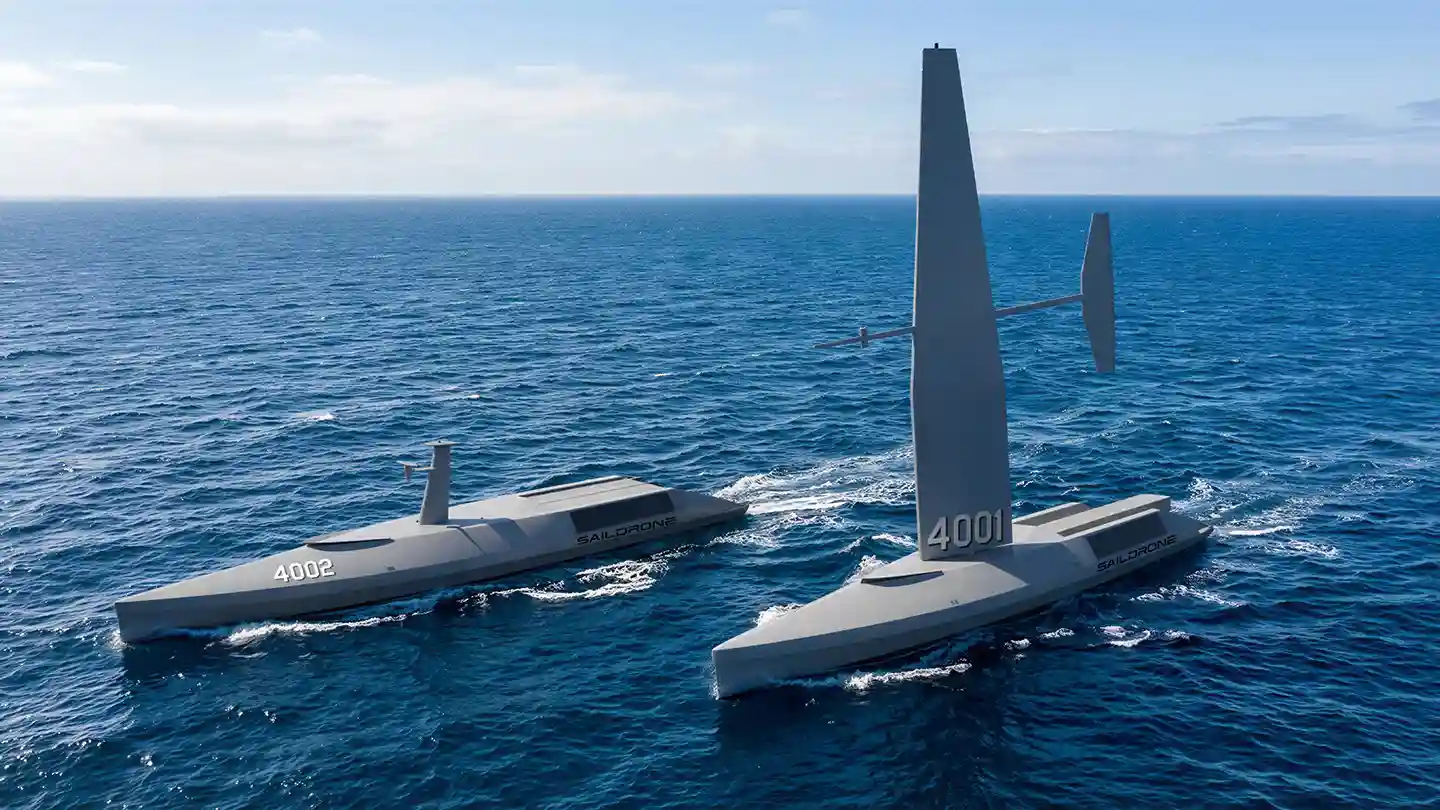
The US Court of Federal Claims has set aside the US Navy’s decision to exclude Saildrone from the Medium Unmanned Surface Vessel (MUSV) competition and ordered the service to reevaluate the company’s proposal, Saildrone announced on November 2, 2026. Until that reevaluation is complete, the Navy cannot commit more than $1.5 billion of the program’s $2.1 billion to production, according to the company. Judge Philip S. Hadji also denied a parallel protest from Blue Water Autonomy, finding the Navy’s elimination of that proposal reasonable.
The decision comes five weeks after the Navy awarded production other transaction (OT) agreements on September 29, 2026, to Galliano Marine Services, Huntington Ingalls Industries (HII) and Saronic Technologies, each covering 10 vessels at an average cost of $40 million per hull, with first deliveries expected before the end of fiscal 2027. The MUSV marketplace, launched in March 2026 after the cancellation of the Modular Attack Surface Craft (MASC) effort, is designed to field production-ready, mission-capable vessels quickly.
How the MUSV Competition Protest Unfolded in Federal Court
The Navy issued the MUSV solicitation on March 26, 2026, under its OT prototype authority. As publicly reported, the service sought a production-ready vessel able to carry two 40-foot containers and a 25-metric-ton payload over 2,500 nautical miles at 25 knots in sea state 4. In May, the Navy advanced seven companies to at-sea testing: Leidos, HII, Sea Machines, Saronic, Galliano Marine Services, PacMar Technologies and Birdon. Saildrone and Blue Water Autonomy were not selected, and both filed suit in late June.
According to Saildrone, the Navy initially found its proposal non-compliant on all three evaluation criteria, then withdrew two of those determinations after the company challenged them. The court rejected the remaining determination, concluding that the Navy had applied criteria to Saildrone that it did not apply to other competitors, which it found arbitrary and capricious. The specific technical point at issue has not been publicly disclosed.
The ruling followed an October 29 decision in which Judge Hadji denied the government’s motion to dismiss. The government had argued that the court lacked jurisdiction over OT prototype agreements; the judge held that the competition was conducted in connection with the procurement of MUSVs and therefore fell within the court’s bid protest authority. The Navy has not commented on the pending litigation.
Saildrone Spectre: The 170-Foot Design at the Center of the Dispute
Saildrone’s entry is Spectre, unveiled in April 2026. Company figures give the aluminum-hulled vessel a length of 52 meters (170 feet), a weight of about 250 tonnes and a top speed of up to 30 knots. Fincantieri Marine Group is slated to build it in its Wisconsin shipyards, with stated capacity for five hulls per year at a unit cost of roughly $40 million.
Spectre comes in two configurations. Silent Endurance carries a 43-meter (140-foot) composite wing for extended missions, and Saildrone says its dual electric and diesel propulsion allows near-silent transits at up to 12 knots, a profile aimed at anti-submarine warfare (ASW). Stealth Strike drops the wing for high-speed operations. The payload deck accommodates two 40-foot or up to five 20-foot containers, and Saildrone cites a range of 2,790 nautical miles at 25 knots with a 25,000-kilogram payload in sea state 4 head seas.
Announced integrations include two Lockheed Martin Mk 70 Payload Delivery System launchers, each packaging four Mk 41 vertical launch cells in a containerized module, and the Thales CAPTAS-4 variable depth sonar. A first article is expected at sea in early 2027. These are manufacturer figures that have not been independently validated. On paper they track the publicly described MUSV thresholds, but assessing compliance is precisely the task the court has returned to the Navy.
Analysis: The ruling’s most durable effect may be procedural rather than programmatic. OT agreements appeal to acquisition officials partly because excluded bidders cannot protest them at the Government Accountability Office (GAO). By holding that an OT prototype competition linked to production falls within its bid protest jurisdiction, the court signals that program offices running similar marketplaces may need evaluation records that withstand judicial review, balancing speed against defensibility. The split outcome also matters: by upholding the elimination of Blue Water Autonomy, the court did not reject the Navy’s evaluation framework as a whole.
The Navy must now reevaluate Saildrone’s proposal using the criteria applied to other offerors. No timeline has been made public, and the service has not said whether it will appeal. The Navy issued a second MUSV solicitation on September 23, 2026. Saildrone founder and CEO Richard Jenkins said the company is eager to move beyond the litigation, adding: “The future of naval warfare will be fought on the water, not in a courtroom.”