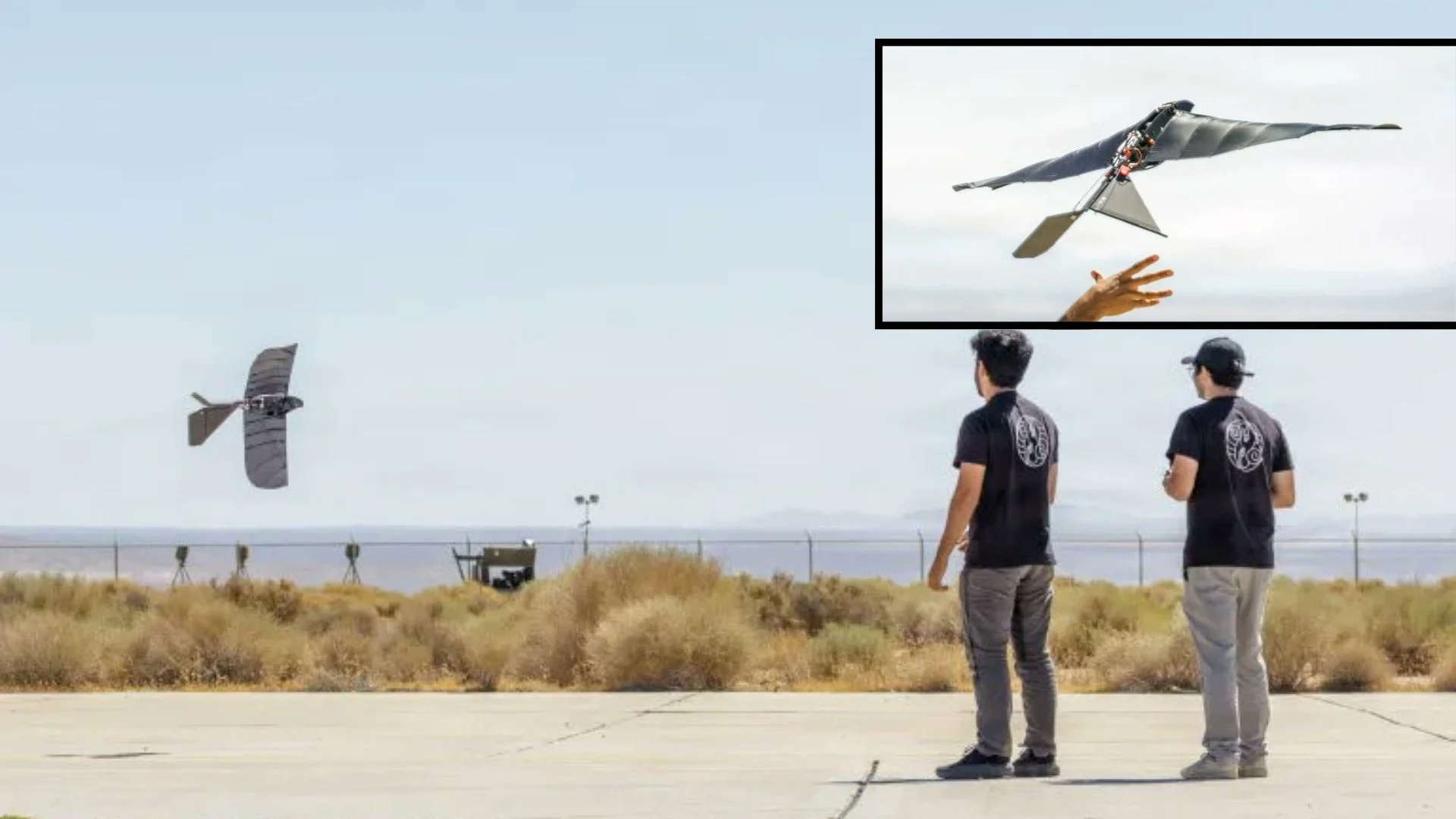
A one-pound flapping-wing drone built by Los Angeles startup Ornadyne went unidentified by commercial counter-unmanned aircraft system (C-UAS) sensors during the Game of Drones 26-3 experimentation event at Edwards Air Force Base, California, in September 2026. According to co-founder Geourg Kivijian, detection equipment fielded by other companies at the event classified the O1 ornithopter as a bird rather than a drone.
The result, disclosed by the Defense Contract Management Agency (DCMA), comes as the Pentagon races to harden installations and forward units against small UAS threats. Game of Drones is a recurring experimentation series for small UAS and counter-small UAS (C-sUAS) technologies, sponsored by DCMA’s Blue List team, which approves commercial drones for sale to the U.S. military, and the 412th Test Wing’s Experimental Test Force. Co-founder Armen Arakelyan said it was the first time the company had tested the O1 against detection systems built by other private companies.
How the Ornadyne O1 Drone Defeats Signature-Based Classification
Most small UAS are detected through a predictable set of cues: the acoustic signature of propellers, micro-Doppler radar returns generated by spinning rotor blades, and radio frequency (RF) emissions from command and video links. C-UAS software must also handle birds, which routinely trigger false positives, so classification pipelines are frequently tuned to discard tracks that behave like wildlife.
The O1 is engineered to exploit that filter. It generates lift and thrust by flapping its wings instead of turning propellers, and Air Force imagery from the event describes it as mimicking a crow in shape and profile. Arakelyan said in the DCMA release that because the aircraft looks and moves like a bird, both human observers and C-UAS systems can misclassify it. He added that replacing propellers with flapping wings also makes it much quieter than propeller-driven UAS.
Ornadyne has not disclosed the O1’s datalink configuration or whether it flew autonomously, so whether it also evaded RF detection is unconfirmed. The C-UAS vendors and sensor types involved have not been named.
O1 Specifications: One Pound, 10 Kilometers, Hour-Class Endurance
Per a company fact sheet, the O1 weighs 1 pound (about 0.45 kilograms), flies up to 10 kilometers (6.2 miles), and stays airborne for more than an hour. Company materials describe a crow-shaped airframe with a wingspan of roughly one meter and a payload budget of 50 to 100 grams, currently allocated to a camera for reconnaissance and target recognition.
Ornadyne says the airframe’s color, wingspan, proportions, and silhouette can be adapted to match native bird species in a given theater, extending the deception to human observers as well as sensors. The company reported the O1 at Technology Readiness Level (TRL) 4 to 5 in June 2026, a level that denotes component and subsystem validation rather than a production-representative system.
Founded in 2026 by Geourg Kivijian and Armen Arakelyan, Ornadyne went through Y Combinator’s Spring 2026 batch and showed the O1 at Special Operations Forces (SOF) Week 2026. Rival efforts exist: footage from a 2024 People’s Liberation Army (PLA) exercise showed Jiaolong commando personnel launching a sparrow-like flapping-wing drone.
Analysis: The O1 result points to a structural weakness rather than a single sensor failure. C-UAS architectures rely on classification libraries built around known drone signatures, and they are deliberately biased to ignore birds to keep operator workload manageable. A platform designed to sit inside that clutter category forces a hard trade: tighten classification and flood operators with avian false alarms, or accept a blind spot that adversary biomimetic intelligence, surveillance, and reconnaissance (ISR) platforms can exploit. Detection is the first link in the kill chain, and an interceptor or jammer can only engage what the sensor layer hands it. With the PLA already experimenting with comparable designs, US base defense and maneuver-force C-sUAS programs will need behavioral analytics, such as loiter patterns and track persistence over sensitive sites, that discriminate intent rather than airframe type.
Open questions include sortie count, detection ranges, and O1 performance in wind, rain, or a contested electromagnetic environment. Ornadyne said in mid-2026 that it aims to deliver a high-fidelity system to military operators within six to 12 months. A Blue List approval would be the clearest signal that the O1 is moving from demonstrator toward procurement.