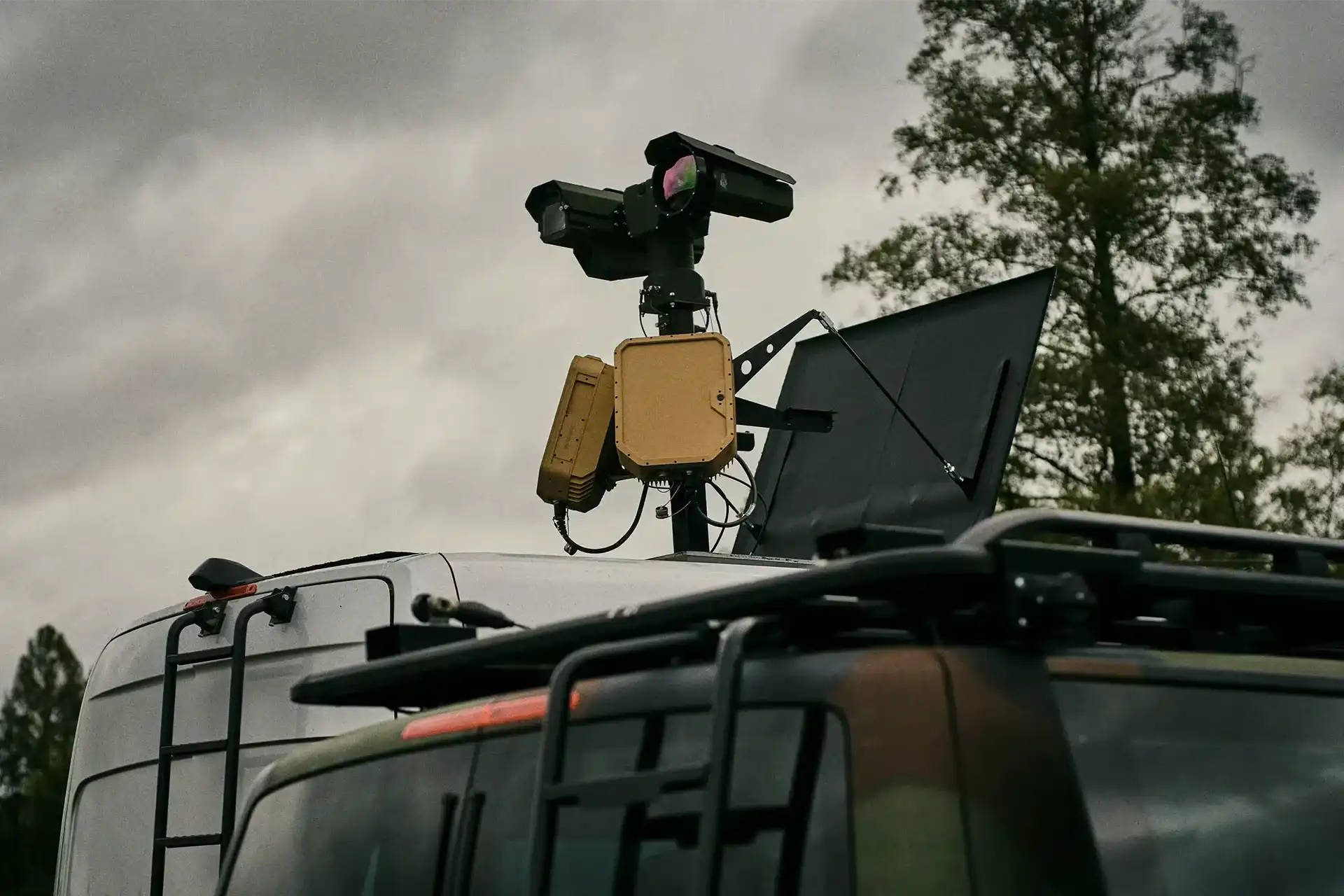
Shield has signed a definitive agreement to acquire Echodyne Corp., the Kirkland, Washington, maker of metamaterials-based counter-drone radars, in a transaction valued at $5.3 billion, the two companies announced on November 5, 2026. To fund the deal, Shield is raising $2.5 billion, including $1 billion in Series H equity at a $28.8 billion post-money valuation. The acquisition is expected to close in early 2027, subject to regulatory approvals.
The deal gives Shield, best known under the Shield AI name for its Hivemind autonomy software and V-BAT drone, a sensor business as Pentagon demand for counter-unmanned aircraft systems (C-UAS) accelerates. Joint Interagency Task Force 401 (JIATF-401) awarded 10 indefinite-delivery/indefinite-quantity (IDIQ) contracts with combined base ceilings of $4.15 billion in late September for its Domestic Shield program. Echodyne received a $250 million ceiling award in that round. Shield’s valuation has more than doubled since its March 2026 Series G at $12.7 billion.
Inside the Shield Echodyne Acquisition: $5.3 Billion Deal Structure
Of the $5.3 billion headline value, $4.8 billion will be paid and issued at closing, with up to $500 million more contingent on Echodyne meeting agreed performance targets. The companies have not disclosed the split between cash and Shield stock, nor Echodyne’s revenue, beyond stating that both firms expect triple-digit revenue growth this fiscal year.
The $2.5 billion financing package combines three instruments: $1 billion in Series H funding co-led by Disruptive and Innovation X Capital; a $1 billion structured equity investment from funds managed by Blackstone; and $500 million in debt financing, with JPMorgan Chase Bank, N.A. as sole arranger. Advent, JPMorganChase’s Strategic Investment Group, Snowpoint Ventures, Apandion and Center15 Capital also joined the Series H, whose proceeds will principally fund the acquisition.
Echodyne will slot into Shield’s Mission Systems unit, the third leg of a structure that CEO Gary Steele described as “three fast-growing, high-margin, mutually supporting business units: autonomy software, autonomous systems, and mission systems.” Echodyne CEO Eben Frankenberg will report directly to Steele and keep responsibility for products, manufacturing, and partner and customer engagement. The Echodyne team stays in place, and MESA radars will remain available as standalone products to third-party integrators.
The deal follows Shield’s purchase of simulation specialist Aechelon Technology, financed through the March 2026 Series G. Echodyne also deepens Shield’s Washington footprint: on September 30, 2026, the company named Des Moines, south of Seattle, as the production home of its X-BAT vertical takeoff and landing combat aircraft.
How MESA Radar Technology Anchors Shield’s Counter-Drone Push
Echodyne’s core technology is its patented Metamaterials Electronically Scanned Array (MESA), which steers radar beams electronically without the discrete phase shifters of conventional active electronically scanned arrays. Built with standard materials and manufacturing processes, MESA yields a solid-state radar with no moving parts and a cost and size, weight and power (SWaP) profile closer to commercial electronics than to military AESA hardware.
Two products carry most of the C-UAS load. Publicly available specifications indicate the short-range EchoGuard operates in K-band (24.45 to 24.65 GHz), covers a 120-degree by 80-degree field of view, tracks up to 20 targets simultaneously and weighs about 1.25 kg. The medium-range EchoShield is a Ku-band pulse-Doppler radar with the equivalent of more than 500 transmit/receive modules, angular accuracy of 0.5 degrees or better in azimuth and elevation, a 10 Hz track update rate and capacity to track roughly 1,000 objects. Echodyne’s published EchoShield tracking ranges (not maximum ranges) include 3.7 km against a DJI Phantom 4-class quadcopter and 11.1 km against a Cessna-class light aircraft.
Those figures matter because a C-UAS kill chain is only as fast as its fire-control-quality track. Echodyne radars are integrated on remote weapon stations, high-energy lasers and high-power microwave systems, and they cue interceptors toward incoming drones. Precise 3D tracks at 10 Hz let an electro-optical sensor or laser slew onto a small target without a separate search phase.
Production capacity is the other asset. Echodyne recently opened an 86,350-square-foot manufacturing facility in Kirkland, a $40 million investment able to produce about 30,000 radars per year. Under the JIATF-401 IDIQ, MESA radars are available through the task force’s C-UAS Marketplace to US and allied forces during an ordering period of up to 36 months. The $250 million figure is a ceiling, not a guaranteed purchase.
Analysis: The acquisition is a bet that sensing, not effectors, will be the bottleneck in layered drone defense, and that a high-volume radar line gives an autonomy company leverage across the market. Echodyne received half the ceiling of rivals such as RADA Technologies and SRC in the JIATF-401 round, but its radars already sit inside hundreds of third-party systems in more than 40 countries. That installed base is both the prize and the risk: integrators competing with Shield will now buy their primary sensor from a rival, making the pledge to keep MESA radars on the open market central to the deal’s value. The financing also matters: $1.5 billion of the $2.5 billion arrives as structured equity and debt, adding fixed obligations while X-BAT heads toward a planned 2029 production start.
Regulatory review will set the closing date, targeted for early 2027. After closing, watch the pace of JIATF-401 task orders, the ramp of the Kirkland line toward its 30,000-unit annual capacity, and whether MESA sensors migrate onto Shield’s own V-BAT and X-BAT platforms, an integration neither company has announced. How much of the $500 million earn-out Echodyne collects will show whether its growth projections hold.