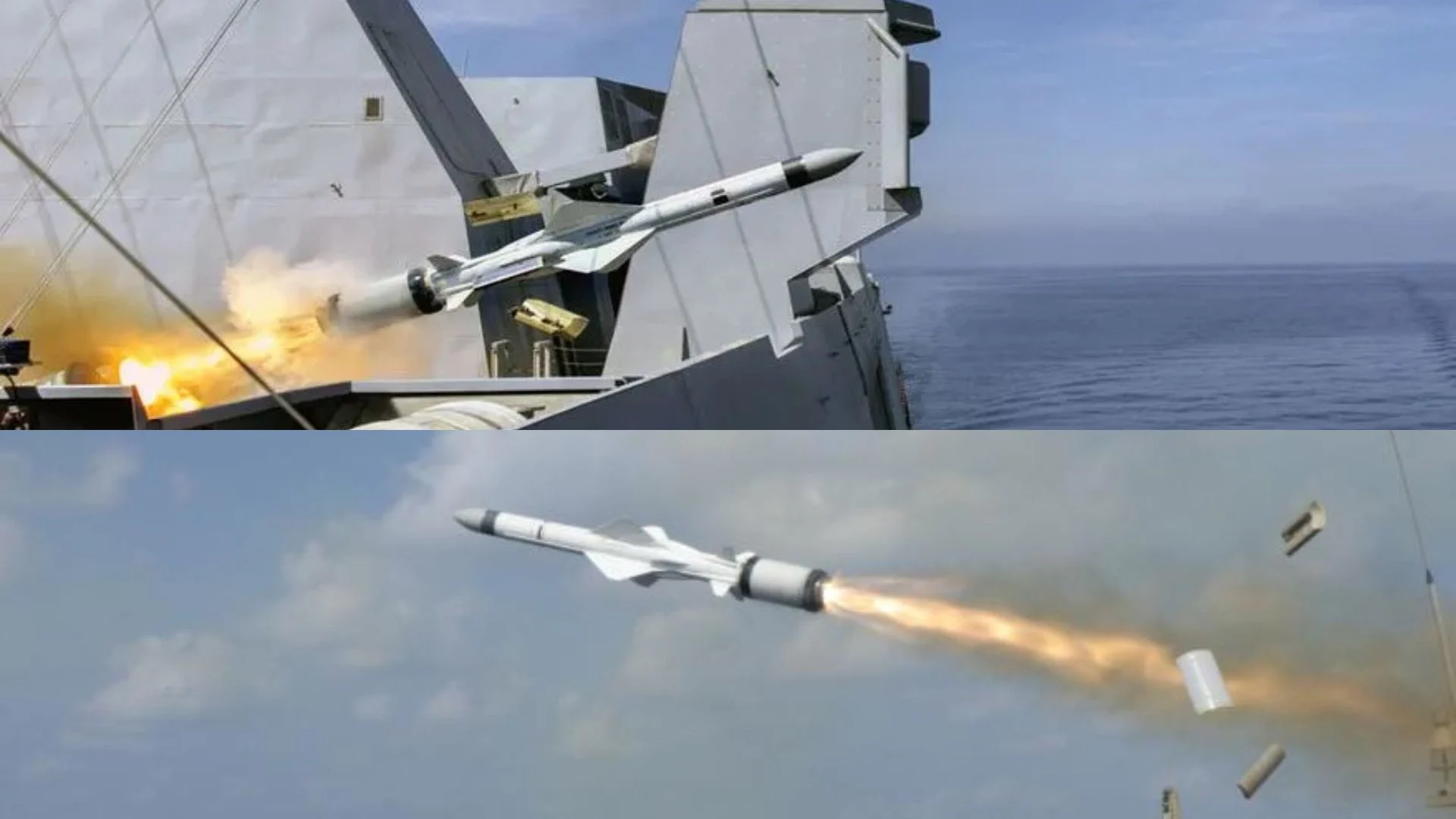
France’s Directorate General for Armament (DGA) announced on November 4, 2026, at the Euronaval exhibition that it will shortly sign a framework agreement with MBDA for Exocet MM40 Block 3C (MM40 B3C) anti-ship missiles for the French Navy. The same agreement will let the DGA place orders on behalf of partner nations, notably under the European Union’s Security Action for Europe (SAFE) loan instrument. Deliveries to the French Navy are scheduled to begin in 2029.
The DGA qualified the variant in 2024, following an operational evaluation firing from the air-defense frigate Alsace on September 20, 2023, and the missile already equips the French Navy’s first-rank frigates. The ministry did not disclose the number of missiles, the value of the framework, or its duration. Deliveries will follow the schedule set by the 2024-2030 Military Programming Law (LPM).
Exocet MM40 Block 3C Seeker and Guidance Upgrades Explained
Exocet is a family of high-subsonic, sea-skimming anti-ship missiles that can be launched from naval, air, and land platforms. Its development has advanced through successive standards designated Block 1, 2, 3, and 3C. According to the Ministry of the Armed Forces, the MM40 B3C reaches beyond 200 km and adds two main components to the Block 3: a digital radar altimeter and a new seeker.
Open-source reporting identifies the seeker as a Thales coherent active radar unit, which accounts for the “C” in the designation. The ministry states that both upgrades target two specific threats: next-generation electronic countermeasures, now widespread on modern warships, and low-observable hulls designed to reduce radar returns. Ministry documentation also cites GPS-aided navigation, giving the missile a secondary capability against coastal targets.
Publicly available specifications for the MM40 Block 3 airframe indicate a length of about 5.8 m, a launch weight of roughly 870 kg, a 165 kg warhead, and a solid-propellant booster paired with a TR40 turbojet sustainer. MBDA has not published updated figures for the B3C. In French service, the missile arms the Aquitaine-class multi-mission frigates (FREMM), the Alsace-class air-defense FREMM, and the Defense and Intervention Frigate (FDI) program. MBDA is also converting in-service Block 3 rounds to the B3C standard, which extends the value of existing inventory.
How the DGA Framework Opens SAFE Funding to Partner Navies
The partner-nation clause is the most consequential element of the announcement. Under the framework, the DGA can contract with MBDA in the name and on behalf of foreign customers. That structure fits SAFE, the 150 billion euro loan instrument adopted by the Council of the EU on May 27, 2025, which favors joint procurement and requires that at least 65 percent of component value originate in the EU, the European Economic Area, or Ukraine.
Exocet has a broad installed base to draw on. MBDA reports 36 customers for the family, roughly half of which operate the Block 3 or 3C versions. Greece has already selected the MM40 B3C to arm its FDI frigates under construction by Naval Group. Final assembly takes place at MBDA’s Selles-Saint-Denis facility in central France. The ministry did not name which partner nations are expected to use the framework.
Analysis: The framework positions the DGA as a procurement aggregator rather than a single-customer buyer. Bundling French and allied requirements into one contract vehicle gives MBDA longer production visibility and lets smaller navies buy a mature, qualified missile without running their own competition. It also signals France’s near-term choice in the anti-ship domain: improving seeker performance and countermeasure resistance on a proven high-subsonic airframe, while speed and range increases are deferred to the Franco-British Future Cruise/Anti-Ship Weapon (FC/ASW) program planned for the next decade.
Key unknowns remain the signature date, the quantity committed for the French Navy, and the list of partner nations. Deliveries from 2029 place the bulk of new missiles at the tail end of the current LPM, which makes the next programming law the likely vehicle for any follow-on volume.