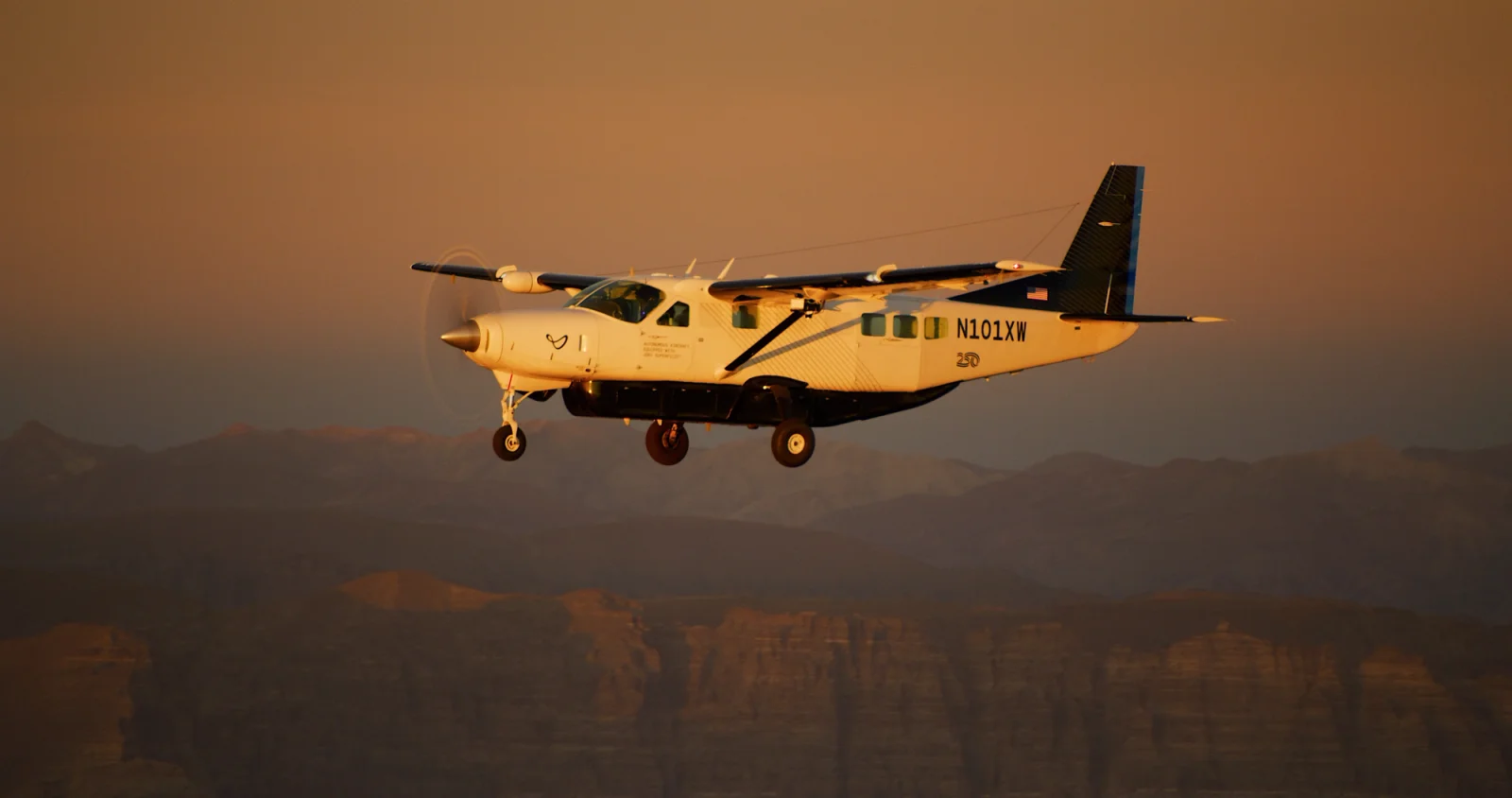
The U.S. Air Force has awarded Joby Aviation additional funding for its autonomous flight technology, raising the service’s total commitment to nearly $37 million from $20 million and lifting the ceiling on the company’s operational testing contract to $50 million, the company announced on November 4, 2026. Issued through AFWERX, the Air Force’s innovation arm, the funding spans two primary contracts covering autonomy software integration and expanded operational testing in the Pacific.
The award follows a multi-leg cross-country tour by Joby’s J208, a converted Cessna Caravan fitted with the company’s autonomy stack. The aircraft covered 6,665 miles, landed in 11 states and conducted integrated flight operations across 24 states as part of Joby’s 2026 Electric Skies campaign. For AFWERX, the work sits within a contested logistics effort aimed at keeping cargo moving in denied environments without putting aircrews at risk.
Joby Autonomous Flight Stack Moves Toward Uncrewed Cargo Operations
On the eastbound leg, completed September 18, 2026, the J208 flew 3,199 miles from Buchanan Field in Concord, California, to Dare County Regional Airport on North Carolina’s Outer Banks with zero control inputs from its onboard safety pilot. The system performed taxi, takeoff, route navigation and landing autonomously, with remote supervision reaching up to 2,537 miles over the full tour. Supervisors worked from Joby’s California autonomy headquarters and from Shaw Air Force Base, South Carolina, which also hosted a military operations demonstration.
The architecture combines onboard sensors and computing with automated flight controls. A ground-based operator monitors each flight, can update routes in real time and communicates with air traffic control. The stack derives from the autonomy division Joby acquired from Xwing in 2024 and has completed more than 400 fully autonomous flights, per the company. Joby has not disclosed its sensor suite, datalink or detect-and-avoid configuration.
The host airframe is central to the cost case. The Caravan family is a line of single-engine turboprops powered by Pratt & Whitney Canada PT6A engines. Textron Aviation lists a useful load of 3,305 lb for the current Caravan and 3,532 lb for the Grand Caravan EX with cargo pod; Joby has not specified which Caravan variant underpins the J208. Integrating autonomy onto a certified, widely fielded utility aircraft gives the Air Force a low-cost testbed rather than a clean-sheet uncrewed design.
Pacific Exercise Record Shapes AFWERX Contested Logistics Testing
The new contracts focus on follow-on Pacific military exercises. During Resolute Force Pacific (REFORPAC) in August 2025, Joby operated an aircraft in Hawaii remotely from Guam, nearly 4,000 miles away. In the Air Force readiness exercise Agile Flag, the system delivered replacement parts 24 hours faster than conventional logistics, according to the company.
“AFWERX is supporting the development and evaluation of autonomous airlift technologies to strengthen Air Force logistics resilience. Our goal is to sustain cargo operations in contested environments while reducing risk to aircrews and preserving crewed aircraft for missions that require them,” said Kate Brown, Contested Logistics Tactical Airlift Lead at AFWERX.
The split of funding between the two contracts has not been disclosed. Joby cautions that the $50 million figure is a ceiling the Air Force is not obligated to reach, and that payments remain subject to appropriations.
Analysis: The award tracks a doctrinal requirement more than a product bet. Agile Combat Employment in the Indo-Pacific disperses forces across austere airfields, placing heavy demand on C-130 and C-17 fleets for intra-theater resupply. An autonomy kit that converts existing light utility aircraft into uncrewed cargo carriers offers a way to thicken that last tactical mile without adding aircrew. The sums remain modest, however, and long-haul remote supervision introduces exposure to jamming and spoofing in a contested electromagnetic environment, a factor Joby has not publicly detailed.
The next milestones are the follow-on Pacific exercises funded under the new contracts and the closing of Joby’s planned acquisition of Resonant Sciences, a Dayton, Ohio, defense technology firm, for approximately $500 million, expected in early 2027. Resonant will then become Joby’s dedicated defense business. In parallel, J208 flights in Utah and North Carolina under the White House-backed eVTOL Integration Pilot Program will feed FAA rulemaking on autonomous flight. Still unresolved: the timeline for removing the onboard safety pilot and any path to an Air Force program of record.