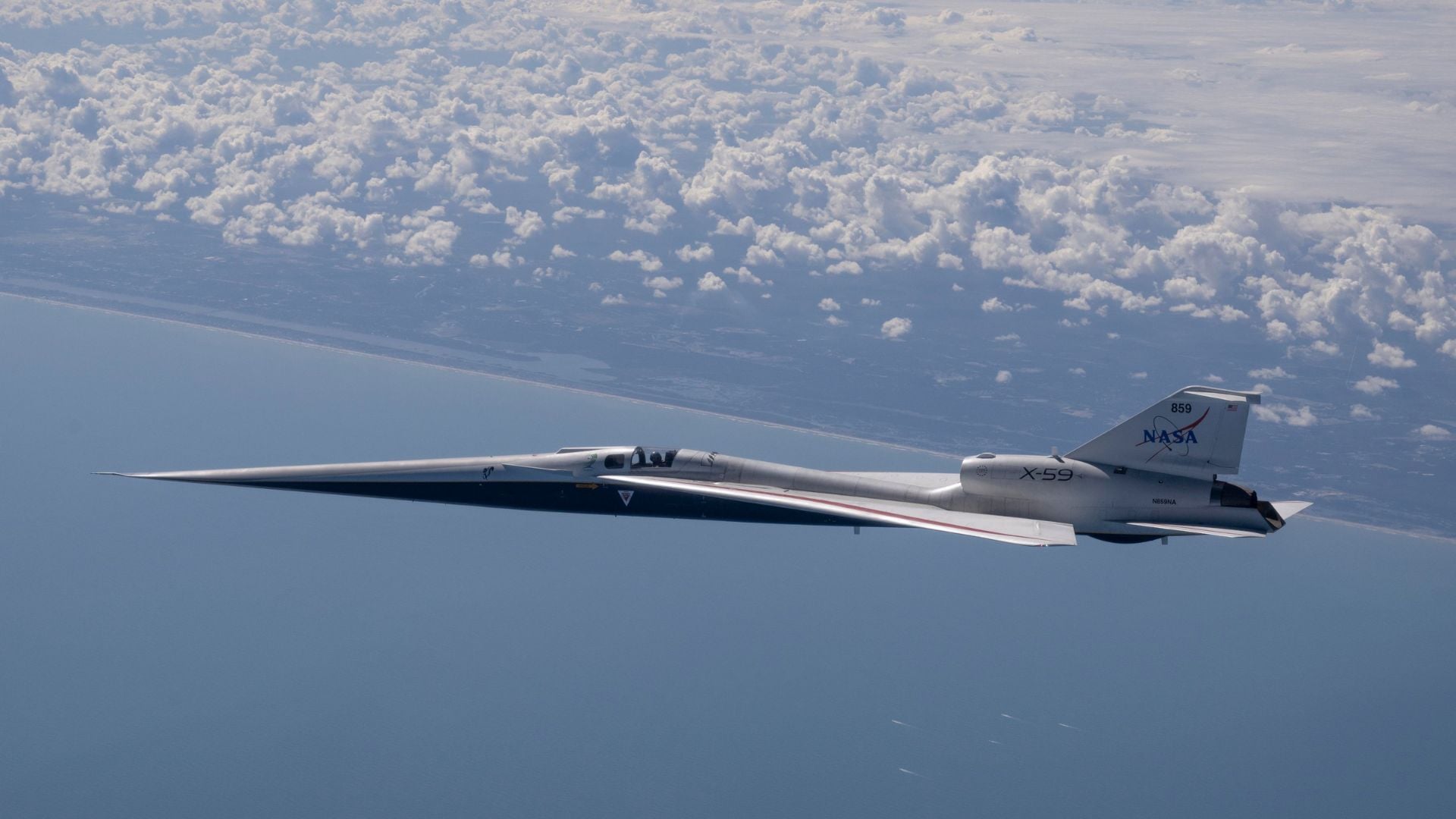
NASA’s X-59 quiet supersonic research aircraft flew from Birmingham, Alabama, to Daytona Beach, Florida, on November 5, 2026, the latest leg of its first cross-country transit. The Lockheed Martin-built demonstrator is headed to Kennedy Space Center, where NASA plans to feature it at the MAX POWER aerospace expo and air show on November 7 and 8.
The trip interrupts an envelope expansion campaign flown from Edwards Air Force Base, California, since the aircraft’s first flight on October 28, 2025. The X-59 left Edwards on October 28, 2026, exactly one year later, staging through El Paso and Fort Worth, Texas, before reaching Birmingham. It is the centerpiece of NASA’s Quesst mission, which aims to give regulators the data needed to reconsider the U.S. ban on overland commercial supersonic flight, in place since 1973.
X-59 Quiet Supersonic Test Record After One Year of Flight
The X-59 has logged more than 40 flights since its maiden sortie, a 67-minute low-speed systems check that topped out at 12,000 feet and 230 mph. NASA test pilot Jim “Clue” Less took the aircraft supersonic for the first time on June 5, 2026, reaching Mach 1.077. One week later, on June 12, the X-59 hit its design mission condition of Mach 1.4 at 55,000 feet. The envelope has since grown to Mach 1.53, roughly 1,010 mph, and altitudes above 56,000 feet.
The ferry flight, flown under callsign NASA859 with civil registration N859NA, is the aircraft’s first operation away from its California test ranges. Less and fellow NASA test pilot Nils Larson are sharing the legs, escorted by NASA F-15 and F/A-18 chase aircraft and supported by a NASA Gulfstream. Moving a one-of-a-kind X-plane through airfields across four states offers an early look at the logistics the later community overflight phase will demand.
Shaped Shock Waves: How the X-59 Airframe Suppresses the Boom
Publicly available specifications put the X-59 at roughly 99.7 feet long with a wingspan of about 29.5 feet. The tapered nose alone measures 38 feet, nearly a third of the aircraft’s length, and is designed to break up the shock waves that would otherwise merge into a conventional sonic boom. A single General Electric F414-GE-100 turbofan, derived from the F/A-18E/F Super Hornet engine and rated at about 22,000 pounds of thrust, sits atop the fuselage. That placement directs engine noise upward and keeps the lower surface clean so shock waves do not coalesce.
The nose leaves no room for a conventional forward windscreen, so the pilot relies on the eXternal Vision System, a camera-and-display suite that presents the forward view with flight data overlaid. NASA’s design target is a ground signature of about 75 perceived level decibels (PLdB), compared with roughly 100 to 110 dB attributed to the Concorde. A shock-sensing probe mounted on a NASA F-15 will measure the X-59’s actual signature during acoustic validation. NASA stresses that the X-59 is a research aircraft, not a prototype airliner.
Analysis: The Florida deployment is a public showcase, but it also costs flight test time. NASA set a goal of completing both envelope expansion and acoustic validation by the end of 2026, and envelope work is still under way. With roughly two weeks devoted to transit and display, that target looks increasingly tight, and community overflights appear more likely to begin in 2027. The stakes extend beyond NASA: a June 2025 executive order directed the Federal Aviation Administration to lift the overland ban and pursue a noise-based certification standard, and Quesst’s acoustic data is the most direct technical evidence available to underpin that standard.
NASA has listed the X-59 among the aircraft it will display at MAX POWER, where it will be on static display, according to AIN, and has scheduled an X-59 media session on November 8 with Less, Quesst mission manager Peter Coen, and NASA Aeronautics Division director Laurie Grindle. The agency has not published a date for the return transit to Edwards. Once back in California, the team will finish envelope expansion before shifting to acoustic validation, followed by overflights of selected U.S. communities whose survey results will go to U.S. and international regulators.