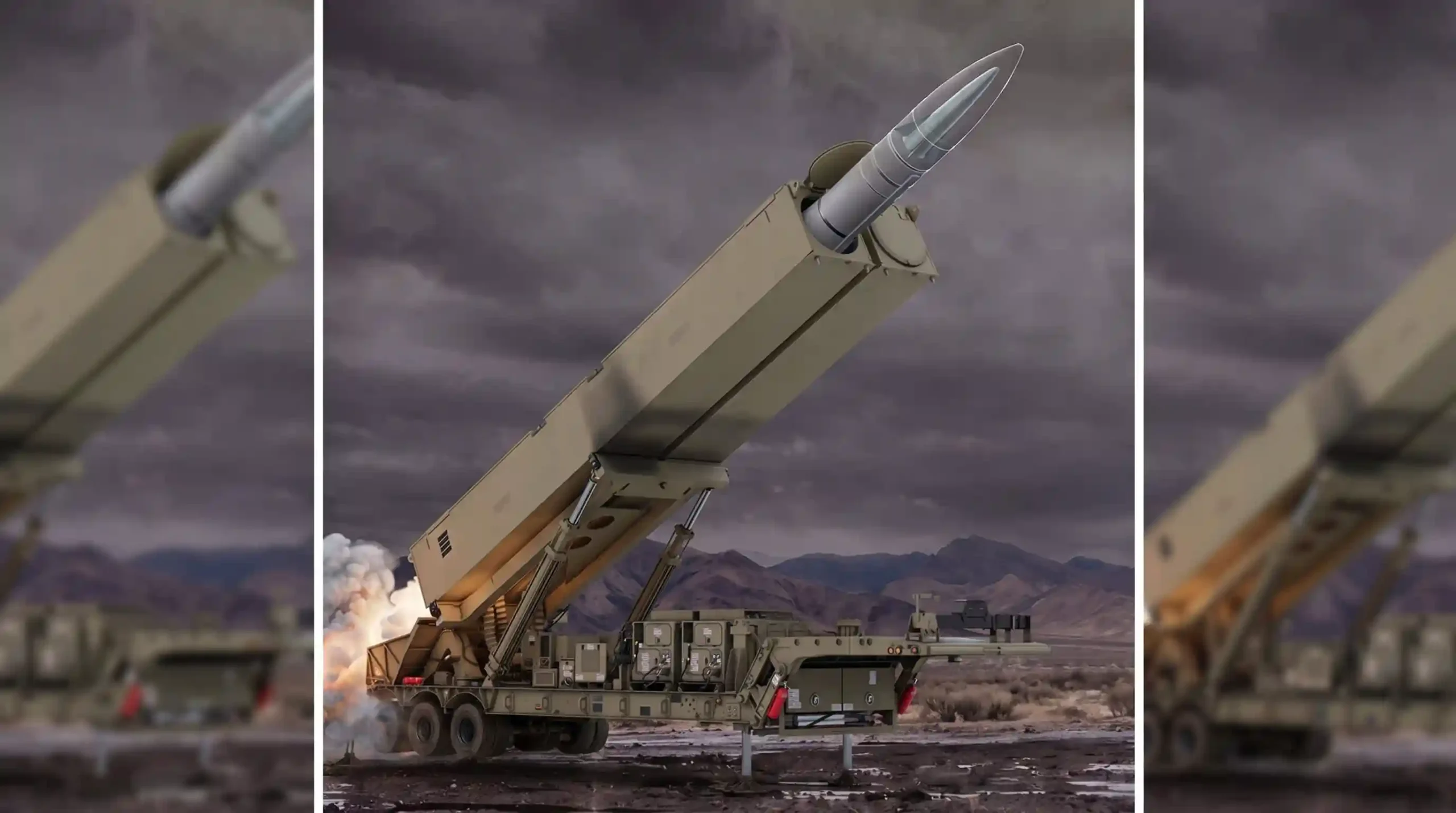
General Atomics Electromagnetic Systems (GA-EMS) will manufacture precision-machined parts and cable assemblies for the Common Hypersonic Glide Body (CHGB) under a multiyear subcontract from Leidos running through 2031, the company announced on November 4, 2026. The hardware supports both the U.S. Army’s Long-Range Hypersonic Weapon (LRHW), known as Dark Eagle, and the U.S. Navy’s Conventional Prompt Strike (CPS) program, which fly the same glide vehicle.
The subcontract sits under the $2.7 billion contract that Army Contracting Command at Redstone Arsenal awarded Leidos on March 31, 2026, and that Leidos made public on May 12. That award folded the CHGB and Thermal Protection System (TPS) efforts into a single vehicle and, according to the Army, became the glide body’s first production contract, shifting the program from an Other Transaction Authority agreement to a Federal Acquisition Regulation Part 15 contract. Neither GA-EMS nor Leidos disclosed the subcontract’s value or the number of glide bodies it covers.
What GA-EMS Will Build for the Common Hypersonic Glide Body
The work package covers two families of hardware: precision-machined metal parts and substructures for the glide body, and cable assemblies for both the glide body and its Elevon Control Module. The elevons are the movable control surfaces that steer the unpowered vehicle through its maneuvering glide phase, and the cable runs carry power and signals between guidance, actuation and payload sections. At speeds above Mach 5, those harnesses and structural parts operate under severe thermal and vibration loads, where one defective connector can cost the vehicle its control authority.
“Our expertise spans cable assemblies for the Elevon Control Module and hypersonic glide body, along with precision-machined metal parts and substructures,” said Mike Rucker, vice president of GA-EMS Weapons Programs. “For our customer, this combination brings continuity across electrical and mechanical manufacturing from a team familiar with the program’s exacting requirements.”
GA-EMS built prototype glide-body subassemblies and supplied hardware and cables for the 2020 CHGB flight test. According to the Department of Defense, the Navy and Army jointly conducted that test on March 19, 2020, from the Pacific Missile Range Facility in Kauai, Hawaii, with the glide body reaching hypersonic speed before striking its designated impact point. GA-EMS will draw on its existing domestic workforce and high-volume machining capacity.
“This agreement carries forward our prototype manufacturing and flight-test experience into component production through 2031,” said Scott Forney, president of GA-EMS.
One Glide Body Serving Dark Eagle and Conventional Prompt Strike
The CHGB descends from the Alternate Re-entry System developed by the Army and Sandia National Laboratories and flown as the Advanced Hypersonic Weapon in 2011, according to publicly available program histories. It is an unpowered, maneuvering vehicle carried to altitude and speed by a two-stage solid rocket booster common to both services, then released to glide through the atmosphere above Mach 5 on a path that ballistic missile defenses struggle to predict. Dark Eagle has a reported range of 1,725 miles (2,776 kilometers).
On land, a Dark Eagle battery fields four transporter erector launchers on modified M870A4 trailers, each carrying two all-up rounds plus canisters, for eight missiles alongside a battery operations center. The Army activated its first Dark Eagle battery, Bravo Battery, 1st Battalion, 17th Field Artillery Regiment, 3rd Multi-Domain Task Force, at Joint Base Lewis-McChord, Washington, on December 12, 2025. A joint Army-Navy team launched a common hypersonic missile from Cape Canaveral Space Force Station, Florida, on March 26, 2026.
At sea, USS Zumwalt (DDG-1000) has traded its two 155mm Advanced Gun Systems for four large-diameter missile tubes holding up to 12 CPS missiles. On March 31, 2026, the Navy awarded Lockheed Martin, the weapon system integrator for both services, a $1.356 billion contract modification for CPS production and integration. The Government Accountability Office (GAO) reported in July that the first live CPS launch from Zumwalt has slipped from 2025 to 2027. The other Zumwalt-class destroyers and Block V Virginia-class submarines are slated to follow.
Why Production Capacity Now Drives Hypersonic Weapon Fielding
The common design spreads nonrecurring engineering cost across two services and lets one production line feed both an Army battery and a Navy magazine. It also means a defect or bottleneck at any tier of the glide-body supply chain hits both programs at once. GAO’s 2026 weapon systems assessment found that missing and unclear production work standards had pushed the second Dark Eagle battery back by at least six months, to no earlier than the second quarter of fiscal 2027. Auditors warned that the third battery could slip as well because the Navy, which develops the missile for both services, had not finalized the CPS design as of January 2026, and they noted Army concerns about contractor capacity.
Leidos, prime contractor on the CHGB since 2019 and on the TPS since 2021, says the combined contract is meant to shorten production timelines and secure a reliable component supply. The award uses a base-plus-options structure tied to available funding. Keeping a supplier that built flight-test hardware removes a requalification step from a thin supply chain.
Analysis: The GA-EMS subcontract value is undisclosed, but its weight lies in where it sits: second-tier manufacturing of parts that must survive thermal environments few suppliers have qualified for, the layer where GAO has located the program’s delays. The Pentagon has spent 15 years proving the glide body can fly. The next five will test whether the industrial base can build it in quantities that matter for Indo-Pacific deterrence, where eight-missile batteries and 12-cell destroyers form a thin magazine against a peer adversary. Locking a proven prototype supplier in through 2031 shows the Army and Leidos choosing continuity over competition to protect schedule.
Key milestones now cluster in 2027: fielding of the second Dark Eagle battery, the first live CPS launch from Zumwalt and the CPS design finalization that gates the third Army battery. Subcontract value, annual quantities and the Leidos option schedule remain undisclosed, and fiscal 2027 appropriations will shape how many options the Army exercises before 2031.