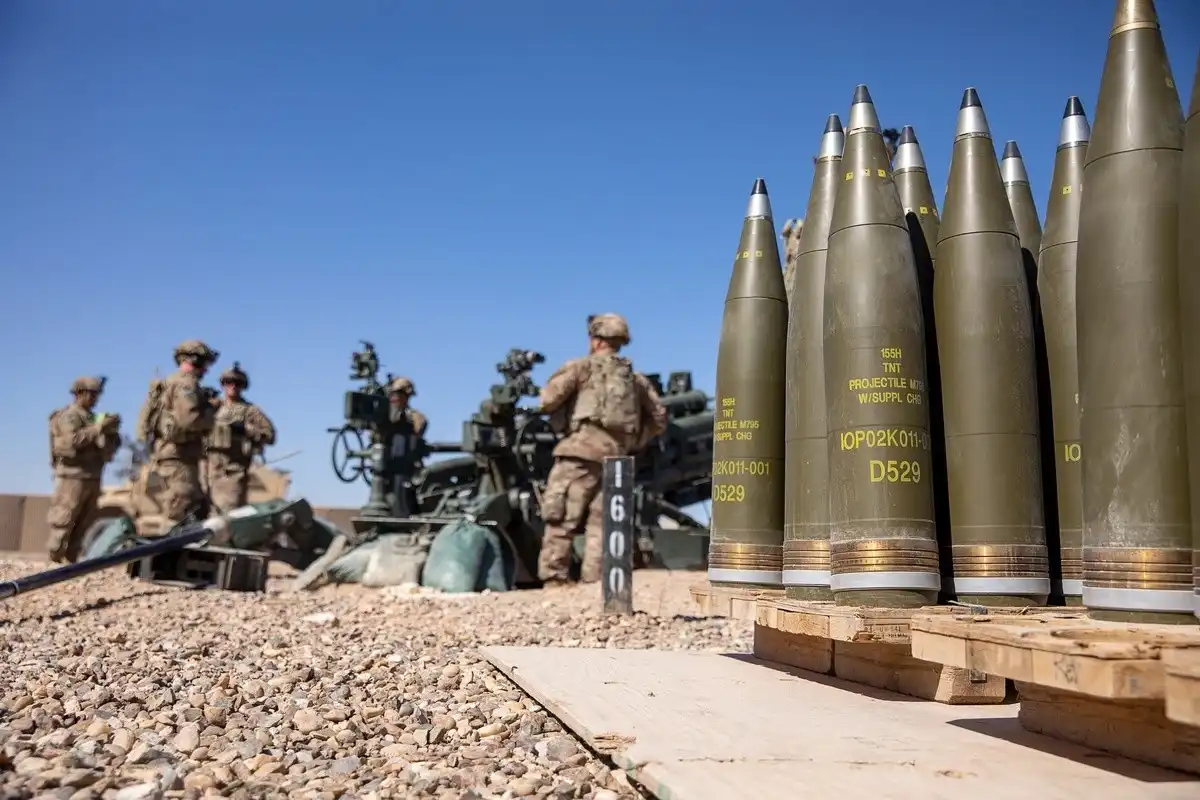
The US Army awarded MSM Group North America Inc. of St. Petersburg, Florida, a $105,774,000 contract modification on November 6, 2026, for the Future Artillery Complex, the 155mm load, assemble, and pack (LAP) facility the company is building at the Iowa Army Ammunition Plant (IAAAP) in Middletown, Iowa. Modification P00004 to contract W519TC-25-C-0032 lifts the cumulative face value of the design, build, and commission effort to $740,974,000, according to the Department of War contract announcement.
The award comes as the Army works to recover from a missed production target. The Army had set a goal of producing 100,000 155mm rounds per month by October 2025. A Department of War Inspector General report dated July 9, 2026, found the Army was producing roughly 36,000 rounds per month as of March 2026, up from about 14,000 when the ramp-up began, and identified projectile metal parts as the limiting factor.
Future Artillery Complex Contract Grows 17 Percent Since 2025 Award
Army Contracting Command, Rock Island Arsenal, Illinois, originally awarded the contract on August 15, 2025, at $635.2 million, as a sole-source undefinitized contract action. The new modification accounts for the entire difference to the current total, a 16.7 percent increase over the baseline in roughly 15 months. The Army obligated $42,887,000 in fiscal 2025 Army ammunition procurement funds when the modification was awarded, leaving about $62.9 million of the modification to be funded through later actions.
The announcement does not state what drives the increase. The estimated completion date of August 10, 2029, matches the original schedule, which targets commissioning and full-scale production in September 2029. The Army appears to be absorbing cost growth to hold the timeline rather than trading schedule for price.
Construction is already underway. The Army broke ground on the complex on July 15, 2026. MSM Group North America is the US subsidiary of the Czechoslovak Group (CSG), which says it is building vertically integrated production of large-caliber ammunition, from input commodities to the final product.
Melt-Pour Automation Behind the 36,000-Round Monthly LAP Capacity
The complex spans 201.6 acres and 13 buildings with 123,200 square feet of operational space, according to the Army. It is designed for end-to-end production of 155mm melt-pour variants: receiving empty projectile bodies, melting and casting the explosive fill, curing, fuze-well preparation, final assembly, and packing for shipment. At full rate, the facility is sized for 36,000 rounds per month, equal to the entire US output recorded in March 2026.
The Army has emphasized robotics and automation that allow fast changeovers between products. That flexibility matters for surge planning: a plant that can shift between variants with minimal downtime can drop to a reduced minimum sustaining rate when peacetime orders fall, rather than idling.
Publicly available specifications indicate the M795 high-explosive projectile, the Army’s standard 155mm round, weighs about 103 pounds and carries roughly 23.8 pounds of TNT, with an insensitive munitions variant using IMX-101. Both fills are melt-pour, which places them within the complex’s stated process. The exact product mix the Army intends to load at the facility has not been disclosed. IAAAP has produced ammunition since 1941, and the Army notes that most US munitions plants were built during World War II and still operate much as they did some 80 years ago.
Analysis: The modification buys more LAP capacity, but LAP is not the constraint the Inspector General identified. Every round the Future Artillery Complex fills requires a forged projectile body, and the metal parts base is underperforming. The Mesquite, Texas, facility had produced no metal projectile parts meeting specifications as of March 2026 against a planned 30,000 per month, and the Scranton Army Ammunition Plant was producing about 15,000 shell bodies per month. Unless metal parts output rises in step, the Iowa complex risks replacing legacy loading capacity rather than adding net rounds to the stockpile. The value of the investment depends on the forging side of the base catching up before 2029.
The next indicators to watch are the obligation of the remaining $62.9 million, construction progress at Middletown through 2027 and 2028, and the Army’s corrective actions on metal parts following the Inspector General’s findings. Commissioning and full-scale production, both planned for September 2029, remain the program’s defining milestones. The scope behind the November 6 modification remains undisclosed.