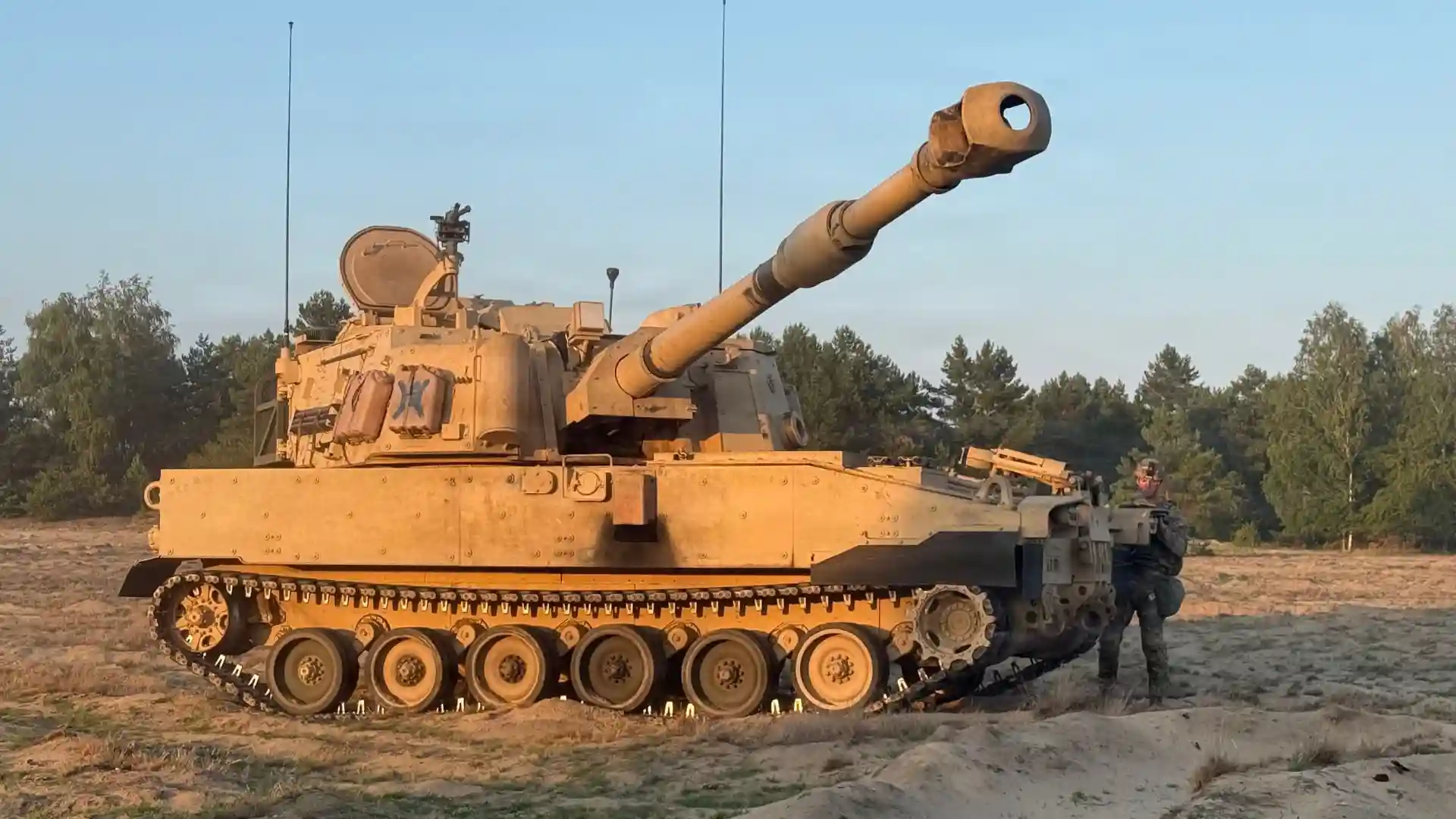
The U.S. Army has opened competition for a production-ready tracked howitzer for its armored brigades, issuing a Call for Solutions for the Mobile Tactical Cannon-Tracked (MTC-T), a 155mm self-propelled howitzer to be fielded with a new Resupply Vehicle-Tracked (RSV-T). Army Contracting Command-Detroit Arsenal (ACC-DTA) wants a mature system from existing production lines with testing and safety evaluation already completed, and plans to award one or more Other Transaction (OT) prototype agreements. Responses to notice MOSAIC-27-01 are due November 16, 2026.
The tracked effort runs separately from the wheeled Mobile Tactical Cannon, for which Hanwha Defense USA won an OT agreement on August 18, 2026, worth up to $262.9 million for as many as 18 K9-based systems, since designated XM1776, to replace M777 towed howitzers in select formations. The Army’s fiscal 2027 request seeks to stop buying M109A7 Paladins, asking for $84 million and no new vehicles after receiving $715 million for 40 in fiscal 2026. MTC-T is now the service’s path to a new tracked cannon for Armored Brigade Combat Teams.
Inside the MTC-T Tracked Howitzer Call for Solutions
The notice runs under the Munitions Open Solicitation for Advanced and Innovative Capabilities (MOSAIC), a standing solicitation Portfolio Acquisition Executive (PAE) Fires opened in March 2026. Awards will follow 10 U.S.C. 4022, which lets a successful prototype transition directly into follow-on production, and the government may award to all, part or none of the offerors. The agreements will be fixed-price, and eligibility is a go/no-go test: a nontraditional defense contractor must participate to a significant extent, all significant participants must be nontraditional contractors or small businesses, or at least one-third of the prototype cost must come from non-federal funds. A traditional defense prime therefore needs a significant nontraditional partner or a cost share.
The process is phased: draft attachments target vendors later selected to propose, and the sample license agreement refers to a Phase 3 request for commercial solution proposals. Each MTC-T set pairs the howitzer with an RSV-T, and the cost volume asks for unit prices in lots of 1 to 24, 25 to 36 and 37 to 48 of each vehicle. Those bands frame pricing, not a stated buy. The draft agreement calls for six prototype sets, three within 12 months of award and three more within 18 months, with options for up to 12 more. A draft milestone pricing appendix dated September 23 lists the first howitzer and first resupply vehicle 90 days after award.
Key performance figures remain out of public view. Ten of the 24 numbered attachments are Controlled Unclassified Information, including the draft Key Characteristics Description, the U.S. 155mm ammunition interface document and the program security classification guide. The public Call for Solutions does set one marker, a 155mm cannon longer than 50 calibers, but required range, rate of fire, protection level and weight limits cannot be confirmed from the public package. At a September 8 industry day, the Army pointed to a solicitation in the first quarter of fiscal 2027 and a pre-decisional production award in the second quarter of fiscal 2029.
US Ammunition, Digital Fires and a 40-Month Test Plan
A draft test schedule shows how the Army would adapt an existing design. It lists five howitzer and three RSV-T test vehicles, opens with a wheeled-versus-tracked comparative demonstration about three to four months after award, and runs out to 40 months. The howitzers are budgeted for at least 8,500 rounds, including 500-round firing table events, 210-round reliability, availability and maintainability blocks, blast overpressure and toxic fume trials, a 3,000-mile durability run, 22 weeks of live fire test and evaluation, electromagnetic effects testing, counter-drone trials and precision-guided munition integration.
Ammunition is the pacing item. Offerors must report rifling twist, chamber volume, pressure-time curves, projectile ram velocity and fuze setter interfaces, and deliver ballistic fire control data under NATO STANAG 4144. The Call for Solutions ranks compatibility in two tiers: Priority 1 covers M795 projectiles, M231 and M232A2 propelling charges (increments 1 through 5) and the M782 Multi-Option Fuze for Artillery, while Priority 2 adds the M1128 projectile, M982 Excalibur and M1156 Precision Guidance Kit, among others. Bidders must also show a path to the M1155 Enhanced Portable Inductive Artillery Fuze Setter. The package describes the Army’s Proof Gun Stand, a hard-mounted rig that accepts 105mm to 155mm cannons from 23 to 58 calibers, and an off-platform plan at Yuma Proving Ground covers M795 projectile and M231 and M232 Modular Artillery Charge System safety firings, followed by 40 weeks of U.S. ammunition compatibility testing.
The schedule also includes Artillery Execution Suite (AXS) software integration, and a controlled memorandum covers initial MIL-STD-6017 Variable Message Format (VMF) integration. A survivability report must describe crew and subsystem protection against kinetic energy, artillery and underbody threats, referencing STANAG 4569, and state whether armor is integral or an add-on kit.
Onshoring and Data Rights Shape the Industrial Bet
A Production Capability Plan requires biweekly reporting on onshoring U.S. production, covering facilities, tooling, staffing, links to the Organic Industrial Base and qualification of new suppliers. The Call for Solutions asks bidders to demonstrate production readiness at a U.S. facility no later than 24 months after award, to support a rate of 18 sets a year during the first two years of domestic production and to lay out the investments needed to reach a sustained 40 sets a year. A supply chain checklist asks what share of parts already carry U.S. and NATO stock numbers and how many are common with fielded U.S. platforms. On the wheeled program, Brig. Gen. Robert Mikesh, portfolio management executive for offensive fires, said foreign winners must onshore production within two years.
The baseline data demands are firm. The Call for Solutions requires Unlimited Rights to operation, maintenance, installation and training (OMIT) data, excluding detailed manufacturing or process data but including depot-level teardown and overhaul procedures, and to form, fit and function data down to the lowest field-replaceable assemblies, plus Government Purpose Rights for diagnostics software and firmware. Deeper access is priced as options: the government seeks specially negotiated licenses for modular system interface data, a lightweight computer-aided design model, and technical data packages and software for targeted subsystems, led by the fire control system, cannon assembly and armament human-machine interface, with Government Purpose Rights defined to cover competitive procurement and transfers to foreign governments.
The package is still being adapted for tracks: the draft pricing appendix lists a “Wheel and Tire Assembly” data option even though the Call for Solutions names the track assembly among priority subsystems, and one controlled attachment on planned performance locations is titled as needing an update for the tracked version.
In October 2024, the Army gave Self-Propelled Howitzer Modernization (SPH-M) demonstration agreements to American Rheinmetall Vehicles, BAE Systems Bofors, Hanwha Defense USA, General Dynamics Land Systems and Elbit Systems. Hanwha has said it will offer the K9A1 or the K9A2, which it credits with a fully automated turret and 9 to 10 rounds per minute. BAE Systems, which pitched its M109-52 prototype against the SPH-M requirement in 2025, builds the M109 family in Elgin, Oklahoma.
Analysis: After Crusader, the Non-Line-of-Sight Cannon and Extended Range Cannon Artillery failed to reach fielding, the Army is buying a cannon rather than developing one. The MTC-T package indicates the contest will turn less on headline range than on how quickly an existing design can fire U.S. ammunition safely, plug into Army fire control over VMF and AXS, and move production onto American soil with usable technical data. Pairing the howitzer with a dedicated RSV-T treats rearm time as a survivability metric against counterbattery fire. The opening wheel-versus-track demonstration is the variable to watch: a strong XM1776 showing could pressure tracked quantities and timing.
Phase 1 questions close November 10, and the notice goes inactive December 1. The Army has not disclosed how many vendors will advance or how many OT agreements it will sign. Congress must also decide whether to accept the fiscal 2027 Paladin halt, which will determine whether a production gap opens before an MTC-T production decision now pointed at fiscal 2029.