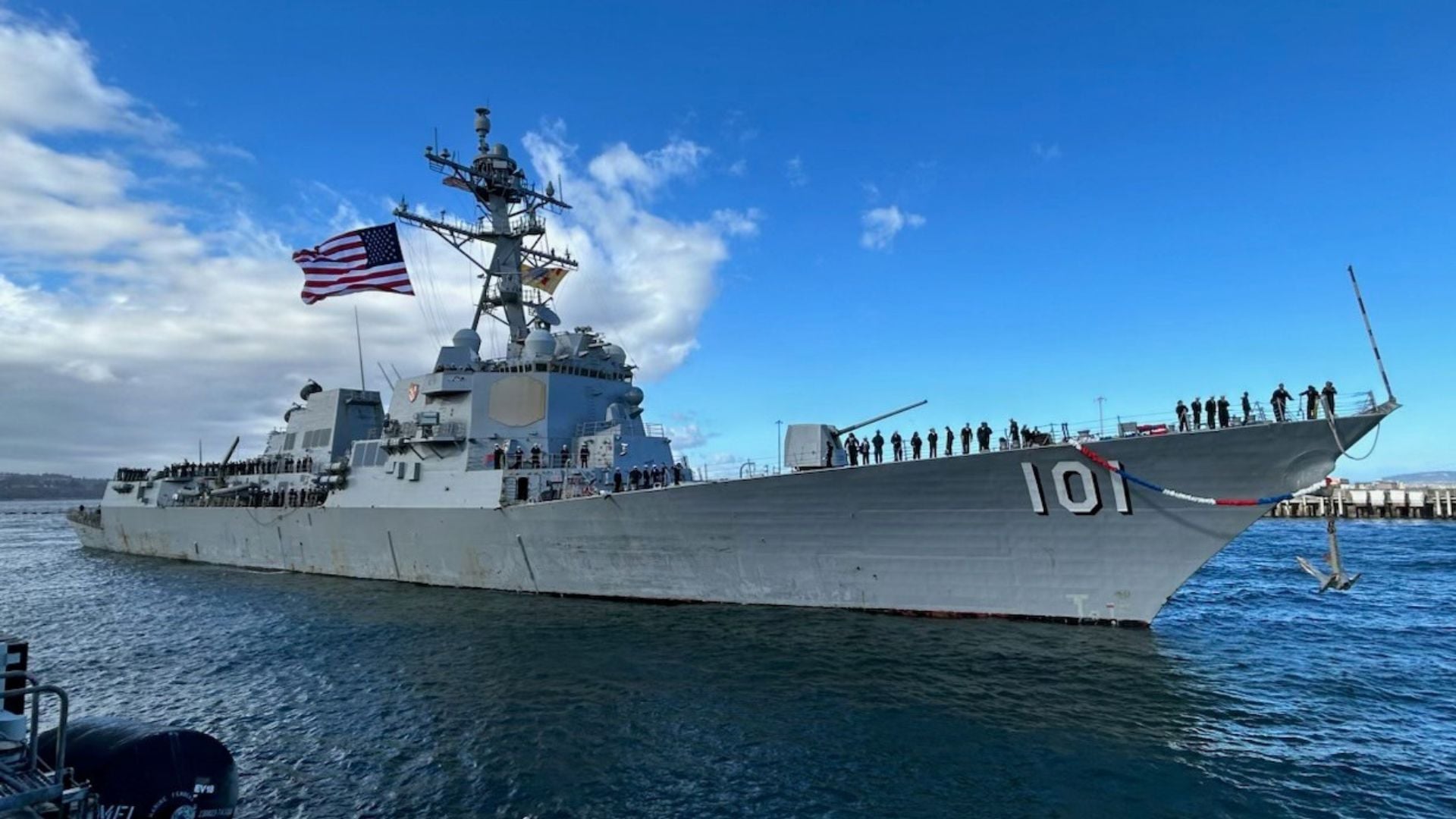
Vigor Marine LLC of Portland, Oregon, has received a $222,483,603 firm-fixed-price contract to execute the Fiscal 2027 Depot Modernization Period (DMP) on the Arleigh Burke-class guided-missile destroyer USS Gridley (DDG 101), the Pentagon announced on November 6, 2026. Work will take place in Seattle, Washington, and is scheduled for completion by December 2028. Options, if exercised, would raise the cumulative contract value to $232,543,042.
The award covers a Chief of Naval Operations (CNO) availability, the Navy’s term for its largest scheduled maintenance periods, and it extends an established pattern in the Pacific Northwest. Vigor received the Fiscal 2025 DMP for USS Kidd (DDG 100), valued at $277,010,546, in October 2024, and the Fiscal 2026 DMP for USS Sampson (DDG 102), valued at $252,849,606, in April 2026, both performed in Seattle. Like those awards, the Gridley contract was issued without full and open competition under 10 U.S. Code 3204(a)(3), which permits sole-source contracting to maintain industrial mobilization capability the Navy considers essential.
Inside the USS Gridley Modernization Contract and Funding Mix
The scope includes all labor, supervision, equipment, production, testing, facilities, and quality assurance required to prepare for and accomplish the availability. Fiscal 2027 Other Procurement, Navy (OPN) funds account for $207,116,783, or 93% of the obligation. Fiscal 2027 Operations and Maintenance, Navy (O&MN) funds contribute $13,412,467 (6%), and Fiscal 2026 OPN adds $1,954,353 (less than 1%). The O&MN portion expires at the end of the current fiscal year on September 30, 2027.
The split matters because the two appropriations pay for different work. O&MN typically funds repair and routine upkeep of hull, mechanical, and electrical systems. OPN funds the procurement and installation of new equipment, which in a DMP generally means combat system, communications, and engineering upgrades. A 93% OPN share points to a modernization-weighted package rather than a repair-driven one. The announcement does not list the specific alterations, and the Navy has not publicly detailed Gridley’s work package or confirmed whether it includes a combat system baseline upgrade.
The contracting activity is the Navy’s Portfolio Acquisition Executive (PAE) Maritime in Washington, D.C., the organization created under the service’s 2026 acquisition reform to oversee surface combatants, carriers, amphibious ships, and ship readiness programs. The contract number is N00024-27-C-4414.
What Back-to-Back Deployments Mean for a Flight IIA Destroyer
Gridley, a Flight IIA Arleigh Burke built by Bath Iron Works and commissioned in February 2007, enters the yard roughly two decades into its service life. Publicly available specifications indicate a length of 509.5 feet (155.3 meters), a full-load displacement of roughly 9,500 tons, and four General Electric LM2500 gas turbines generating about 100,000 shaft horsepower for speeds above 30 knots. The ship carries the Aegis Combat System with the AN/SPY-1D(V) radar, 96 Mark 41 Vertical Launching System (VLS) cells, a Mark 45 Mod 4 5-inch/62-caliber gun, and twin hangars for two MH-60R Seahawk helicopters. That combination of magazine depth and organic anti-submarine aviation made Flight IIA the Navy’s standard carrier strike group escort.
The availability follows an intense operational stretch. Gridley returned to Naval Station Everett on December 12, 2025, after a nine-month deployment with the Nimitz Carrier Strike Group across U.S. 3rd, 5th, and 7th Fleets. Less than three months later, it sailed as escort for USS Nimitz (CVN 68) on Southern Seas 2026, a circumnavigation of South America, before the carrier reached Norfolk, Virginia, in July 2026. Consecutive deployments compress the maintenance windows between cycles and push accumulated wear into the depot period. The modest O&MN share suggests planners do not anticipate heavy repair growth, though growth work on destroyer availabilities often surfaces only once tanks, voids, and machinery are opened for inspection.
Analysis: The Gridley award confirms that the Navy treats Vigor’s Seattle yard as the default private depot for Everett-based destroyers, and the repeated use of the industrial mobilization exception formalizes that dependence. Three consecutive Flight IIA DMPs, for Kidd, Sampson, and now Gridley, have gone to the same contractor without full and open competition, at values declining from $277.0 million to $222.5 million. Lower figures do not necessarily mean smaller scope, since government-furnished equipment is procured separately, but the series gives the Navy a fixed-price benchmark for Flight IIA mid-life work in Puget Sound. The flip side: when the Navy itself justifies sole-source awards on industrial mobilization grounds, any schedule slip in Seattle translates directly into fewer deployable destroyers in the Pacific Northwest.
Gridley’s availability runs through December 2028, removing the destroyer from the deployable pool for roughly two years. Near-term markers include whether the Navy exercises the $10,059,439 in options and the ship’s arrival date at the yard. Whether the Kidd and Sampson availabilities finish on schedule will offer the clearest indication of whether Seattle can sustain a cadence of one Flight IIA DMP per fiscal year.