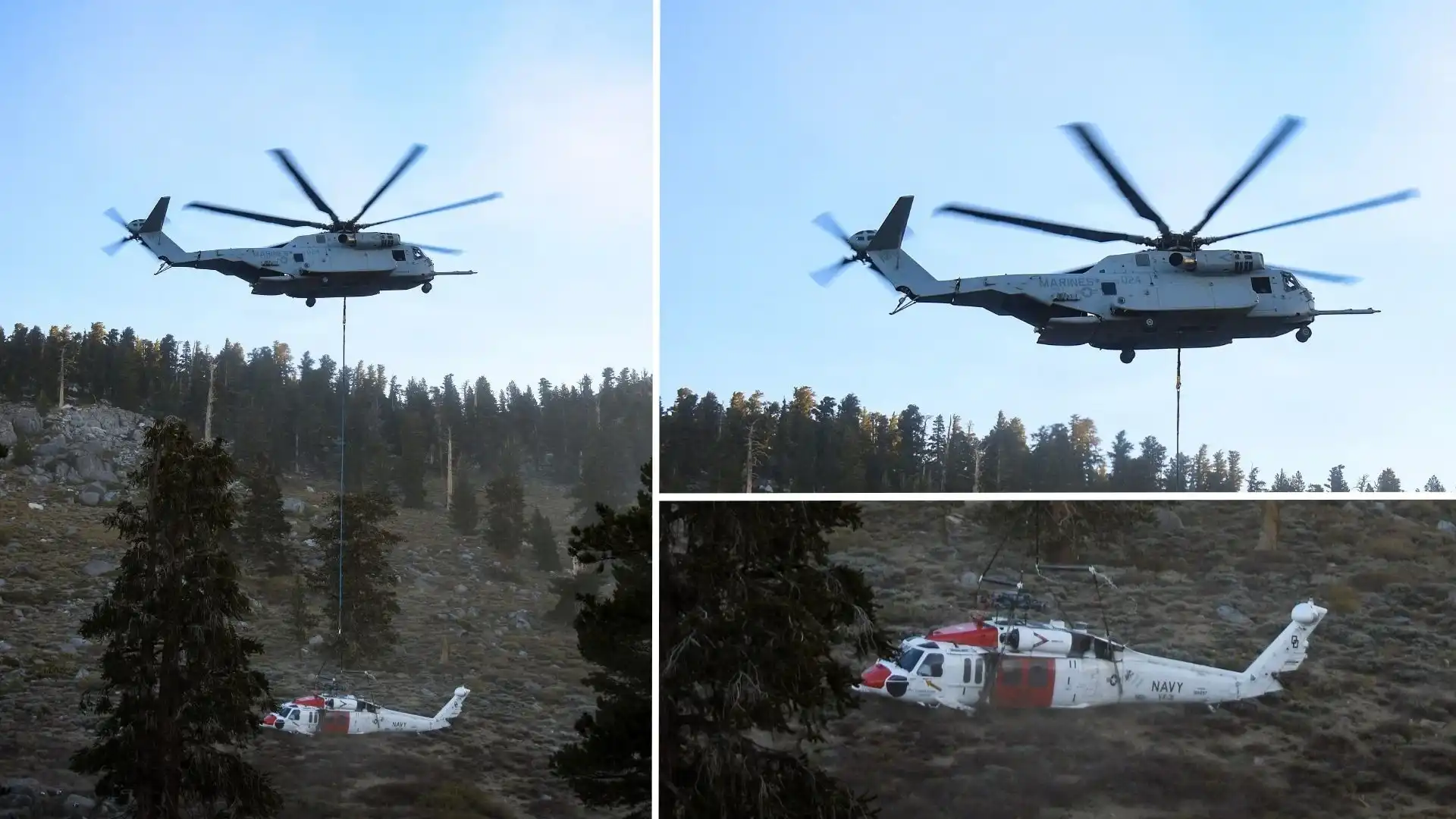
A U.S. Marine Corps CH-53K King Stallion recovered a downed U.S. Navy MH-60S Seahawk from the Sierra Nevada mountains in late September 2026, carrying the nearly 16,000-pound helicopter on a 70-foot long-line to an airfield at Naval Air Weapons Station China Lake, California. The lift was flown by Marine Operational Test and Evaluation Squadron 1 (VMX-1) and completed without incident or additional damage, meaning the Seahawk will be able to fly again without extensive maintenance, according to a U.S. Marine Corps release dated November 4, 2026.
The MH-60S belongs to Air Test and Evaluation Squadron 31 (VX-31). It landed hard at an elevation of 10,000 feet and sustained no damage, but the angle of the terrain prevented it from taking off. The remote site also made it extremely difficult to bring personnel and equipment forward to defuel the helicopter and reduce its weight. Officials assessed the CH-53K as the only aircraft able to perform the recovery, given the power required and the restrictive terrain.
How the CH-53K King Stallion Rigged and Lifted the Seahawk
The recovery relied on a specialized rigging configuration developed with the Naval Air Warfare Center Aircraft Division (NAWCAD) Cargo Lab, Maritime Industrial Base, and NAWCAD Structures Lab. Major Lee Henderson, the VMX-1 pilot and lead planner, said the team integrated established MH-60S crane-lifting procedures and the hoist sling with the 70-foot long-line “to ensure proper load distribution and obstacle clearance.”
The overriding objective was to keep the MH-60S whole. Rather than lifting the aircraft by its main rotor head, engineers used the built-in lift points and the hoisting sling designed for them. Michele Hoefer, an aerospace engineer with the Cargo Lab, said the team planned to remove only the main rotor blades and tail blades to prevent damage in transit. The H-60 Fleet Support Team at Marine Corps Air Station Cherry Point, North Carolina, advised on lift configuration and weight reduction.
The commercially available long-line exceeds the standard U.S. Marine Corps equipment sling line in length. Brandon Norris, team lead at the Structures Lab, coordinated testing at Naval Air Station Patuxent River, Maryland, using a locally available Defense Supply Center crane capable of testing the line up to 20,000 pounds. After safety and test lifts, the data went through flight clearance. Norris said the process took less than two weeks from the squadron’s request, and the operation doubled as a chance to certify the CH-53K on the longer line.
Power Margins and Flight Controls at the Edge of the Envelope
Hoefer said the Seahawk’s weight, the elevation, the transit distance, and on-site weather would put the CH-53K “in the corner of its envelope” for both power required and fuel consumption. Thinner air at altitude reduces both engine output and rotor lift, eroding the margin between available and required power.
Naval Air Systems Command (NAVAIR) specifications list three General Electric T408-GE-400 turboshafts rated at 7,332 shaft horsepower each, a maximum external lift of 36,000 pounds, and a maximum gross weight of 88,000 pounds. The CH-53K is designed to carry 27,000 pounds over a 110-nautical-mile mission radius in Navy high/hot conditions, almost triple the baseline of the CH-53E Super Stallion. At 10,000 feet, even a 16,000-pound load tests that margin.
Henderson credited the aircraft’s available power, its precision flight-control system, and its ability to calculate instantaneous power available from real-time engine performance and environmental conditions. He said those features significantly reduced risk during the lift.
Analysis: The recovery demonstrates the CH-53K’s value in a mission officials said no other aircraft could perform: lifting a medium helicopter intact from high-altitude terrain where defueling was extremely difficult. Real-time power-available computation matters most precisely in these marginal conditions, and the episode validates it outside a test card. The rapid testing and clearance of a commercial long-line also turned an unplanned event into an opportunity to certify the CH-53K on a longer line than the standard Marine Corps sling.
NAWCAD’s Cargo and Structures Lab experts are processing the long-line test data for a final report. VX-31 has not released a timeline for the MH-60S’s return to flight, and the cause of the hard landing remains undisclosed.