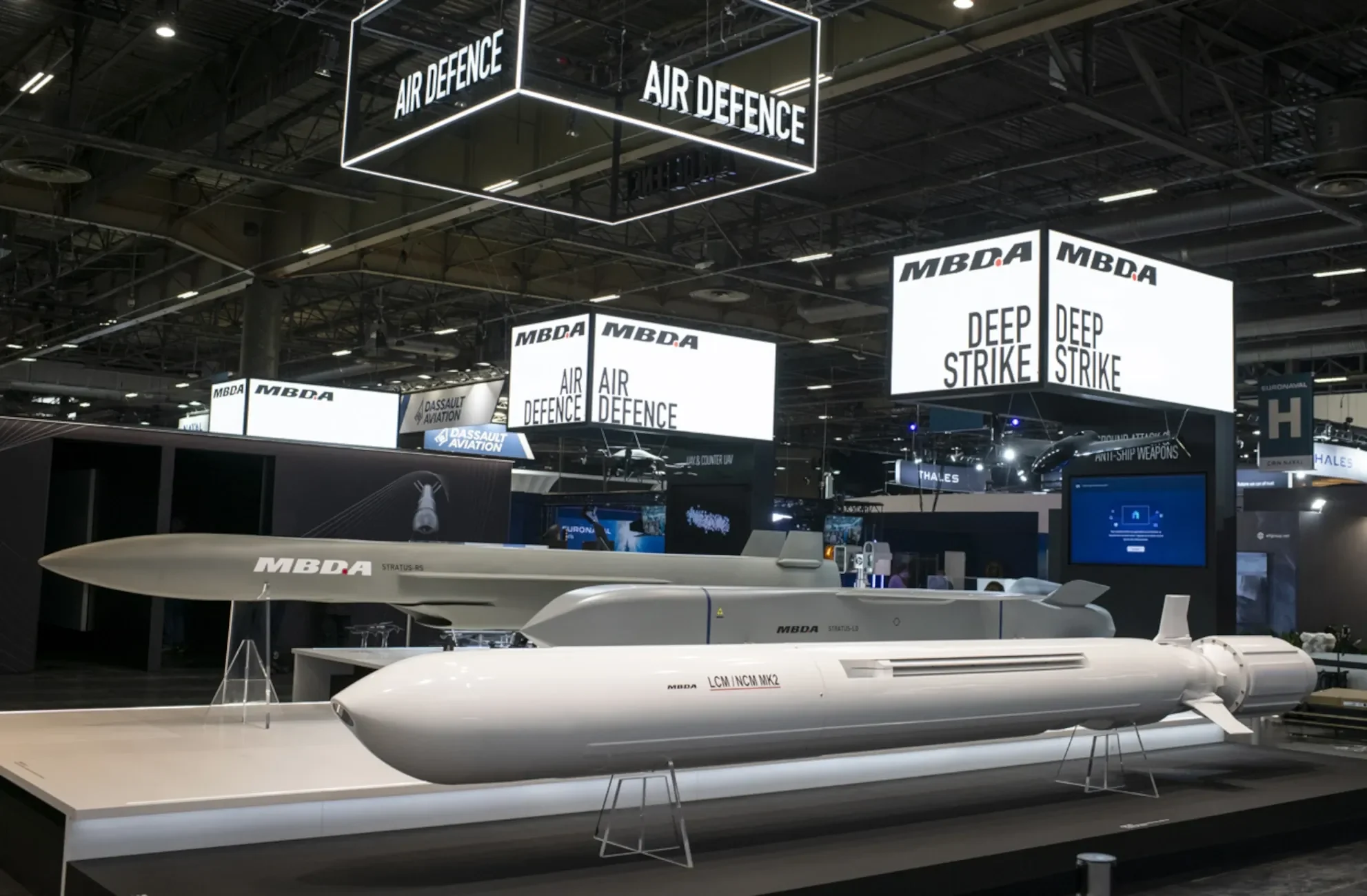
France’s defense procurement agency, the Direction générale de l’armement (DGA), announced on November 6, 2026, at the Euronaval exhibition that it will shortly sign a contract with MBDA for the MdCN Mk2, a new standard of the Missile de Croisière Naval (MdCN) naval cruise missile. The upgraded weapon adds range, a better ability to penetrate enemy surface-to-air defenses and greater lethality, with deliveries to the French Navy scheduled to begin in 2030.
The order is part of France’s broader rearmament effort and modernizes the Navy’s long-range land-attack capability from surface and subsurface platforms. The original MdCN, developed under a December 2006 contract, entered service on Aquitaine-class multi-mission frigates (FREMM) in 2017 and on Suffren-class nuclear-powered attack submarines (SNA) in 2022. The DGA has disclosed neither the value of the contract nor the number of missiles. Planning in 2006 called for roughly 250 rounds to arm 17 FREMM and six Barracuda-type submarines; the frigate program was later cut to eight hulls.
MdCN Mk2 Cruise Missile: Stealth, Anti-Jam Navigation and AI Planning
According to the DGA, the MdCN Mk2 improves on its predecessor in four areas: reduced observability, greater resistance to jamming of Global Navigation Satellite System (GNSS) signals, a range exceeding 1,000 km, and faster mission preparation built on artificial intelligence modules developed by MBDA. The agency links these changes to deeper strike reach while keeping launch platforms outside enemy engagement envelopes. MBDA, which offers the MdCN for export as the Naval Cruise Missile (NCM), unveiled an NCM Mk2 at Eurosatory in June 2026 with the same headline features: a range beyond 1,000 km, better stealth and new-generation anti-jamming.
The DGA has not quantified the range increase. Open-source figures for the current missile vary from about 1,000 km for the submarine-launched round to roughly 1,400 km for the ship-launched variant, so the Mk2’s exact reach remains undisclosed.
GNSS resilience is the most operationally pressing change. Publicly available specifications indicate the baseline MdCN navigates with an inertial measurement unit, an altimeter supporting terrain-referenced navigation and GPS updates, before an infrared seeker performs terminal target recognition. Satellite navigation jamming and spoofing are routine across Eastern Europe, the Baltic and the Middle East, and a cruise missile that loses its midcourse fix over defended territory loses accuracy. Hardening that link protects the metric-level precision France advertises for the weapon.
AI-assisted mission planning targets a different bottleneck. Cruise missile routes must be plotted against terrain, known air defense sites and timing constraints, a labor-intensive process that limits how quickly a strike can be retasked. Faster planning shortens the kill chain from target nomination to launch.
How FREMM Frigates and Suffren Submarines Will Employ the Mk2
The Mk2 retains the dual-platform concept of the original. Each of the six anti-submarine FREMM carries 16 missiles in two eight-cell Sylver A70 launchers. On Suffren-class boats, the missile is fired from 533 mm torpedo tubes inside a watertight capsule that is jettisoned at the surface; a booster then lifts the missile to cruise altitude before a Microturbo TR50 turbojet takes over.
Publicly available specifications for the baseline round indicate a length of about 6.5 m without booster, a diameter of 0.5 m, a wingspan of 2.85 m and a mass near 1,400 kg, rising to roughly 7 m and 2 tonnes with the booster. It carries a single unitary warhead optimized for soft and moderately hardened targets. MBDA has not released Mk2 dimensions, and it is not known whether the upgrade alters the airframe or propulsion.
The DGA frames the two launch modes as complementary: overt from a frigate, covert from a submarine. The frigate offers visible signaling and volume of fire, while the SNA offers surprise and an unpredictable launch point. Both are assigned to the destruction of high-value strategic infrastructure, complementing the air-launched SCALP-EG in service. The MdCN saw its first combat use in April 2018, when FREMM frigates launched three missiles against Syrian chemical weapons sites during Operation Hamilton.
Analysis: The Mk2 order shows Paris treating sovereign long-range strike as a sustained inventory requirement rather than a niche capability. The Royal Navy relies on the US Tomahawk for maritime land attack, and the Netherlands has ordered it, while France keeps design authority, production and employment decisions inside its own industrial base. The emphasis on low observability and GNSS resilience mirrors lessons from Ukraine, where Russian electronic warfare and layered air defenses have degraded Western precision munitions. For NATO, a modernized French inventory adds a European-controlled strike option from both surface and subsurface launchers, though the order’s size will decide how much it shifts allied deep strike capacity.
The next milestone is contract signature with MBDA, which the DGA describes as imminent. Key unknowns remain the number of missiles, the contract value, the exact range gain and whether existing MdCN rounds will be upgraded to the Mk2 standard. With first deliveries due in 2030, the closing year of the 2024-2030 military programming law (LPM), MBDA’s production ramp-up becomes the variable to watch.