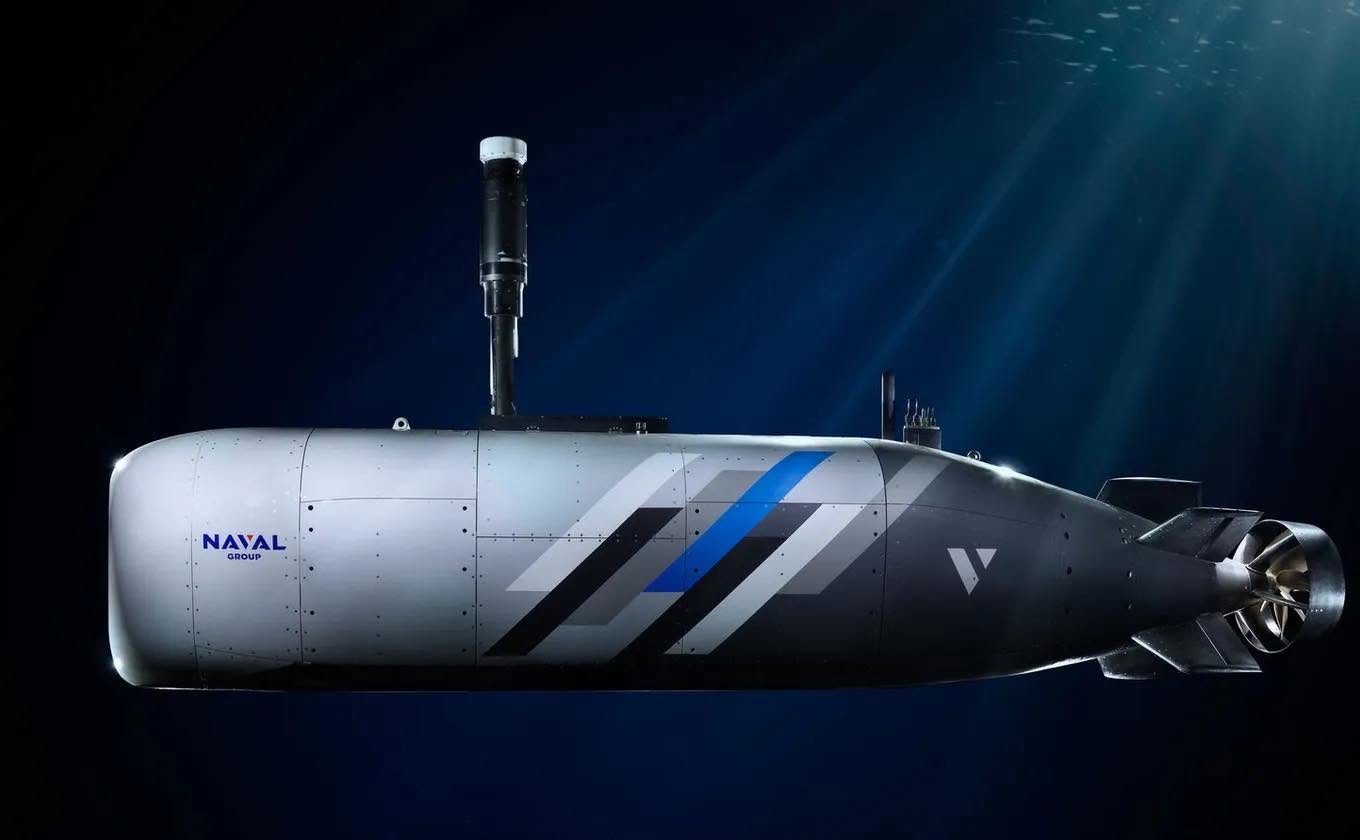
France has ordered an operational demonstrator of the UCUV underwater drone, a large uncrewed combat underwater vehicle, from Naval Group, with sea trials scheduled to begin in 2028. The Defense Innovation Agency (AID) and the shipbuilder signed the agreement on November 3, 2026, as the Euronaval exhibition opened outside Paris, extending a framework agreement the Directorate General of Armament (DGA) notified in December 2023.
The award moves France into the extra-large uncrewed underwater vehicle (XL-UUV) class as the ministry’s naval drones program, launched in June 2026, prepares to move its first increment into the realization phase in mid-2027. The ministry framed the UCUV as a response to intensifying competition in the underwater domain and to threats weighing on critical infrastructure, across an exclusive economic zone of about 11 million square kilometers, the second largest in the world behind the United States.
UCUV Underwater Drone Requirements and the XL-UUV Testbed
When the project launched in January 2024, the ministry set the target as a long-endurance platform longer than 10 meters (33 feet) and heavier than 10 metric tons. The demonstrator must be air-transportable and able to deploy from a pier or a surface ship. Its stated mission set runs from intelligence, surveillance and reconnaissance (ISR) and underwater detection to the protection of carrier groups, surface ships and submarines, up to what the ministry calls “more offensive neutralization actions.” The vehicle is also expected to carry and recover smaller underwater drones, acting as a mothership.
The contractual path has been incremental. A study contract on use cases and system architecture was awarded on May 4, 2023, followed by the December 28, 2023, framework agreement and a 24-month first follow-on contract covering autonomous decision-making and secure surface and underwater navigation.
The technical foundation is Naval Group’s self-funded XL-UUV demonstrator. Launched discreetly in southern France in November 2020 and unveiled in October 2021, the vehicle measures about 10 meters and displaces about 10 tons. It completed sea qualification at the end of summer 2023 and has since served as a testbed for mission autonomy, safe navigation, endurance and specialized payloads. Publicly available specifications indicate the design could be lengthened to as much as 25 meters with added battery sections or air-independent propulsion. The energy architecture selected for the UCUV has not been disclosed, and endurance remains the parameter that will define its operational value.
Steeris OB Autonomy and the French Naval Drone Roadmap
The UCUV will run Steeris OB, Naval Group’s onboard autonomous decision-making system, which delivers what the ministry calls controlled autonomous decision-making. It is designed to execute long missions without remote control where communications are limited or jammed, continuously replanning route and behavior against the tactical situation, the environment and onboard failures, either alone or alongside crewed and uncrewed systems. The ministry has said the goal is missions lasting several days without teleoperation, under human supervision.
For a submerged platform, that autonomy is the enabling capability rather than an add-on. Acoustic links offer little bandwidth and surfacing to communicate compromises stealth, so a combat UUV unable to make tactical decisions on its own is limited to short, scripted tasks. The “controlled” qualifier signals that France intends to keep a human operator in the decision loop as the vehicle moves toward offensive roles.
Funding remains modest at this stage. The 2026 defense budget allocated €30 million in commitment authorizations and €17 million in payment appropriations to an ocean-going underwater drone demonstrator, against €5 billion earmarked for drones and robots across the 2024-2030 military programming law. The UCUV sits alongside the naval drones program, whose second increment, planned for 2028, covers the DANAÉ armed surface drone and a command-and-control system.
Analysis: France is entering the XL-UUV race from behind. The U.S. Navy has taken delivery of its first Boeing Orca, the Royal Navy fired a heavyweight torpedo from an extra-large uncrewed vessel for the first time in October 2026, and Australia committed A$1.7 billion (US$1.2 billion) in September to a fleet of Anduril Ghost Shark vehicles. Against those programs, the UCUV remains a single risk-reduction demonstrator funded in the tens of millions of euros, which makes a fielded French capability unlikely before the early 2030s. France’s advantage lies elsewhere: Naval Group’s submarine design base and years of at-sea data from its self-funded demonstrator lower the technical risk, and an endurance vehicle able to watch over seabed infrastructure would free the Navy’s small nuclear attack submarine fleet for higher-end missions.
Sea trials in 2028 will validate the demonstrator’s technical choices and shape the Navy’s concept for underwater drone combat. Key unknowns include the contract value, the number of vehicles, the UCUV’s final dimensions and energy system, and whether weapons integration, from torpedoes to mines, will be tested on the demonstrator or deferred to a follow-on program.