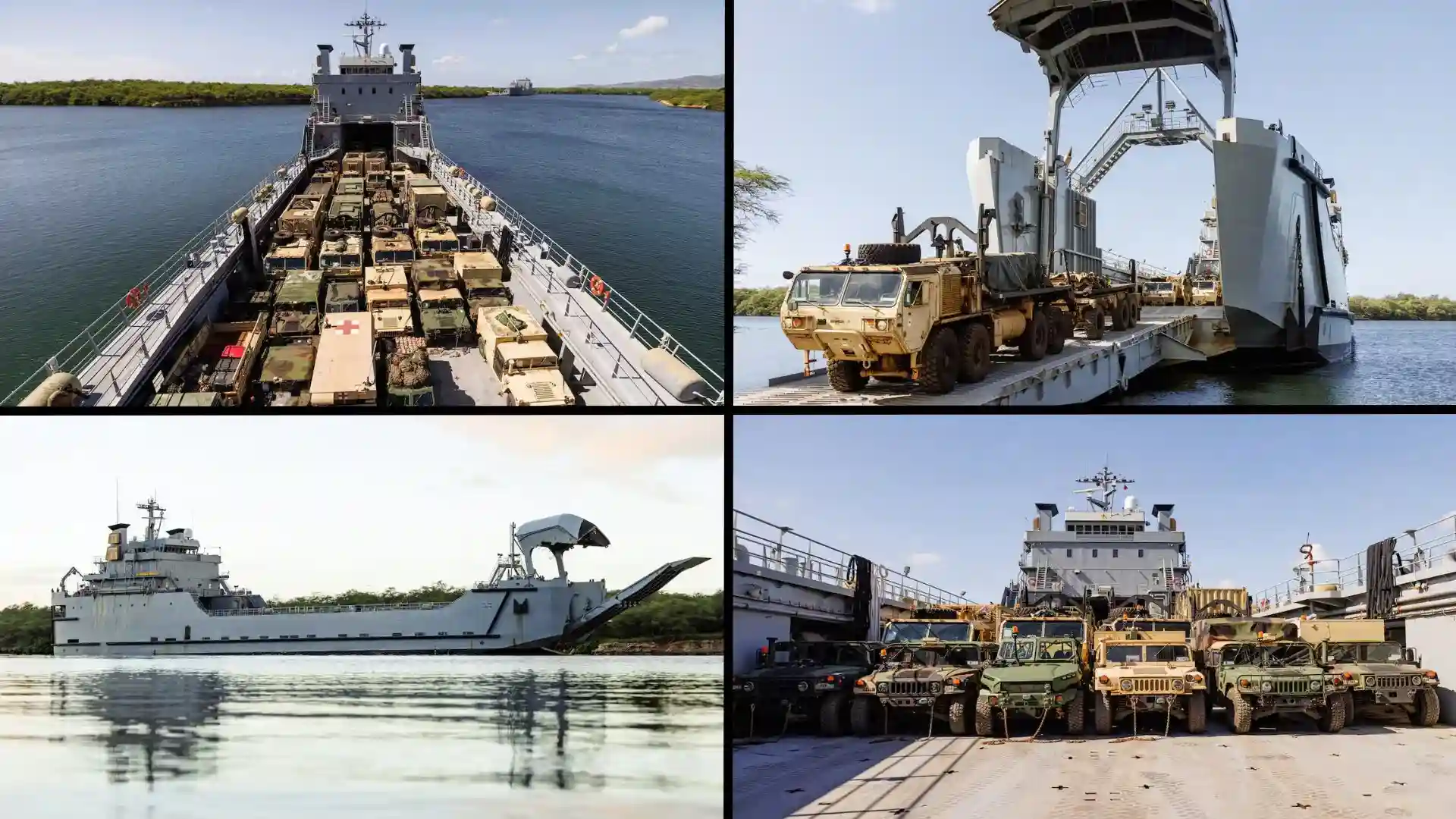
U.S. Army forces and multinational partners began force-on-force training against an opposing force in Hawaii on November 4, 2026, opening the combat phase of the latest Joint Pacific Multinational Readiness Center (JPMRC) rotation, according to the 25th Infantry Division. Approximately 7,000 personnel are taking part across Oahu, Maui, and Hawaii Island, including elements of France’s 6th Light Armored Brigade operating alongside the 25th Combat Aviation Brigade.
JPMRC is the Army’s newest combat training center, run by U.S. Army Pacific to generate readiness in the jungle and archipelagic terrain where Pacific forces are most likely to fight. The Hawaii iteration has become the 25th Infantry Division’s annual validation event and now doubles as a test bed for the Army’s conversion of light infantry into mobile brigades built around ground mobility, small drones, and modernized command and control. The previous Hawaii rotation, JPMRC 26-01, ran from November 3 to 17, 2025, and certified the division’s 3rd Mobile Brigade. The Army tags the current iteration as rotation 27.
JPMRC Hawaii Rotation Shifts From Staging to Multidomain Combat
This phase tests the 25th Infantry Division’s ability to seize and hold key terrain in a simulated contested, multidomain environment. Army Brig. Gen. Robert Bryant, the division’s deputy commander for support, framed the objective around the close fight: “We are leveraging the condition setting and synchronization of warfighting functions to enable our light fighters to win in close combat.”
The division identified distributed access and mobility as the key component of the transition from staging to combat. On Oahu and Hawaii Island, ground forces are moving to secure initial objectives, while elements of the 2nd Mobile Brigade, 25th Infantry Division, are combining fieldcraft, ground mobility, and modernized command-and-control systems to move through demanding jungle terrain.
The 2nd Brigade was one of the three brigades selected for the first phase of the Army’s Transformation in Contact initiative, which reorganizes infantry brigade combat teams around lighter formations, organic unmanned aircraft, and vehicle mobility. Its soldiers already maneuvered in the Infantry Squad Vehicle (ISV) during the October 2024 Hawaii rotation. Publicly available specifications indicate the ISV, built by GM Defense on a Chevrolet Colorado ZR2 chassis, carries a nine-soldier squad and can be sling-loaded beneath a UH-60 Black Hawk. That characteristic matters in an island campaign, where roads end at the shoreline and every movement between islands depends on rotary-wing lift or watercraft.
The Army has not disclosed which brigade serves as the primary rotational training unit for this iteration, the composition of the opposing force, or which unmanned and command-and-control systems are under evaluation. Those details will determine how much the rotation reveals about the maturity of the mobile brigade construct after more than two years of experimentation.
French Brigade, FARPs, and Forcible Entry Extend Reach Across Hawaii
On Maui and Oahu, the 25th Combat Aviation Brigade is working with elements of France’s 6th Light Armored Brigade (6e Brigade Légère Blindée, or 6e BLB) to secure forward arming and refueling points (FARPs). According to the division, this integration extends the joint force’s operational reach and lets aviation assets sustain pressure and project combat power across the island chain. The 25th CAB operates AH-64 Apache attack helicopters, UH-60 Black Hawk utility helicopters, and CH-47 Chinook heavy-lift helicopters; the FARP network is what converts the limited unrefueled range of those aircraft into persistent coverage across several islands.
The 6e BLB, headquartered in Nîmes and subordinate to France’s 3rd Division, combines Foreign Legion, Troupes de Marine, and Spahi cavalry regiments and serves as the French Army’s main formation on its Mediterranean front. French troops also took part in the 2025 Hawaii rotation. The Army did not specify which French regiments deployed, how many French personnel are participating, or whether French vehicles were shipped to Hawaii.
The next phase centers on a joint forcible entry operation. The 11th Airborne Division will conduct a mass tactical airborne jump into the Pōhakuloa Training Area on Hawaii Island to secure key infrastructure, after which the 25th Infantry Division will fly infantry over water in a long-range air assault to reinforce the position. The sequence mirrors the 2025 rotation, when roughly 445 paratroopers from the 11th Airborne Division’s 2nd Infantry Brigade Combat Team (Airborne) exited six C-17 Globemaster III aircraft over Pōhakuloa to establish a foothold for a 25th Infantry Division maritime air assault. It was the brigade’s third consecutive year of large-scale airborne training on Hawaii Island.
Analysis: The rotation rehearses the operational problem at the center of Army planning for the Indo-Pacific: inserting light forces onto contested terrain, then sustaining them across open water with aviation that depends on exposed refueling sites. FARPs are among the most vulnerable nodes in that chain, and assigning an allied brigade to help secure them tests coalition interoperability precisely where a failure would ground the aviation scheme of maneuver. The headcount also deserves attention. At approximately 7,000 personnel, this rotation is smaller than the more than 9,000 who took part in October 2024, though larger than the more than 5,000 reported in November 2023.
The Army has not announced an end date; the 2025 Hawaii rotation lasted 15 days. The next milestones are the 11th Airborne Division’s jump into Pōhakuloa and the over-water air assault that follows, with the division describing later phases as large-scale joint integration events. The full list of partner nations, the opposing force’s capabilities, and the performance of the mobile brigade’s command-and-control systems remain undisclosed.