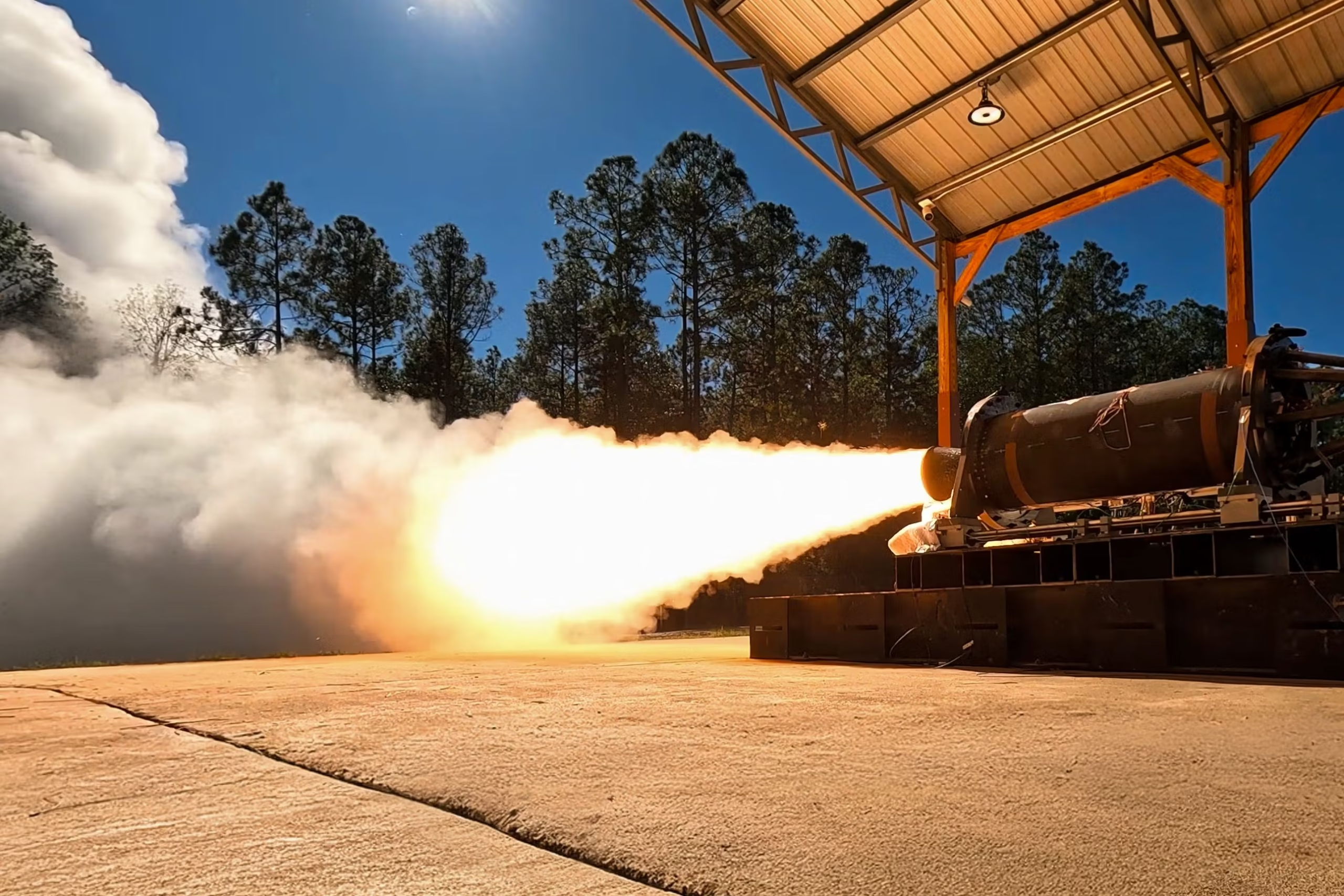
Anduril Industries and Voyager Technologies formalized a strategic partnership on September 29, 2026, covering the development, testing, qualification and production of propulsion and maneuvering technologies for U.S. weapon systems and missile defense. Voyager, listed on the New York Stock Exchange as VOYG, is already under contract to supply Anduril with more than $60 million in hardware, including solid rocket motors and divert and attitude control systems (DACS).
The agreement lands two weeks after the Congressional Budget Office (CBO) estimated that the United States has probably expended between one-half and two-thirds of its combined inventory of Patriot, Terminal High Altitude Area Defense (THAAD), Standard Missile-3 (SM-3) and Standard Missile-6 (SM-6) interceptors since June 2025, largely in operations against Iran. The CBO put the replacement bill at $13.1 billion and warned that rebuilding stocks could take at least five years. Propulsion remains one of the tightest constraints in that equation, with solid rocket motor supply concentrated in two incumbents, Northrop Grumman and L3Harris Technologies’ Aerojet Rocketdyne.
How the Anduril Voyager Partnership Links Rocket Motors and DACS
The partnership formalizes work already under way across multiple strategic weapons programs, including some the companies place among the Department of War’s highest priorities. Neither firm named those programs, identified the contract vehicles behind the $60 million figure, or attached a value to the new framework. The companies said the agreement establishes a shared pipeline of additional programs to pursue jointly as systems move toward long-term, high-rate production.
The DACS work is the more specialized half of the relationship. A DACS is the terminal steering package of a hit-to-kill interceptor: after the final booster stage separates outside the atmosphere, small thrusters deliver divert thrust plus roll, pitch and yaw control to guide the kill vehicle into the target. Voyager’s architecture uses solid controllable, throttleable propulsion with hot-gas valves, a technology the company says it has matured for more than a decade. On August 6, 2026, Raytheon selected Voyager to supply that propulsion and DACS technology for the SM-3 interceptor family and for its next-generation interceptor development. Publicly available program information indicates that the throttleable DACS on the current SM-3 Block IB kinetic warhead comes from Aerojet Rocketdyne, underscoring how narrow the supplier base for this subsystem has been. At a CBO-estimated unit cost of roughly $28 million, the SM-3 is the most expensive interceptor in the depleted pool.
Anduril brings its own motor enterprise. The company entered the market by acquiring Adranos in June 2023 and in June 2024 committed $75 million to expand its Mississippi Solid Rocket Motor Complex in McHenry from roughly 600 to more than 6,000 tactical-scale motors per year. That same month, the Navy awarded Anduril $19 million to develop a 21-inch second-stage motor for an SM-6 variant. The companies did not say whether Voyager’s motors supplement Anduril’s in-house production or cover different size classes.
Long Beach and Pueblo Facilities Target High-Rate Propulsion Output
Manufacturing sits at the center of the agreement. The companies cited a combined investment in the billions of dollars in testing and production infrastructure, without a breakdown, and said co-located engineering teams in Southern California will compress design, integration and prototyping cycles.
Anduril is building a 1.18 million-square-foot campus in Long Beach, California, scheduled to open in 2027, adding to production lines already running at its Arsenal-1 facility in Columbus, Ohio. Voyager is developing its American Defense Complex in Pueblo, Colorado, on the grounds of the former Pueblo Army Depot. At its January 29, 2026 groundbreaking, Voyager described a 150,000-square-foot manufacturing and test facility on a 16,000-acre property with more than 1,000 earth-covered magazines. The site is designed to produce propulsion systems, assembled energetic grains and controllable propulsion products, and to host chemical and black powder development backed by more than $39 million in federal funding.
Voyager says the Pueblo complex, once fully scaled, could support approximately 15,000 to 20,000 propulsion systems per month across its portfolio. That figure is a capacity target, not a delivery rate, and it aggregates every product line, from small DACS thrusters to larger motors. By comparison, the McHenry expansion targets roughly 500 tactical-scale motors per month, though the two figures measure different product mixes. Matt Magaña, president of Voyager’s Space, Defense and National Security business, said the company has invested more than $500 million in propulsion, energetics and manufacturing capacity, and that the partnership turns that investment into production programs.
Analysis: The agreement is less about a new capability than about de-risking the supply chain beneath interceptors the Pentagon now needs in volume. By pairing Anduril’s integration and motor production with a DACS and energetics supplier outside the traditional incumbents, the two firms are positioning as an alternative propulsion bloc at the moment the CBO has quantified the cost of depletion. Magaña’s reference to demand as next-generation missile defense expands nationally aligns with the Golden Dome homeland architecture, although neither company tied the agreement to that initiative. The real test is qualification: new-entrant motors and DACS must clear the same flight and lot-acceptance regime as incumbent hardware before reaching a program of record.
Near-term markers include progress on Voyager’s SM-3 propulsion work for Raytheon, the ramp of the Pueblo complex and the 2027 opening of Anduril’s Long Beach campus. The companies have not identified the programs in their shared pipeline or any production contract timelines. Those details will determine whether the partnership grows beyond its current $60 million base.