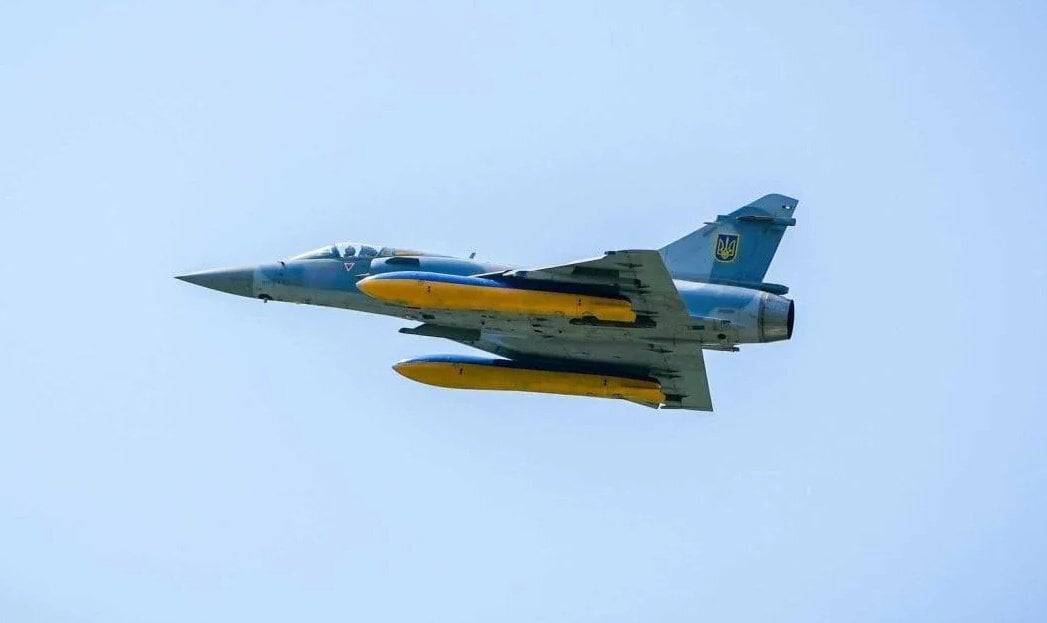
A Ukrainian Air Force Mirage 2000-5F destroyed a Russian S8000 Banderol cruise missile with its internal 30mm cannon rather than an air-to-air missile, according to French Aid to Ukraine, a French open-source project that tracks military assistance to Kyiv. The project published the claim late on October 1, 2026, describing it as the first known gun kill of a Banderol by a Western fighter. Neither the Ukrainian Air Force nor the French Ministry of the Armed Forces has confirmed the engagement.
The report lands as Russia widens its mix of low-cost, jet-powered strike weapons to stretch Ukrainian air defenses already short of interceptors. Ukraine’s defense minister recently named air-to-air missiles among the country’s key needs in an appeal to European Union partners, and every target a fighter kills with gunfire preserves a missile for threats that demand a standoff shot.
Mirage 2000-5F Gun Engagement Against a Banderol Cruise Missile
The date, location, pilot, firing range, and rounds expended have not been disclosed. The weapon itself is well documented. The Mirage 2000-5F carries two fuselage-mounted DEFA 554 revolver cannons firing 30x113mm ammunition, with 125 rounds per gun and a rate of fire of up to 1,800 rounds per minute. At that rate, the guns empty their magazines in roughly four seconds of trigger time. Muzzle velocity is about 815 m/s, with high-explosive and armor-piercing incendiary rounds.
That magazine depth defines the tactical problem. A MICA shot can be taken beyond visual range; a gun pass requires the pilot to close to cannon range on a small, fast target, hold a firing solution, and accept exposure to debris or a detonation of the missile’s 49.5 kg explosive fill. The Banderol cruises at 520 to 560 km/h, roughly three times the speed publicly cited for the piston-engined Shahed-136, which compresses the window for a second attempt if the first burst misses.
The aircraft’s sensor and defensive suite supports the profile. French official specifications list the 30mm cannon alongside MICA IR and MICA EM missiles, and the 2000-5F integrates the Thales RDY multimode radar, Link 16, the SERVAL radar warning receiver, SABRE jammer, and SPIRALE countermeasures dispenser. Publicly available specifications indicate a single SNECMA M53-P2 turbofan producing about 95 kN with afterburner and a top speed near Mach 2.2, giving the Mirage ample energy to overtake a subsonic target and reposition.
Inside the S8000 Banderol: Speed, Warhead, and Launch Platforms
Developed by Kronshtadt, the sanctioned Russian firm that builds the Orion medium-altitude drone, the S8000 Banderol was first recorded in combat over southern Ukraine in spring 2025. Ukraine’s Defense Intelligence (HUR) credits it with a cruising speed of 520 to 560 km/h, a maximum speed of 620 to 650 km/h, and a range of about 500 km. A Chinese-made Swiwin micro-turbojet weighing 8.5 kg produces up to 81.6 kgf of thrust at 65,000 rpm. The OFBC-150 high-explosive fragmentation warhead weighs 114.3 kg, of which 49.5 kg is explosive.
The Orion remains the primary launch platform, and HUR says the missile is being adapted for the Mi-28N attack helicopter; Ukrainian investigators have also identified a ground launcher. According to HUR, the Banderol turns on a tighter radius than larger Russian cruise missiles such as the Kh-101 and 3M-14 while keeping a cruise-missile flight profile, and it contains more than 20 foreign-made components, including US-made microchips.
Two figures explain why the weapon matters. HUR estimates Russian industry can build up to 80 Banderols per month, and published cost estimates place each round between roughly 42,500 and 127,500 euros, a fraction of the cost of a conventional Russian cruise missile. Its 500 km reach has concentrated launches on southern Ukraine, notably Odesa from occupied Crimea.
France’s Mirage 2000-5F Transfers and the Road to Rafale
President Emmanuel Macron announced the Mirage transfer in June 2024, and the first aircraft, drawn from French Air and Space Force inventory, reached Ukraine in February 2025. Paris has not published fleet totals. Open-source reporting indicates three airframes arrived in 2025, one of which was lost to an equipment failure in July 2025, and French press reported in February 2026 that a 2 billion euro aid package announced by Armed Forces Minister Catherine Vautrin included two more 2000-5Fs. France added air-to-ground capability and upgraded electronic warfare equipment before delivery, and Ukrainian crews have dropped AASM Hammer guided bombs from the type since February 2026.
Air defense remains the core mission, alongside F-16s and ground-based systems. On July 14, 2026, Kyiv and Paris announced an initial order for 16 Rafale fighters, the first tranche of a planned 100-aircraft fleet, with four to be delivered once training in France, which could start in 2026, is complete. The same declaration authorized licensed production of AASM bombs, SCALP cruise missiles, and Aster 30 interceptors in Ukraine before the end of 2026.
Analysis: The intercept matters less as a single kill than as evidence of how Ukraine manages magazine depth against Russian cost imposition. A weapon Moscow can reportedly build at 80 units per month is designed to drain interceptors Kyiv cannot replace at the same rate. Internal guns give an airborne fighter a near-zero marginal cost per engagement, but only when ground radar, the RDY radar, and datalink cueing deliver favorable geometry, and only for about four seconds of fire per sortie. For NATO air forces facing the same class of cheap jet-powered threats, guns and low-cost air-to-air munitions belong in the counter-air layer to reserve missiles, not replace them.
Key details remain unconfirmed, including the date and location of the engagement, the firing range, and the rounds expended. An official Ukrainian Air Force account would establish whether gun attacks on Banderols are a repeatable tactic or an opportunistic kill. Near-term markers include the delivery status of the two additional Mirage 2000-5Fs pledged in February, the start of Rafale training in France, accelerated Aster 30 deliveries due by October 2026, and the launch of licensed missile production in Ukraine before year-end.