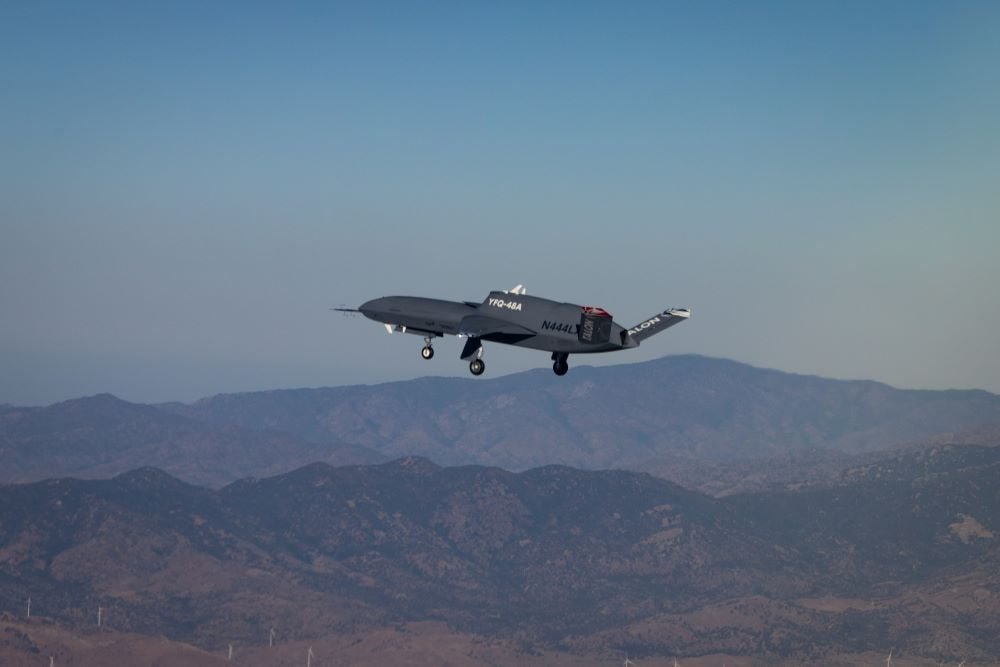
Northrop Grumman’s YFQ-48A Talon Blue has completed its first flight, operating fully autonomously through taxi, takeoff, in-flight maneuvers, and landing at Mojave, California, the company announced on October 3, 2026. The company-funded aircraft is the third uncrewed fighter prototype designated by the US Air Force under the Collaborative Combat Aircraft (CCA) program.
The milestone comes three and a half months after the Air Force awarded engineering and manufacturing development (EMD) and production contracts to General Atomics Aeronautical Systems (GA-ASI) and Anduril Industries on June 17, 2026, moving their designs into production as the FQ-42A and FQ-44A. Northrop Grumman was among five companies funded for Increment 1 design work in 2024 but was passed over for both prototyping and production. With the service planning more than 150 Increment 1 aircraft by the end of the decade and roughly 1,000 CCAs across successive increments, Increment 2 is now Northrop Grumman’s primary path into the program.
Talon Blue First Flight Caps a 10-Month Path From Unveiling
Northrop Grumman unveiled the aircraft, then known as Project Talon, at Mojave on December 3, 2025. On December 22, 2025, the Air Force assigned it the YFQ-48A Mission Design Series (MDS) designation, in which Y denotes a prototype, F a fighter, and Q an uncrewed aircraft, and described it as a strong contender in the CCA program. The company adopted the Talon Blue name in February 2026.
Pratt & Whitney confirmed on April 17, 2026, that its engine was integrated and ready to support flight tests. The aircraft completed its first taxi test at Mojave on May 14, 2026, followed by fully autonomous taxi runs that Northrop Grumman disclosed on May 18. Northrop Grumman has not released the flight date, duration, or envelope, nor whether Air Force personnel took part.
“Our customers made it clear they need autonomous systems that can be fielded faster and more affordably without sacrificing mission effectiveness. We listened,” said Craig Woolston, vice president and general manager of research and advanced design at Northrop Grumman. The company cites seven decades of uncrewed aviation and more than 500,000 autonomous flight hours.
Airframe, Propulsion, and Weapons Bay: Inside the YFQ-48A Design
Talon Blue was developed with Northrop Grumman subsidiary Scaled Composites under the internally funded Project Talon portfolio. Northrop Grumman says the airframe uses composite materials, cuts part count by 50 percent, and weighs about 1,000 pounds less than its previous CCA design, with a 30 percent faster assembly timeline also reported. Those figures target the cost line on which Northrop Grumman’s Increment 1 entry reportedly fell short, a decisive factor in a program built on affordable mass.
Propulsion comes from a single Pratt & Whitney PW500-family turbofan. The engine maker ran a dedicated test program to extend the family’s commercial limits for the CCA mission; the variant and thrust rating remain undisclosed. Publicly available specifications indicate that commercial PW500 variants, which power Cessna Citation and Embraer Phenom 300 business jets, span roughly 2,900 to 4,100 pounds of thrust. A commercial engine with an established support base lowers unit cost and sustainment risk, at the price of a lower performance ceiling.
Northrop Grumman highlights three configuration choices: a high-mounted air intake, a wide wheelbase, and an integrated weapons bay. Internal carriage preserves the radar signature that external pylons would degrade. A high inlet limits debris ingestion on rough surfaces, and a wide track improves ground stability, both relevant to the Air Force’s Agile Combat Employment (ACE) concept of dispersed operations. Dimensions, maximum takeoff weight, internal payload, sensors, datalinks, and combat radius have not been released, including whether Talon Blue meets the 700-nautical-mile minimum radius set for Increment 1.
Where Talon Blue Fits in the CCA Increment 2 Competition
The Air Force awarded Increment 2 concept refinement contracts to nine unnamed vendors in December 2025, and more than 20 companies remain eligible for later phases. Air Force acquisition officials said in July 2026 that concept refinement would run roughly 10 more months and yield about six closed conceptual designs, with entry reopened beyond the initial nine. The Air Force has not confirmed whether Northrop Grumman holds a refinement contract.
Propulsion offers the clearest signal of Increment 2’s direction. The Air Force is funding two new engine classes: a small engine of 1,400 to 1,600 pounds of thrust, in preliminary design since May 2026, and a medium engine of 5,000 to 6,000 pounds, with GE Aerospace and Rolls-Royce tapped for development. Air Force propulsion officials tied the medium class to range requirements and onboard power demand. On publicly available figures, the PW500 sits below that bracket, placing Talon Blue closer to the Increment 1 performance class.
Software may weigh as heavily. Talon IQ, operating on the Scaled Composites Model 437, runs Prism Mission Autonomy as a government reference architecture, matching the Air Force’s decision to compete autonomy separately from airframes; Anduril, Shield AI, and Collins Aerospace were selected in June 2026 to vie for the Increment 1 primary autonomy role.
Analysis: Increment 1 showed that the Air Force rewards designs that fly early, price aggressively, and keep production risk low. Talon Blue now offers flight evidence on all three fronts, but it arrives in a competition whose engine roadmap points toward larger, longer-ranged aircraft than a PW500-class airframe is likely to deliver. Northrop Grumman’s strongest card may therefore be its manufacturing method, with halved part counts and faster assembly transferable to a scaled-up design, rather than the YFQ-48A in its current form. A flying third design also hedges the Air Force’s Increment 1-class supply base.
Milestones to watch include envelope expansion, weapons bay separation testing, and any formal Air Force role in the flight test campaign, none of which Northrop Grumman has scheduled publicly. Increment 2 concept refinement is expected to close around mid-2027, followed by a down-select toward prototyping. Whether Talon Blue competes as flown, re-engined, or as the basis for a larger derivative remains the open question.