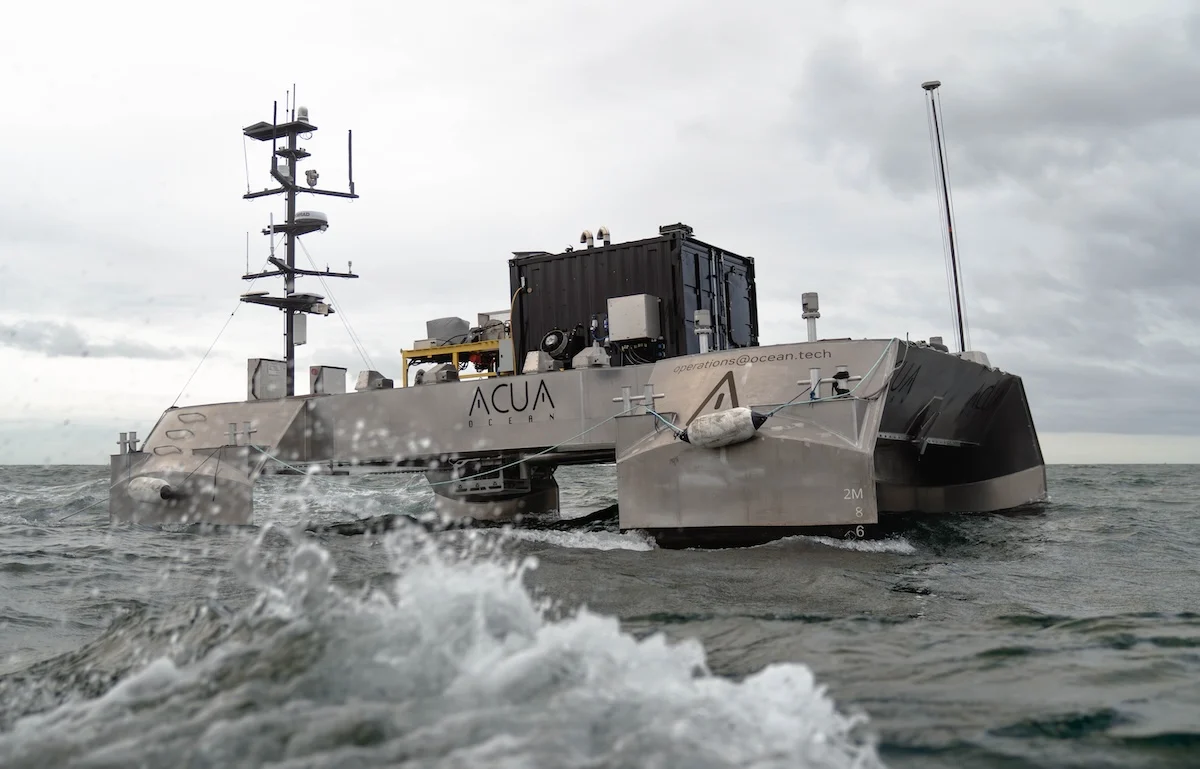
ACUA Ocean and Forssea Robotics have completed a three-week trial off Plymouth, England, in which Forssea’s 170-kilogram ARGOS remotely operated vehicle (ROV) was launched, flown and recovered more than 40 times from ACUA’s Pioneer uncrewed surface vessel (USV), with every launch, dive and recovery commanded from shore. The companies announced the results on September 28, 2026. The work was carried out under a European Space Agency (ESA) contract.
The campaign falls under the “nested robotic” program ESA awarded ACUA in October 2025 with UK Space Agency backing, which combines satellite communications and GNSS positioning to give operators beyond-visual-line-of-sight (BVLOS) control of a USV and its tethered ROV. Pioneer had earlier become the first remotely operated vessel certified under the UK Maritime and Coastguard Agency’s Workboat Code Edition 3 Annex 2. The timing matters: European navies and infrastructure operators are looking for ways to monitor seabed cables and pipelines without committing scarce crewed vessels, following repeated damage to undersea infrastructure in the Baltic Sea since 2023.
Pioneer USV Design: SWATH Hull, Moonpool and Payload Margin
Pioneer is a 14.2-meter aluminum small waterplane area twin hull (SWATH) design drawn by naval architect John Kecsmar of Ad Hoc Marine Designs and built by Aluminium Marine Consultants on the Isle of Wight. It was launched at Turnchapel Wharf in late 2024. Published displacement figures range from 25 to 28.5 tonnes on a 9-meter beam. Buoyancy sits in two submerged demi-hulls, which damps pitch and roll; ACUA cites University of Southampton tank testing showing seakeeping comparable to a monohull three times its length and 10 times its displacement, a company claim not independently verified.
Propulsion is a battery-electric hybrid driving twin propellers, with bow thrusters for dynamic station keeping and diesel generators as range extenders. Publicly available specifications indicate a maximum speed of 8 knots, endurance of more than 50 days at around 4 knots and a 5,000-nautical-mile range; earlier company material quoted 40 days. Roughly 50 kilowatts of electrical margin is reserved for payloads, and a central ISO-standard moonpool accepts one 20-foot or two 10-foot modules, with about 7 tonnes of payload capacity depending on center of gravity.
Those figures explain why the hull suits ROV work. A slow, stable SWATH spends less energy fighting sea state, and a central launch aperture largely isolates a tethered vehicle from roll and pitch, leaving heave as the main load to compensate. The companies have not disclosed whether ARGOS was deployed through the moonpool or from a deck-mounted launch-and-recovery system during the Plymouth trial.
How the ARGOS ROV and Sonardyne USBL Performed off Plymouth
ARGOS is a compact inspection-class ROV that Forssea, headquartered in Sète, France, markets as fully web-controllable. Earlier published technical data rate the vehicle to 500 meters. For Pioneer, Forssea supplied a dedicated plug-and-play integration kit, and the ROV accepts interchangeable payloads for inspection, survey and light intervention. Forssea also offers ARGOS-X, a hybrid derivative built for USV integration in currents up to 2.5 knots, with an optional battery pack for tetherless operation. The companies did not specify which configuration flew in Plymouth.
Positioning relied on a pole-mounted Sonardyne Mini-Ranger 2 ultra-short baseline (USBL) system aboard Pioneer tracking a WSM6+ transponder on ARGOS, while Pioneer alternated between manual station keeping and dynamic positioning to hold the ROV on task. Over six days at sea, the team logged up to eight launch-and-recovery cycles in a single day, reached and inspected the seabed in more than 20 meters of water and paid out up to 35 meters of tether. Conditions included 1-meter waves and winds averaging 18 knots, gusting 20 to 30 knots. One sortie south of Plymouth Breakwater ran in roughly 2-meter waves, which the companies say had no effect on the ROV. Targets included the Poulmic wreck, a seabed feature and a concrete block in Cawsand Bay, all located and filmed.
Control ran from ACUA’s Remote Operations Centre at Turnchapel Wharf, with Forssea supervising simultaneously from Sète. The companies have not said which data links carried the Plymouth operations.
What USV-Launched ROVs Mean for Undersea Infrastructure Protection
The commercial pitch targets offshore wind, pipeline and inspection, repair and maintenance operators, but the companies also list security of critical national infrastructure among their markets. One live dive was streamed to the Bundeswehr’s Cyber Innovation Hub in Eckernförde, Germany, showing the feed could be monitored from a third country. No German procurement link has been announced.
ACUA has pitched a Pioneer-based “Sentinel” concept to the Royal Navy, in which the USV serves as a persistent sensing node guarding ports and infrastructure, and the company belongs to the SCEPTRE consortium, which the Ministry of Defence down-selected onto its Digital Decision Accelerators for Defence (DDAD) framework. Neither step amounts to a program of record. The Royal Navy’s Atlantic Bastion construct, which pairs crewed platforms with distributed uncrewed systems, creates a potential requirement, but no related USV-ROV contract has been disclosed.
Analysis: The operationally relevant figure is launch-and-recovery cadence, not depth. Recovery is the step that typically limits uncrewed subsea work, and eight cycles in one day in 18-knot winds suggests the integration has moved beyond one-off demonstrations. For navies, that matters because seabed surveillance competes for a small pool of crewed specialist ships such as RFA Proteus and for mine countermeasures hulls; shifting routine cable and pipeline inspection onto uncrewed platforms would free those assets for contested tasks. The limits are equally clear: 20 meters of water and 35 meters of tether in coastal conditions remain far from North Sea depths, tidal currents and the dwell times a wartime inspection campaign would demand.
Key unknowns include the value of the ESA contract and performance in deeper water and stronger currents. ACUA contracted Aluminium Marine Consultants for a second Pioneer-class hull, scheduled at the time for commissioning in summer 2026, and Forssea’s tetherless ARGOS-X option offers a path beyond tether constraints. The next indicator is whether a defense customer funds a follow-on trial under military conditions.