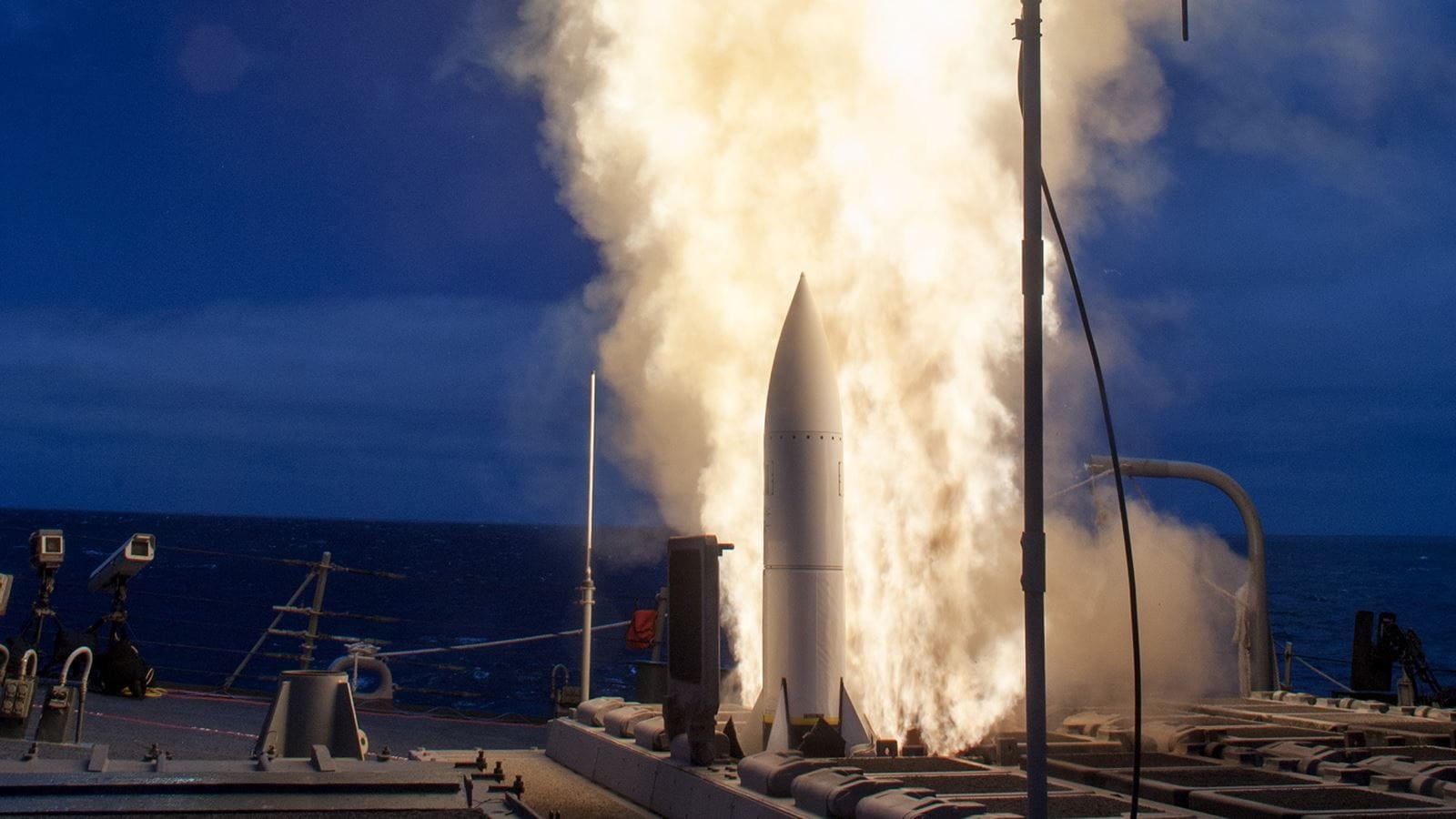
The U.S. Navy awarded Raytheon, an RTX business, a multiyear contract worth up to $24.4 billion on October 1, 2026, to produce Standard Missile-6 (SM-6) interceptors. The deal covers five years of production plus two option years and dwarfs the first SM-6 multiyear procurement, a $1.03 billion agreement signed in 2019 that ran through October 2026.
The award follows a year in which combat consumed SM-6 rounds far faster than the production line could replace them. The Center for Strategic and International Studies (CSIS) estimated in April that U.S. forces expended between 190 and 370 SM-6s during the 2026 Iran war, from a prewar inventory of about 1,160, while fiscal year (FY) 2026 funding covered only 139 new missiles. The contract builds on framework agreements the Department of War signed with Raytheon on February 4, 2026, which set a goal of more than 500 SM-6s per year, and arrives three days after a $20.7 billion multiyear award for the AIM-120 Advanced Medium-Range Air-to-Air Missile (AMRAAM).
SM-6 Contract Terms and Raytheon’s 500-Missile Annual Production Goal
The Navy’s Portfolio Acquisition Executive (PAE) for Munitions, created on May 11, 2026, and led by Van Hendrey, spearheaded the award, which follows a seven-year Tomahawk production contract announced in August. Chief of Naval Operations Adm. Daryl Caudle framed the deal as an industrial signal: “This SM-6 award gives industry the demand signal and stability to expand production, strengthen the munitions industrial base, and build the magazine depth our Fleet needs.”
Neither the Navy nor Raytheon has disclosed quantities, unit pricing, contract type or the funding obligated at award. For scale, the $24.4 billion ceiling equals roughly 4,600 missiles at the $5.3 million unit cost cited in independent estimates, although contracts of this kind typically also fund spares, flight test rounds and engineering support. The FY2027 budget request, which seeks 540 SM-6s in a single year, offers a clearer marker of the intended ramp. Raytheon remains the only qualified SM-6 producer, so multiyear commitment, rather than competition, is the Navy’s main lever on unit cost.
Throughput remains the binding constraint. Annual deliveries have hovered around 125 missiles, and CSIS puts the SM-6 procurement lead time at 53 months. Under the most recent production modification, a $335 million award in April 2026, work is split between Tucson, Arizona, and East Camden, Arkansas, at 35 percent each, with 8 percent in Wolverhampton, United Kingdom. The work distribution for the new contract has not been published. Raytheon President Phil Jasper said the company is “removing constraints and boosting capacity,” citing workforce growth, deeper supplier partnerships and production automation.
SM-6 Block IA and IB: Seeker, Range and Launch Platforms
Publicly available specifications describe the RIM-174 as a two-stage missile about 6.6 meters long and weighing roughly 1,500 kilograms at launch. It mates a 21-inch Mk 72 booster with the 13.5-inch airframe and Mk 104 dual-thrust rocket motor of the SM-2ER Block IV. The decisive change is an active radar seeker derived from the AMRAAM, which allows terminal homing without shipboard illuminators and enables engage-on-remote intercepts beyond the launching ship’s radar horizon through Naval Integrated Fire Control-Counter Air (NIFC-CA), with cueing from the E-2D Advanced Hawkeye. Open-source estimates put its range beyond 370 kilometers and its speed near Mach 3.5.
That architecture explains the demand. One round covers anti-air warfare against aircraft and cruise missiles, sea-based terminal defense against ballistic missiles, and anti-surface strike, a combination Raytheon describes as unique among combat-proven weapons. Missile Defense Agency flight tests in 2016 and 2017 validated the sea-based terminal role. The current production standard, SM-6 Block IA, introduced an upgraded guidance section, while Block IB, still in development, widens the second stage to the full 21-inch diameter to extend range and speed.
The launcher base keeps widening. SM-6 fires from the Mk 41 Vertical Launching System aboard Arleigh Burke-class destroyers and Ticonderoga-class cruisers, from the Army’s land-based Typhon Mid-Range Capability, and, as the air-launched AIM-174B, from Navy F/A-18E/F Super Hornets. Every new launcher, and every export customer such as Japan or Australia, draws on the same production line, so the missile’s versatility translates directly into consumption pressure across fleet, joint and allied requirements.
Analysis: The $24.4 billion figure is a ceiling and a demand signal, not a delivery schedule. At a 53-month lead time, missiles placed on order in late 2026 would not reach the fleet before 2031, so the contract does little to refill magazines in the near term. Its value lies upstream: up to seven years of committed demand gives Raytheon and its sub-tier suppliers, particularly solid rocket motor and seeker producers, the business case for tooling, labor and facility investments that single-year buys never justified. The metric that matters is whether annual deliveries climb from roughly 125 toward the 500-plus target. Until they do, fleet commanders will keep rationing SM-6 across air defense, missile defense and strike missions, a constraint that weighs most heavily on Indo-Pacific contingency planning.
Several details remain open: lot quantities, the negotiated unit price, the share of foreign military sales volume on the same line, and the timing of decisions on the two option years. Congress must still appropriate the FY2027 request for 540 SM-6s, and Block IB maturity will determine when the larger-diameter variant enters the production mix. Delivery data through 2027 will show whether the multiyear model is increasing output, not just contract value.